
OpenFlags
Self-hosted feature flags for React, Bun, and Node.js
Replaces Launchdarkly, Optimizely, Statsig
Who it's for
OpenFlags fits teams that want to gate React, Bun, or Node.js features without buying a larger flag service.
You need mature enterprise governance, audit workflows, and many official SDKs.
The self-hosted model gives small teams a way to turn features on gradually while keeping costs predictable.
You need no-maintenance SaaS operations more than data ownership.
The problem
Feature flags should reduce release risk, but managed flag tools can add cost, latency, and vendor dependency for small teams. Teams shipping JavaScript apps often need simple flag control before they need an enterprise experimentation suite. When flag evaluation depends on a hosted service for every request, reliability and speed become part of the release risk. Local evaluation and self-hosted control make more sense for teams that want predictable behavior close to the app.
How it works
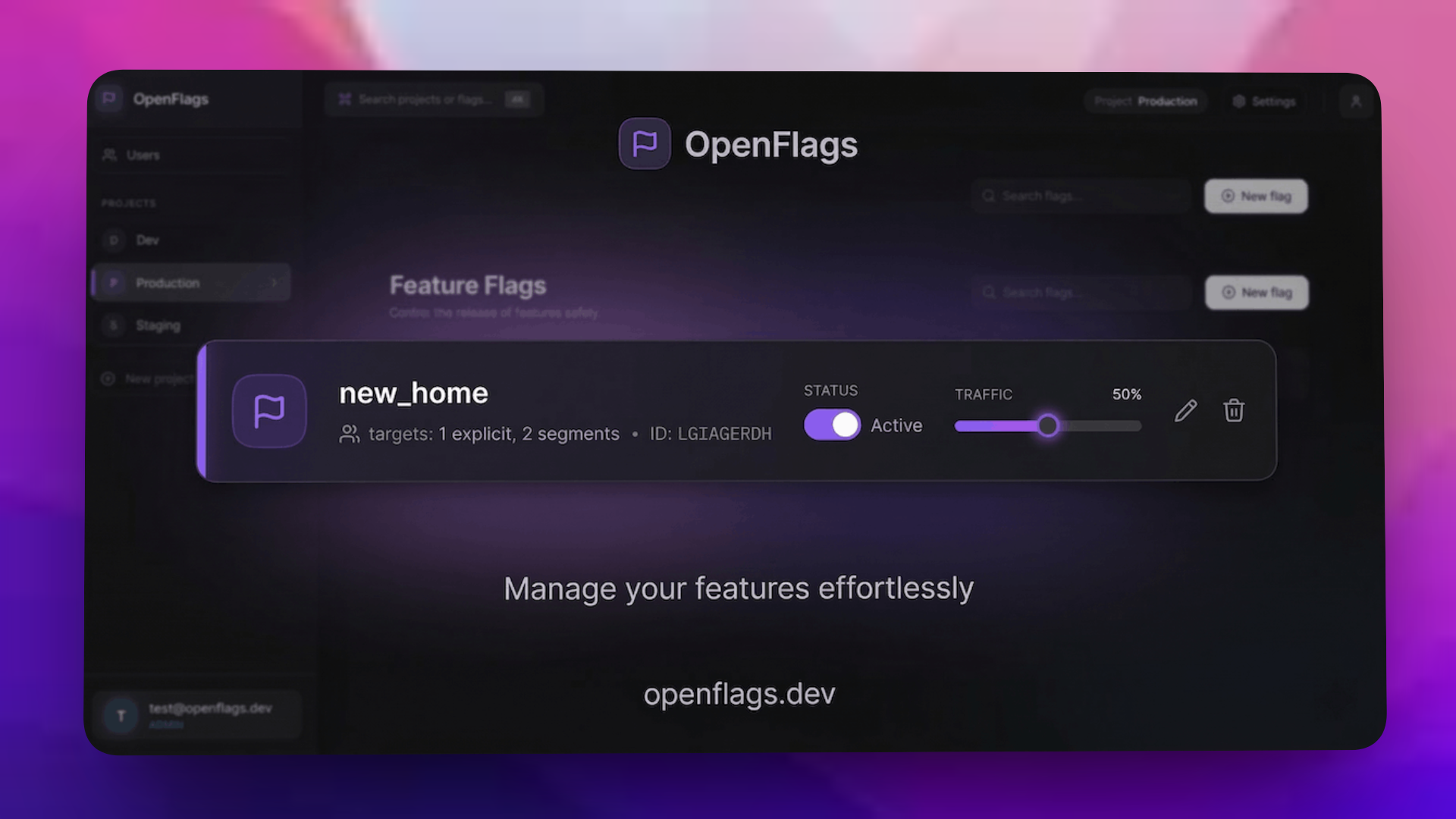
OpenFlags provides a self-hosted feature flag control plane for teams that want ownership of flag data and rollout state.
The README positions OpenFlags for React, Bun, and Node.js applications.
The README includes Railway and Zeabur deploy buttons, giving small teams a quicker path than manual server setup.
Features
- Self-hosted feature flags
- JavaScript stack focus
- Hosted deploy templates
Recommended for this setup
Strengths
- Lightweight alternative to enterprise flag tools: OpenFlags focuses on core flag workflows, which can fit small JavaScript teams better than a full experimentation product.
- Data stays in your deployment: Self-hosting helps teams keep flag definitions and rollout state under their own operational control.
Trade-offs
- JavaScript-centered adoption: Teams with polyglot backends, mobile apps, or complex experimentation needs should verify SDK coverage before standardizing on OpenFlags.
Tech stack
FAQ
OpenFlags is a self-hosted feature flag tool for modern JavaScript applications.
The README positions OpenFlags for React, Bun, and Node.js teams.
OpenFlags is MIT licensed according to repository metadata.