
Nuphos
Agent workspace for teams running Claude Code or Codex
Replaces Conductor
Who it's for
Teams investigating live clusters, cutting cloud costs, or migrating services benefit from Nuphos's Kubernetes and Grafana integrations alongside the agent conversation. Cloud-provider connections stay on the team's own infrastructure rather than passing credentials through a third-party service.
Your infra work is entirely script-based and does not involve iterative agent-assisted investigation. A single-user session on a local machine serves that case without the overhead of a shared workspace.
When more than one person needs to steer, observe, or hand off an ongoing coding agent task, Nuphos provides shared session rooms, synchronized context, and team-wide memory without setting up a custom server.
Every engineer works independently with no need to share context, tools, or sessions. In that case, running Claude Code or Codex natively on each machine is simpler.
For a solo engineer who wants an agent running in the background while stepping away, the runtime switcher migrates sessions from laptop to a cloud runtime, and the iOS app brings them back without losing context.
You have no need to continue sessions after closing your laptop and are not sharing agent work with others. The desktop workspace adds overhead over running Claude Code directly in that case.
The problem
Coding agents today are built for a single person at a single machine. A session ends when the laptop closes, and there is no way to share what the agent is doing with a teammate or hand off a running task. Each engineer maintains their own agent configuration, tools, and context, so there is no team-level memory and no path for a less technical teammate to observe or contribute to agent work. For DevOps teams especially, the pain sharpens: live infra investigations through an agent terminal require someone to stay at their keyboard, integrations like Kubernetes and Grafana are set up per-machine rather than once for the team, and there is no shared record of what the agent did or why.
How it works
Connect Claude Code or Codex through an ACP adapter that signs in with the account you already pay for. There is no separate model charge on top of your existing coding-plan subscription.
A session can run on a local machine, a remote machine you own, or Nuphos Cloud. Close the laptop and the agent keeps working; pick the session back up from the iOS or Android app.
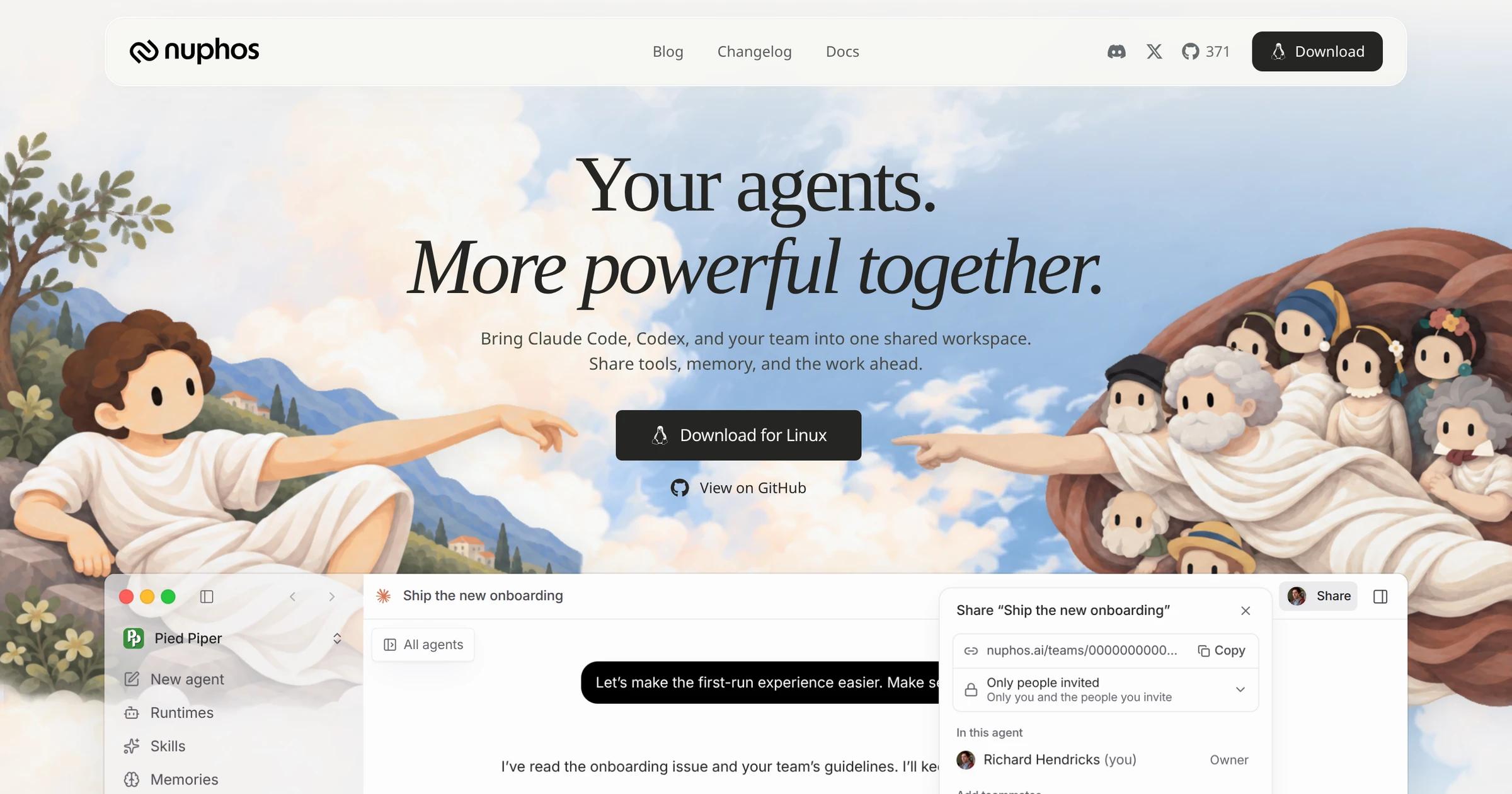
Invite a teammate into a running session the way you would a shared document. Multiple people can talk to the same agent, see the same tool calls in real time, and steer the work together.
Grant a skill or integration once and every team member's agent gets it, synced across sessions. Cloud provider connections (AWS, GCP, Cloudflare), databases, GitHub, and Linear belong to the workspace, not to individual machines.
The desktop puts a live Kubernetes GUI, Grafana dashboards, GitHub, and Linear beside the conversation. Cloud-provider connections use cross-account role assumption (AWS) or service-account impersonation (GCP), bound to the self-hosted instance rather than to nuphos.ai.
A cron schedule or an incoming webhook starts a new agent turn without anyone sitting in the chat. Use it to run nightly infra checks, respond to alert webhooks, or queue regular tasks for the agent.
Features
- Bring your own agent subscriptions
- Sessions that outlive your machine
- Multiplayer agent sessions
- Shared team skills and tool connections
- Built-in GUI for Kubernetes, Grafana, and cloud providers
- Schedules and webhook triggers
How to install
git clone https://github.com/nuphos/nuphos.git cd nuphos/deploy/compose ./init-env.sh docker compose up -d --build --wait --wait-timeout 600 docker compose exec backend nuphos-admin bootstrap --email you@example.com --team MyTeam
Recommended for this setup
Strengths
- No extra model billing: Because you bring your own Claude Code or Codex subscription, Nuphos adds no model charge on top of the coding plan you already pay for. Teams keep the billing relationship with Anthropic or OpenAI directly.
- Team memory with nothing extra to install: Memory across teammates, agents, and sessions is built in. There is no separate MCP memory server to configure, no extra database to manage, and no context that resets between sessions.
- Self-hosted via Docker Compose, Railway, or Kubernetes: The backend ships as container images deployable via a Docker Compose file, Railway templates, or a Helm chart. You own the data, the agent connections, and the cloud-provider integrations on your own infrastructure.
- Mobile companion for sessions away from the desk: The iOS app (available on the App Store) lets any team member monitor, join, or steer a running session from a phone. An Android client is also available for Nuphos Cloud sign-in.
Trade-offs
- Agent runtime image is amd64 only: The Claude Code runtime container is built for amd64 only. On Apple Silicon it runs under emulation (Rosetta in Docker Desktop) and starts slower, so a self-hosted runtime is best placed on an x86 server.
- High open issue count for a new project: The repository showed 72 open issues on November 7, 2026, a little over a month after it was created on October 1, 2026. The project is young and moves fast, so expect rough edges in reliability and documentation.
- Android client requires Nuphos Cloud: The Android app currently works only with Nuphos Cloud sign-in. Custom self-hosted endpoints are not yet supported on Android, so Android users on a self-hosted deployment cannot use the mobile companion.
- One team per self-hosted deployment: A self-hosted instance is scoped to one team. Multi-team setups require multiple deployments or the hosted product. Managed runtime provisioning, managed backups, and the hosted service's operational tooling are also not available self-hosted.
Tech stack
FAQ
At launch, Claude Code and Codex are the two supported runtimes, each connected via an ACP (Agent Client Protocol) adapter. The README lists them as the runtimes shipping today; additional adapters may follow, but support beyond these two is not documented in the available source material.
The self-hosted version is open source (Apache-2.0) and free to run on your own infrastructure. You bring your existing Claude Code or Codex subscription; Nuphos adds no model charge on top. The hosted Nuphos Cloud service is a separate product.
Yes. Nuphos is licensed under Apache-2.0, an OSI-approved license that permits deploying, running, modifying, and distributing the software for any purpose, including commercial use, as long as you keep the copyright and license notices. The NOTICE file reserves the Nuphos name and logo as trademarks of Zeabur Inc., so a modified build you redistribute should not carry them beyond describing where it came from.
Three capabilities are not available self-hosted: managed runtime provisioning (the hosted product handles scaling agent runtime containers), managed backups, and the operational tooling of the hosted service. Each self-hosted deployment also supports one team only; the hosted product supports multiple teams in one instance. Google sign-in routes through nuphos.ai, so self-hosted instances use email sign-in codes instead.
The README documents three self-hosting paths: a Docker Compose stack in deploy/compose (MongoDB, S3-compatible storage, the Bun/Hono backend, and a Claude Code agent runtime brought up with one docker compose up), Railway project templates, and a Kubernetes Helm chart. On Apple Silicon the runtime image is amd64 only and runs under emulation, so it starts slower. After the stack is up, create the first user and team with the bundled nuphos-admin command, since a backend without a Resend key sends no sign-in emails.