
Fizzy
Free open source kanban by 37signals, self-hostable.
Replaces Trello, Linear, Jira, Asana
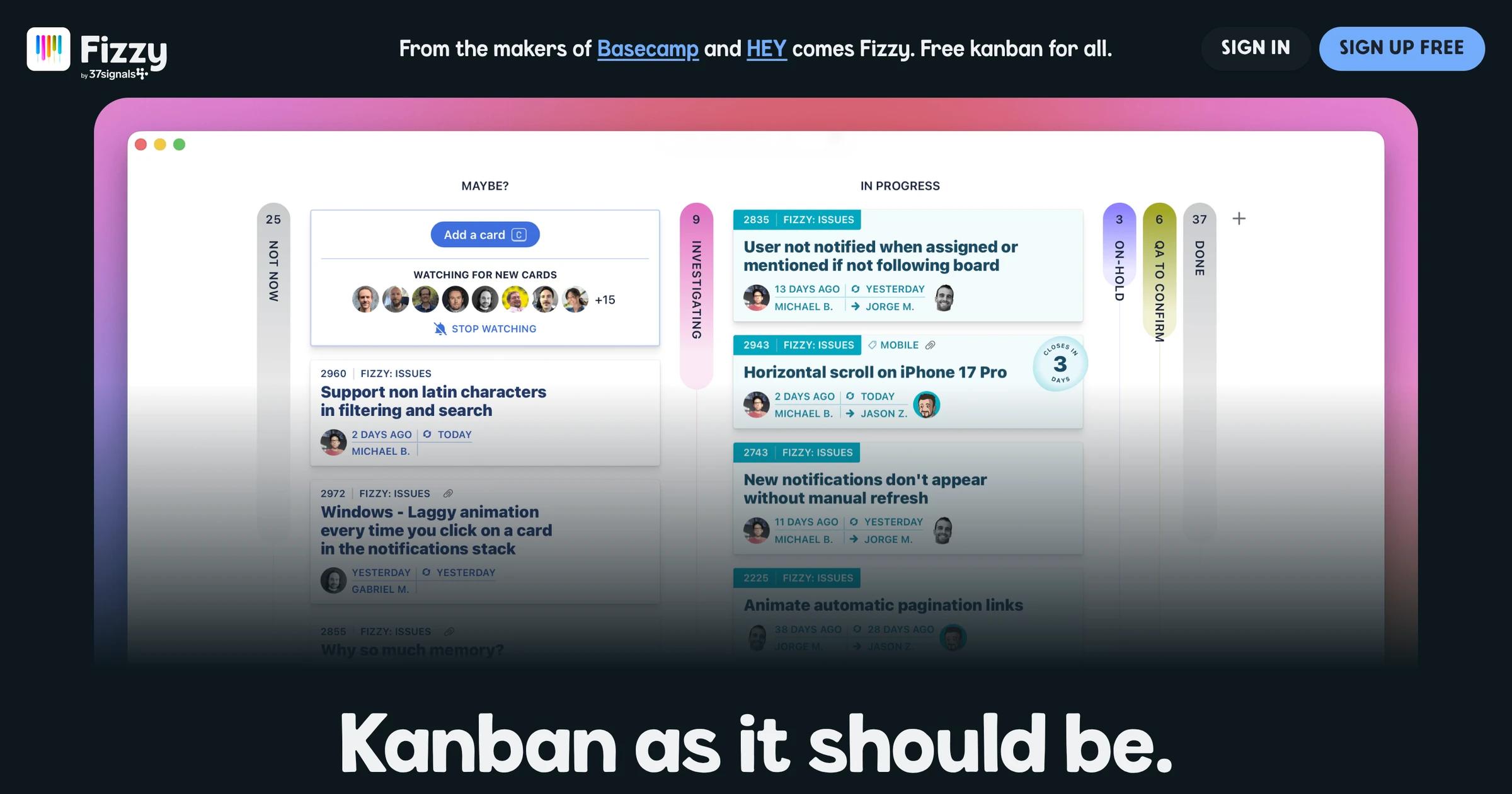
Who it's for
Fizzy gives individual developers a free, low-maintenance board for feature ideas, bug lists, and release planning without the overhead of a full project management tool. The hosted version requires no infrastructure and no payment.
If you need to track work across multiple interconnected projects with dependencies, sprints, and velocity metrics, a tool like Linear or Jira is a better fit.
Teams tracking ten to fifty active issues get a faster interface than Jira or Asana with no onboarding overhead. Webhooks feed new cards and completions to Slack channels, and stamps keep attribution visible without digging through activity logs.
If your team needs sprint planning, burndown charts, Gantt views, or tight GitHub and GitLab integration, Fizzy does not cover those workflows.
The ONCE installer deploys a fully functional Fizzy instance on a single machine with automatic updates. Teams that want project data on their own infrastructure rather than stored in a third-party service have a supported path without the complexity of a full project management deployment.
If you are migrating from Trello, Jira, or Asana and need to bring card history along, Fizzy has no import tool and you would start fresh.
The problem
Most project tracking tools start simple and grow into enterprise software. Trello added Power-Ups and pricing tiers. Jira became a configuration layer most teams only partially understand. Asana expanded into goal-setting and workload management designed for large organizations. By the time teams notice the bloat, they're paying for features they never use and learning interfaces that assume a dedicated project manager. The specific pain is a loss of speed. Setting up a kanban board to track ten bugs or thirty ideas should take minutes. Instead, it takes invitations, permission models, integrations, and onboarding flows that assume everyone is building enterprise workflows. Free-tier limits eventually push you toward a paid plan, and paid plans push you toward using the full feature set to justify the cost. A fast, focused board without the cruft became genuinely difficult to find in this category.
How it works
Fizzy sends webhooks on card events (new card created, assigned, completed) to Slack channels, Campfire rooms, or any endpoint that accepts HTTP POST. No dedicated integration app is required. Paste a webhook URL in board settings and choose which events to forward.
The auto-close feature prunes cards that have sat idle past a configured threshold, keeping boards from accumulating abandoned items over time. Teams that track ideas alongside active bugs benefit from this without needing to schedule manual cleanup.
Any board can be made public so external stakeholders, customers, or the public can follow progress without creating an account. This is useful for open source projects or teams that report status to outside audiences.
Stamps record who filed a card and when, providing a lightweight audit trail without a full activity log. Teams tracking bugs or feature requests can see attribution on every card without searching through notification histories.
Fizzy exposes an API for custom integrations beyond the built-in webhook support. Teams that need to connect Fizzy to internal tooling, CI pipelines, or custom dashboards can use the API as the integration layer.
Features
- Webhook notifications for Slack and Campfire
- Auto-close for idle cards
- Public board sharing
- Stamps for card attribution
- API for custom integrations
How to install
Self-hosting uses the ONCE installer for single-machine deployment and automatic updates.
curl https://get.once.com/fizzy | shRecommended for this setup
Strengths
- Made and maintained by 37signals: 37signals (the team behind Basecamp) shipped Fizzy and continues to maintain it. The repository had 8,283 stars and its last push was November 2026. 37signals has a track record of maintaining opinionated tools for the long term.
- Self-hosting via ONCE or Docker: Fizzy ships a ONCE installer that sets up a fully functional single-machine deployment and keeps it up to date automatically. A Docker deployment guide is in the repository for teams that want containerized infrastructure. Teams that want to run Fizzy on their own hardware have a supported, documented path.
- No freemium pricing tricks: The hosted version is entirely free with no paid tier, no feature gates, and no upsell path. 37signals funds it through Basecamp and HEY revenue. The only limit is a 1 GB file storage cap; there is no time limit, no seat limit, and no automation limit.
- Open codebase on GitHub: The full Ruby on Rails codebase is on GitHub with 1,211 forks. Teams that want to customize the interface, add integrations, or modify board behavior can fork and modify within the O'Saasy License terms, which permit internal commercial use.
Trade-offs
- No data import from other services: Fizzy has no way to import cards, boards, or project history from Trello, Jira, GitHub Issues, Basecamp, or other tools. Switching means starting a new board from scratch. The team noted in the FAQ that import is on the roadmap, but it is not part of the current release.
- O'Saasy License restricts managed service use: The O'Saasy License permits self-hosting, modification, and internal commercial use. It does not permit running Fizzy as a hosted or managed service offered to third parties where Fizzy's functionality is the primary value. Organizations building a Fizzy-based SaaS or managed hosting service are outside the license terms.
- Young ecosystem with limited integrations: Fizzy has 10 open issues as of November 2026. The integration catalog that Trello and Jira built over years does not exist yet. Teams that need deep integrations with GitHub, GitLab, Confluence, or time-tracking tools will find only webhooks and an API available.
Tech stack
FAQ
Yes. The hosted version at fizzy.do is entirely free with no paid tier. File storage is capped at 1 GB, but beyond that there are no feature limits, seat limits, or time-based restrictions. 37signals subsidizes Fizzy through its Basecamp and HEY revenue, so there is no business model that depends on converting free users to paid.
Yes. The easiest path is the ONCE installer, which runs with one curl command and handles initial setup and automatic updates. Docker deployment is also documented in the repository for containerized infrastructure. Kamal deployment is available for teams that want to modify the codebase and deploy their own version. All three paths are documented in the GitHub repository.
No. As of the current release, Fizzy has no import tool for migrating cards, boards, or project history from other services. The team noted this is on the roadmap but not part of the current release. Teams switching to Fizzy start fresh with a new board.
The O'Saasy License permits self-hosting, modification, distribution, and internal commercial and team use. What it does not permit is offering Fizzy to third parties as a hosted or managed service where Fizzy's functionality is the primary value of that service. Running Fizzy for your own team is within the license terms. Offering a managed Fizzy hosting service to paying customers is not.
No. Fizzy explicitly has no AI features. The team describes this as a design choice: they removed unnecessary complexity from typical kanban implementations rather than adding AI. For teams that need AI-based issue triage, sprint prediction, or workflow automation, Fizzy does not cover those workflows. Webhooks and an API are available for custom integrations with external tools if needed.