
Temporal
Durable workflow orchestration for reliable, long-running apps
Replaces Aws Step Functions, Camunda Platform, Orkes
Who it's for
Temporal tracks each step of a multi-service process and retries failed activities without losing the workflow state.
Skip if your process is a single short request that can finish inside one service transaction.
Use Temporal to consolidate cron jobs, queues, and manual retry scripts into versioned workflows with visible histories.
Skip if your team cannot operate the server and does not want a managed workflow service.
The problem
Long-running business processes are hard to build with only queues, cron jobs, and database status flags. Payment retries, order fulfillment, onboarding steps, and data pipelines can fail halfway through, leaving engineers to reconstruct state from logs and custom tables. Managed workflow products reduce some pain but can lock teams into vendor-specific definitions, pricing, and operational limits. Engineering teams need workflows that behave like normal code while preserving state through crashes, deploys, and network failures.
How it works
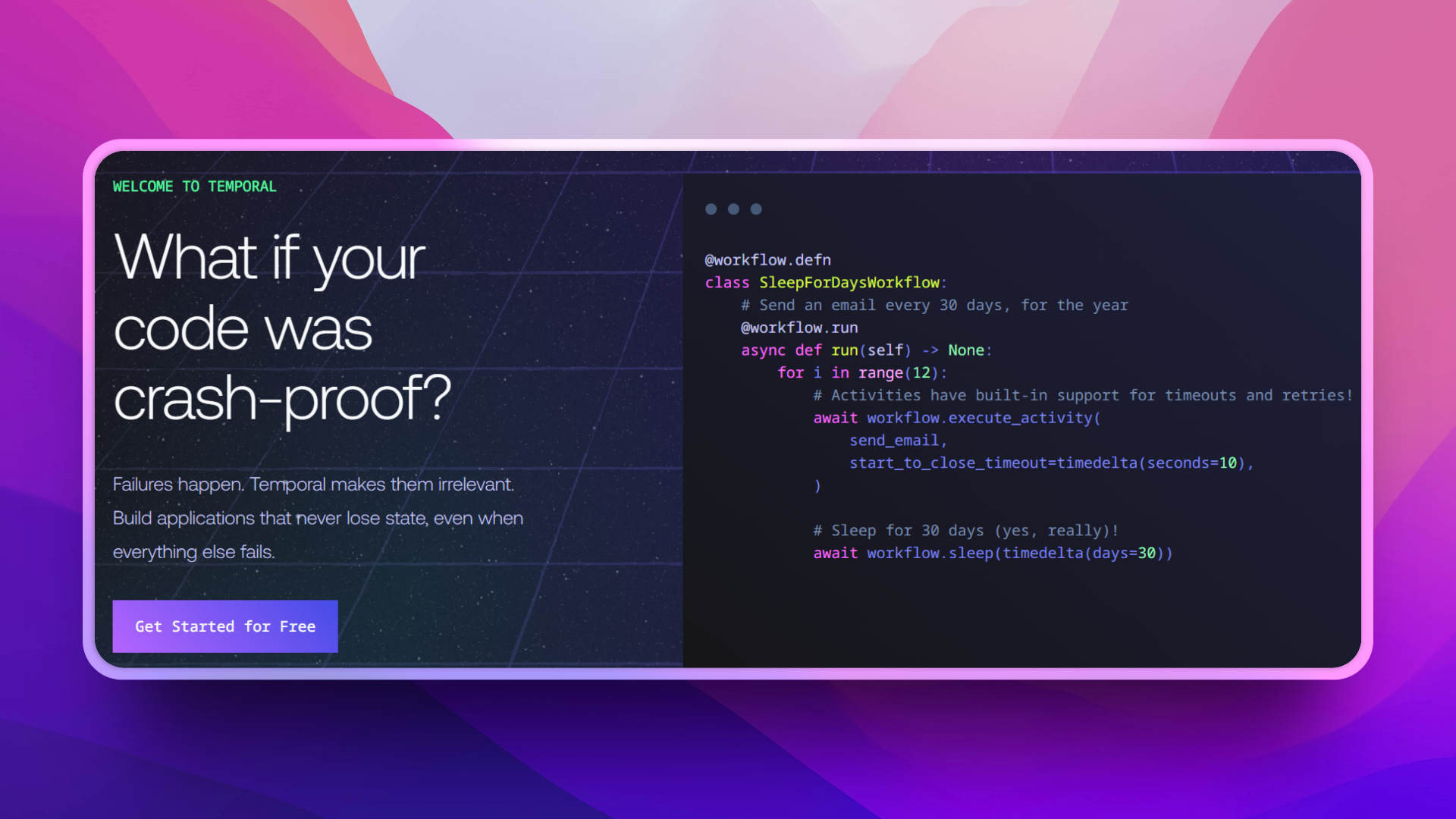
Runs workflows that preserve progress across worker crashes, retries, and restarts, so business processes can continue from the last recorded event.
Developers write workflows in familiar languages instead of modeling every step in a cloud console or YAML-only workflow definition.
Separates workflow state from worker execution, letting teams scale workers independently for CPU-heavy, IO-heavy, or service-specific tasks.
Features
- Durable workflow execution
- Code-first SDKs
- Workers and task queues
Recommended for this setup
Strengths
- Failure handling is built into the model: Retries, timeouts, activity history, and deterministic replay are core Temporal concepts, reducing the amount of custom orchestration code teams maintain.
- Open source server with managed option: Teams can run Temporal themselves or use Temporal Cloud, which makes adoption possible before committing to an operations model.
Trade-offs
- Requires workflow design discipline: Temporal asks teams to learn deterministic workflow rules, activity boundaries, and worker operations. Small jobs may be simpler with a queue or cron task.
Tech stack
FAQ
Yes. Temporal Server is open source under the MIT license.
Temporal is used for durable execution of long-running workflows such as payments, provisioning, onboarding, data pipelines, and background jobs.
Temporal lets developers define workflows in application code and run the open source server themselves. AWS Step Functions is a managed AWS service with state machines defined for the AWS platform.