
Solidtime
Self-hosted time tracker for freelancers and agencies with billing.
Replaces Toggl Track, Harvest, Clockify
Who it's for
Solidtime tracks hours by client and project, applies your configured hourly rate, and shows cumulative totals ready for export to your invoicing tool. The import from Toggl or Clockify lets you switch without losing historical data.
If you bill project-flat rather than hourly, or if you need a built-in invoicing PDF generator rather than rate tracking, a tool with invoice generation built in may save you an extra step.
Multiple organizations, project-level billing rates, and per-member rate overrides cover the structure an agency needs. Team members only see their assigned projects, so billing rate details stay private to project leads and admins.
Agencies that need built-in invoicing, expense tracking, or payroll integration alongside time entries will need to pair Solidtime with a separate billing tool. It covers the time and rate layer, not the full accounts-receivable flow.
Both platforms have dedicated import paths in Solidtime. If your team has years of tracked data in either tool, the built-in importer keeps that history intact so reports spanning past and present entries work without gaps.
If you are migrating from Harvest, only the generic CSV import path applies. There is no Harvest-specific importer in the current feature set.
The problem
Time tracking for freelancers and agencies typically means paying per seat for a managed service. Tools like Toggl Track and Harvest charge monthly fees that grow as teams add members, and they store all time and billing data on third-party servers with no self-hosted option on their free or standard plans. The specific pain appears when agencies have grown past the free tier ceiling or when billing data needs to stay on internal servers for compliance or client confidentiality. At that point, the options are accepting escalating subscription costs or piecing together a workaround from spreadsheets and disconnected tools.
How it works
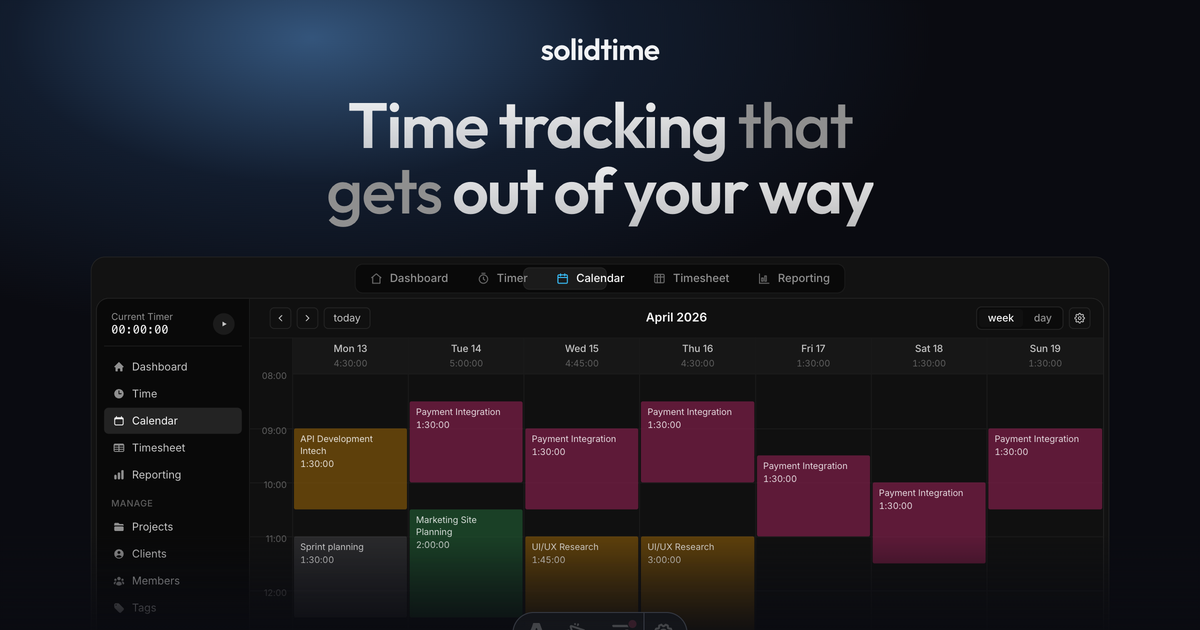
Start and stop timers from the interface and attach each entry to a project and task. Entries include a description field and are grouped by date, project, and client in reports, showing cumulative totals ready for billing review.
Set billing rates at the organization, organization member, project, or project member level. The most specific rate applies, so you can charge different clients different hourly rates while letting project leads work at their configured standard rate.
Create client records, assign them to projects, and use projects to group tasks. Multiple organizations are supported under one account, which lets agencies keep client workspaces separated without managing separate logins.
Migration from Toggl Track and Clockify is built in. A generic time entry CSV import path handles other tools. The import runs in the application interface, not the command line.
Each organization has its own member list with configurable roles. Members only see projects they are assigned to, which keeps client billing rates private from contractors or staff who should not have access.
Features
- Timer Tracking with Project and Task Assignment
- Billable Rates at Four Levels
- Client and Project Management
- Import from Toggl, Clockify, and CSV
- Roles and Permissions per Organization
Recommended for this setup
Strengths
- No per-seat fees when self-hosted: Running Solidtime on your own server means no monthly subscription costs. AGPL-3.0 permits internal commercial use, so agencies can bill clients without licensing restrictions. Teams that have grown past Toggl's 5-user free tier ceiling benefit most from the cost difference.
- Active development with low bug backlog: The repository launched in January 2024 and has grown to over 9,000 GitHub stars with 529 forks and only 12 open issues. A low issue count relative to adoption indicates a maintained codebase where reported bugs are addressed.
- Built-in Toggl and Clockify migration: Both major paid competitors have dedicated import paths. Agencies or freelancers with years of historical data can move without re-entering entries manually, and reports spanning past and present entries work without gaps.
- Mainstream PHP stack with official self-hosting docs: Laravel and Vue are familiar to most web development teams. Official self-hosting guides cover the Docker deployment path, and a dedicated self-hosting-examples repository provides reference configurations for common setups.
Trade-offs
- AGPL-3.0 restricts offering Solidtime as a hosted service: AGPL-3.0 means any modified version you offer as a service to third parties over the internet must have its source code published. Running Solidtime internally for your own agency is fully permitted. Building a commercial managed time-tracking service on top of it is not, without releasing your modifications.
- Self-hosting requires server setup and ongoing maintenance: There is no one-command local install for non-technical users. Self-hosting requires a server, Docker, database configuration, and basic server administration. Non-technical freelancers or small teams who want quick setup should use Solidtime Cloud rather than the self-hosted path.
- No built-in invoicing or expense tracking: Solidtime tracks time and manages billable rates but does not generate invoices or record expenses. Agencies that use Harvest specifically for its invoicing and expense features will need to pair Solidtime with a separate billing tool to cover the full accounts-receivable flow.
Tech stack
FAQ
Yes. Solidtime is AGPL-3.0 licensed and free to run on your own server. You pay for your hosting infrastructure but nothing to the Solidtime team. The Solidtime Cloud managed option is separate and has its own pricing.
For the core use case of timer-based tracking with project and client assignment, yes. Solidtime covers time entries, billable rates, multiple organizations, roles, and CSV, Toggl, and Clockify imports. It does not include the integrations with external project management or calendar tools that Toggl offers on paid plans.
Solidtime includes built-in import support for both Clockify and Toggl exports. In the application, navigate to the import section and upload the export file from your previous tool. A generic time entry CSV import path handles other sources.
The Solidtime Cloud managed service is the right path for non-technical users. Self-hosting requires a server with Docker and basic server administration knowledge. If you are comfortable with Docker, official setup guides at docs.solidtime.io cover the deployment steps.
AGPL-3.0 permits running Solidtime on your own server for any internal or commercial purpose, including billing clients, without paying licensing fees. The restriction applies if you modify the source and offer the modified version as a service to third parties over the internet: you must publish those modifications. For most teams running Solidtime internally, this restriction does not apply.