
DokuWiki
PHP wiki engine with file storage, ACLs, and 1200+ plugins.
Replaces Confluence, Notion, Nuclino, Gitbook
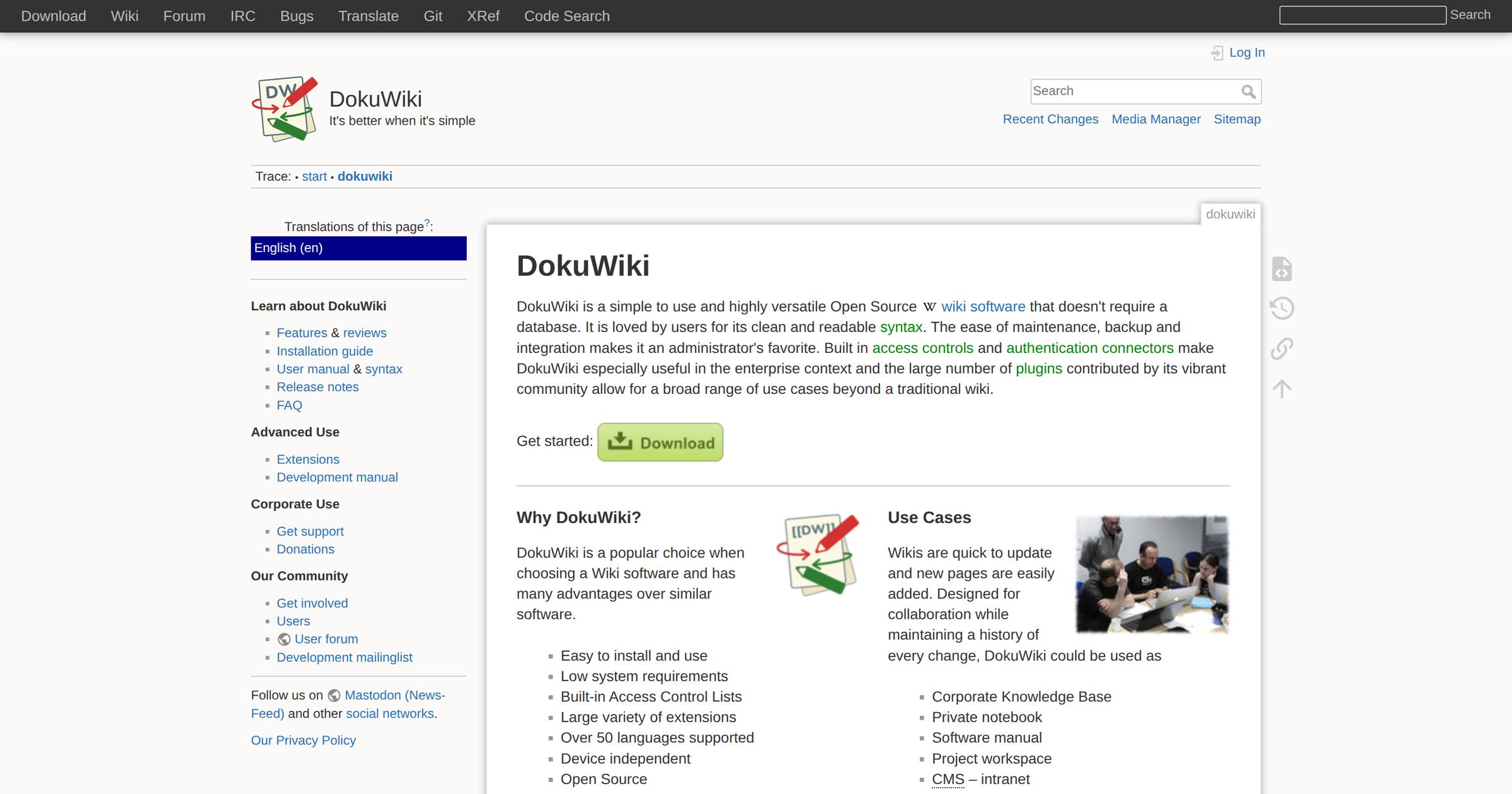
Who it's for
DokuWiki's ACL system and authentication backends make it well-suited for an internal team wiki where different departments need different access levels. LDAP integration keeps user management in your existing directory rather than a separate wiki user store.
Skip if your team needs live database views, Kanban boards, or project tracking in the same tool. DokuWiki is a focused wiki, not a generalist workspace, and lacks the relational data features of Notion or Confluence.
DokuWiki covers the full software documentation use case: simple markup syntax, namespace-based content organization, and unlimited page revisions with diff support. Project maintainers can self-host a docs site with no cloud dependency and no recurring cost.
Skip if your documentation needs to be publicly polished with Git-synchronized content workflows. Static site generators with Markdown or GitBook are better fits for public-facing developer documentation.
Teams leaving Confluence because of per-seat pricing or the Atlassian product direction can get a fully self-hosted wiki with built-in ACLs and no recurring cost. The plain-text file format makes DokuWiki data portable in a way a database-backed wiki is not.
Skip if your team depends on deep Jira or Bitbucket integrations. DokuWiki does not connect natively with the Atlassian ecosystem and would require manual workflow changes for teams that rely on Confluence-Jira linking.
The problem
Running a team wiki or knowledge base on commercial platforms means accepting per-seat pricing that scales with every new hire. Content stored in Confluence or Notion lives in a vendor's data format: exporting it cleanly is not straightforward, and moving to a different tool later means working around that format and its limitations. The deeper pain is infrastructure dependency. These platforms require a live subscription and a third-party connection. Teams that have documented years of internal processes, software manuals, or project decisions in a hosted wiki face real switching costs when pricing changes or the product shifts direction. A flat-file wiki you host yourself sidesteps that dependency entirely.
How it works
DokuWiki stores every page as a plain text file on disk. There is no database server to install, configure, or maintain, which keeps the operational footprint small and backup trivially simple: copy the data directory to another location.
Extended ACLs let you assign read, write, and admin permissions to users and groups at the namespace or page level. Authentication backends include LDAP, MySQL, Postgres, and others, so it integrates into existing directory infrastructure without a separate user database.
The plugin ecosystem covers search enhancements, additional editor modes, authentication adapters, and content types well beyond the core wiki format. Over 100 templates are also available for layout customization, all contributed by the DokuWiki community.
Every page edit is stored as a revision with no limit on history depth. Colored side-by-side diff views let you compare any two revisions and see exactly what changed and when. Section editing lets contributors update a single part of a long page without touching the full document.
DokuWiki builds and maintains a full-text search index across all pages. Page caching speeds up repeated queries, and an Ajax-enhanced interface means search results appear without full page reloads.
Features
- No database required
- Built-in access control lists
- Over 1200 community plugins
- Full revision history with diff support
- Index-based full-text search
Recommended for this setup
Strengths
- Data portability through plain text files: Every page is a text file in a directory on your server. Backup is a file copy. Migration is moving that directory. There is no proprietary export format and no vendor API standing between you and your content, which makes DokuWiki data portable in a way database-backed wikis are not.
- GPL-2.0 with no seat limits: DokuWiki is GPL-2.0 licensed and free to run on your own infrastructure with any number of users. There is no per-seat fee, no commercial tier that restricts features, and no cloud plan required to unlock access controls or plugins.
- Active development since 2004 with 4700+ GitHub stars: DokuWiki has been in continuous development since 2004 with 4737 GitHub stars and 924 forks. The community has contributed over 1200 plugins, giving it broad extension coverage for a wiki engine of its age and scope.
Trade-offs
- Requires a PHP web server to run: DokuWiki is a PHP application that runs on a web server. Setting it up means provisioning and maintaining a server with PHP support. It is not a one-command container deployment, so teams without server administration experience will face a steeper setup path than SaaS alternatives.
- Wiki markup syntax, not a block editor: DokuWiki uses its own wiki markup syntax rather than a modern drag-and-drop block editor. Users accustomed to Notion or Confluence's visual editors will need to learn the markup, and the editing experience is closer to a text editor than a modern workspace tool.
- 396 open GitHub issues: The project carries 396 open issues on GitHub. For a tool active since 2004, the backlog reflects the breadth of edge cases and plugin interactions a PHP wiki engine accumulates over decades, and some feature requests have been open for years.
Tech stack
FAQ
No. DokuWiki stores every page as a plain text file on disk. There is no database to install, configure, or maintain. This is DokuWiki's most distinctive architectural choice and the reason backup is as simple as copying the data directory to another location.
DokuWiki is licensed under GPL-2.0. You can use and modify it freely for any internal team or commercial purpose without restriction. Distributing a modified version requires releasing those changes under the same GPL-2.0 terms.
The DokuWiki community has contributed over 1200 plugins, covering extended authentication, additional editor modes, content types, and search enhancements. Over 100 layout templates are also available. The full list is in the official plugin and template repository at dokuwiki.org.
Yes. The repository at github.com/dokuwiki/dokuwiki shows the last push was September 2026, and the project has been in continuous development since 2004. It has 4737 GitHub stars and 924 forks, with an active community contributing plugins and translations.
DokuWiki ships with support for over 50 interface languages and full UTF-8 encoding, so it handles non-Latin scripts correctly. Interface translations are community-contributed. Content itself is stored as plain text files, so multi-language page sets are organized through namespaces.