
Wan2.2
Open source video AI with text, image, and speech-to-video generation
Replaces Kling Ai, Runway, Sora, Pika
Who it's for
Wan2.2's Apache-2.0 license and published paper (arxiv.org/abs/2503.20314) make it a primary benchmark baseline for video generation research. The multiple model variants (5B, 14B, MoE) provide controlled comparison points for ablation studies on scale, architecture, and training data volume.
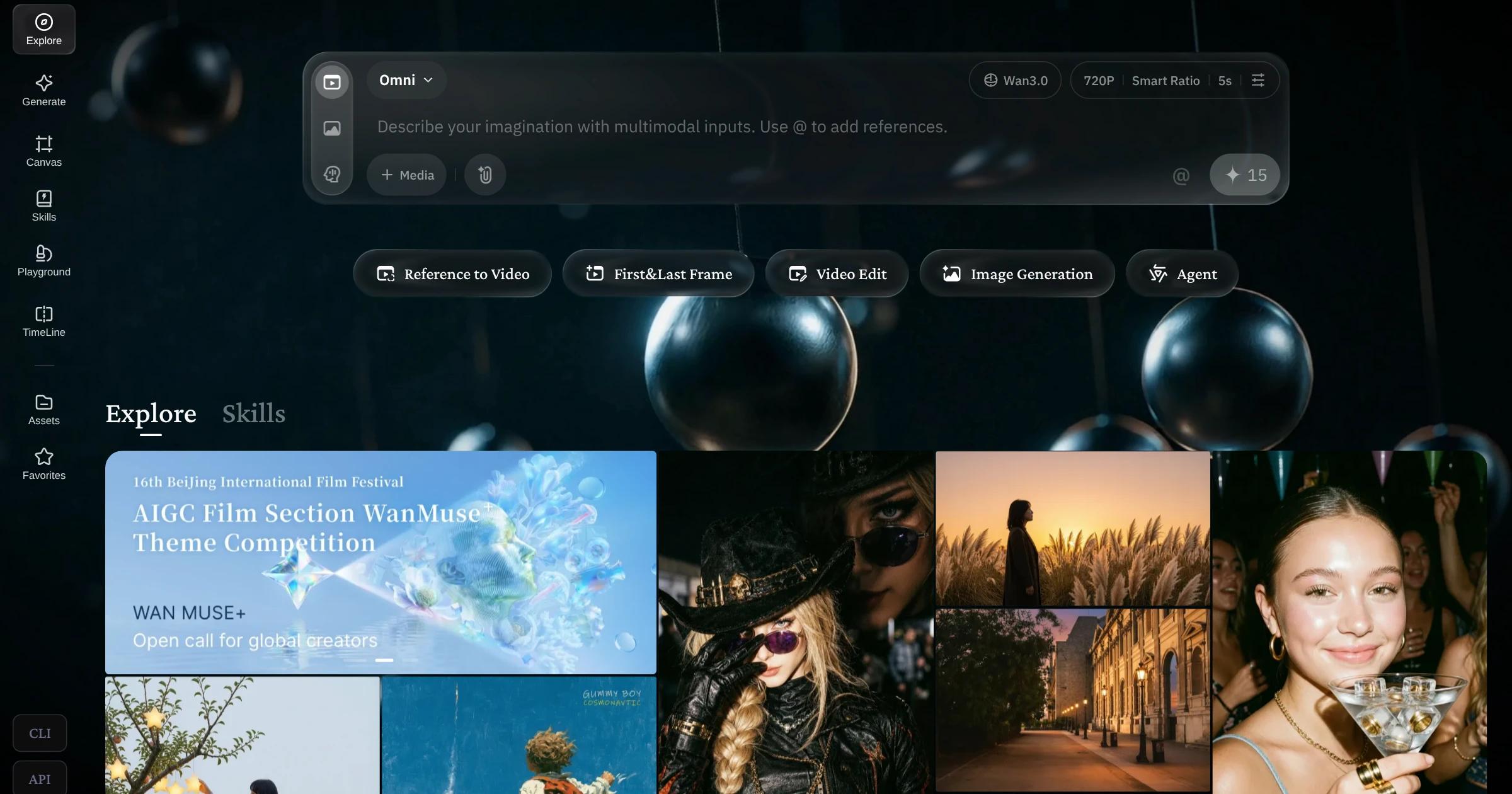
Skip if you need a no-code video creation tool. Wan2.2 requires Python environment setup and model weight downloads and does not include a web UI or GUI.
Teams paying per-clip to Runway or Kling AI can run Wan2.2 on their own GPU infrastructure to eliminate per-generation fees. The 720P at 24fps output from TI2V-5B is production-usable for concept generation and iterative previews.
Skip if your team has no GPU hardware to provision. Wan2.2 has no hosted inference endpoint; you must own and maintain the inference server yourself.
All five Wan2.2 model variants are integrated into ComfyUI, including a community-maintained WanVideoWrapper by Kijai that adds optimization features ahead of the official nodes. Teams already running local image generation in ComfyUI can add Wan2.2 video nodes without changing their core setup.
Skip if you need low-latency or real-time output. ComfyUI inference for 720P video generation takes significantly longer than cloud APIs backed by dedicated GPU fleets.
The problem
AI video generation has reached a quality level where text-to-video and image-to-video outputs are usable in production, but access is gated behind cloud APIs. Services like Runway, Kling AI, Sora, and Pika charge per generation, so teams with high-volume workflows or research workloads face unbounded costs and no way to run inference on their own hardware. Beyond cost, cloud-hosted video APIs give teams no control over output resolution throttling, content policies, or model availability. A pipeline built around a managed API is exposed whenever that provider raises prices or discontinues the model.
How it works
Wan2.2 applies a Mixture-of-Experts architecture to video diffusion, routing the denoising process across specialized expert models separated by timestep. This expands model capacity without increasing inference compute costs, letting the 14B parameter models deliver stronger motion quality and temporal consistency than a dense model of the same compute budget.
The TI2V-5B model uses a 16x16x4 VAE compression ratio to generate 720P video at 24fps on a single RTX 4090. It handles both text-to-video and image-to-video from one checkpoint, making it the most accessible Wan2.2 variant for teams without a multi-GPU cluster. The README describes it as one of the fastest 720P@24fps models currently available.
Wan2.2-S2V-14B takes audio input and generates cinematic video synchronized to the speech, at 480P and 720P. A September 2025 update added text-to-speech synthesis support via CosyVoice, so you can drive video generation from a transcript rather than a pre-recorded audio file. Inference code and model weights are available on Hugging Face.
Wan2.2-Animate-14B is a unified model for character animation and replacement that replicates holistic movement and expression from a reference. It was integrated into Hugging Face Diffusers in November 2025, which means it works within existing Hugging Face inference pipelines without bespoke serving code.
All five Wan2.2 model variants (T2V, I2V, TI2V, S2V, Animate) are integrated into both ComfyUI and Hugging Face Diffusers. Teams already running local image generation in ComfyUI can add Wan2.2 video nodes without changing their core setup. A community-maintained WanVideoWrapper by Kijai adds optimization-focused features ahead of the official nodes.
For the 14B models, multi-GPU inference uses PyTorch FSDP for weight sharding and DeepSpeed Ulysses for sequence parallelism. The README provides an 8-GPU torchrun command that distributes both the DiT and T5 encoders across GPUs, bringing 720P generation within reach of teams with an 8x A100 or H100 cluster.
Features
- MoE architecture for higher capacity video generation
- 720P at 24fps on a consumer RTX 4090
- Speech-to-video generation
- Character animation and replacement
- ComfyUI and Diffusers integration for all variants
- Multi-GPU inference via FSDP and DeepSpeed Ulysses
How to install
Setup requires cloning the repository and installing Python dependencies, then downloading model weights via huggingface-cli.
git clone https://github.com/Wan-Video/Wan2.2.git
pip install -r requirements.txt
pip install "huggingface_hub[cli]"
huggingface-cli download Wan-AI/Wan2.2-TI2V-5B --local-dir ./Wan2.2-TI2V-5B
Recommended for this setup
Strengths
- Apache-2.0 license with no usage restrictions: Wan2.2 is released under Apache-2.0, which permits commercial use, modification, distribution, and private use without requiring source disclosure. Unlike AGPL-licensed models that restrict derivative services, Apache-2.0 lets teams build production video pipelines and hosted services on top of the weights without licensing friction.
- Consumer GPU access to 720P video generation: The TI2V-5B model supports 720P at 24fps on an RTX 4090. The README notes it as one of the fastest 720P@24fps models available, with --offload_model and --convert_model_dtype flags to reduce VRAM pressure on lower-spec hardware. This consumer GPU path does not exist in any of the four paid alternatives it replaces.
- Training scale advantage over Wan2.1: Wan2.2 was trained on 65.6% more images and 83.2% more videos than its predecessor Wan2.1. The README credits this data expansion with top performance on motion quality, semantic fidelity, and aesthetic consistency across all open and closed-source models in its class.
- Active ecosystem integrations: Since the July 2025 release, Wan2.2 has been integrated into ComfyUI, Hugging Face Diffusers, and third-party projects including LightX2V, DiffSynth-Studio, and Kijai's ComfyUI WanVideoWrapper. With 17,975 GitHub stars and 2,331 forks by October 2026, the community extension work is active and growing.
Trade-offs
- 14B models require 80GB VRAM for single-GPU inference: The T2V-A14B and I2V-A14B models need at least 80GB VRAM for single-GPU operation. Without an H100 or A100 80GB, you either use --offload_model (which slows inference significantly) or split across multiple GPUs via FSDP. Teams without enterprise-grade hardware are effectively limited to the TI2V-5B model for practical self-hosting.
- No one-command install or Docker image: Running any Wan2.2 model requires cloning the repo, installing Python dependencies from requirements.txt, and downloading multi-gigabyte checkpoints from Hugging Face or ModelScope. This is a standard ML research workflow, but it is not a quick self-hosting path for teams without existing ML infrastructure.
- 318 open GitHub issues as of October 2026: The repository carries 318 open issues covering inference bugs, quantization edge cases, and integration problems. This is a research-grade release: the core inference pipeline is documented and functional, but operational polish (clear error messages, stable APIs, minimal-config deployment) lags behind commercial video generation services.
Tech stack
FAQ
T2V (text-to-video) generates video from a text prompt alone; I2V (image-to-video) animates a static image guided by a text prompt; TI2V (text-image-to-video) supports both inputs in one 5B model with a 16x16x4 VAE compression ratio. The TI2V-5B runs on a consumer RTX 4090 at 720P and 24fps, making it the most accessible variant. The 14B MoE models (T2V-A14B, I2V-A14B) require 80GB VRAM for single-GPU inference but offer higher quality at larger compute.
Yes, the TI2V-5B model supports 720P generation at 24fps on an RTX 4090. The larger 14B models need at least 80GB VRAM for single-GPU inference, but the --offload_model and --convert_model_dtype flags reduce memory pressure at the cost of inference speed. Multi-GPU setups via FSDP and DeepSpeed Ulysses are the recommended path for the 14B variants.
Yes. Wan2.2 is released under the Apache-2.0 license, which permits commercial use, modification, and distribution without requiring source disclosure. You can build a production video pipeline or a hosted service on top of the model weights without licensing fees or restrictions beyond attribution in derivative works.
Yes. All Wan2.2 variants (T2V, I2V, TI2V, S2V, Animate) were integrated into ComfyUI at launch in July 2025. A community-maintained WanVideoWrapper by Kijai provides additional optimization support and is updated ahead of the official ComfyUI nodes and adds optimization and quantization features not yet merged upstream.
Wan2.2 is self-hostable and Apache-licensed; Runway and Kling AI are cloud-only services with per-generation pricing and no self-hosting path. Wan2.2 gives teams full control over inference, data, and costs once hardware is provisioned. The tradeoff is operational overhead: Runway and Kling AI require no GPU management and offer production-grade web editors and collaboration features that Wan2.2 does not provide.