
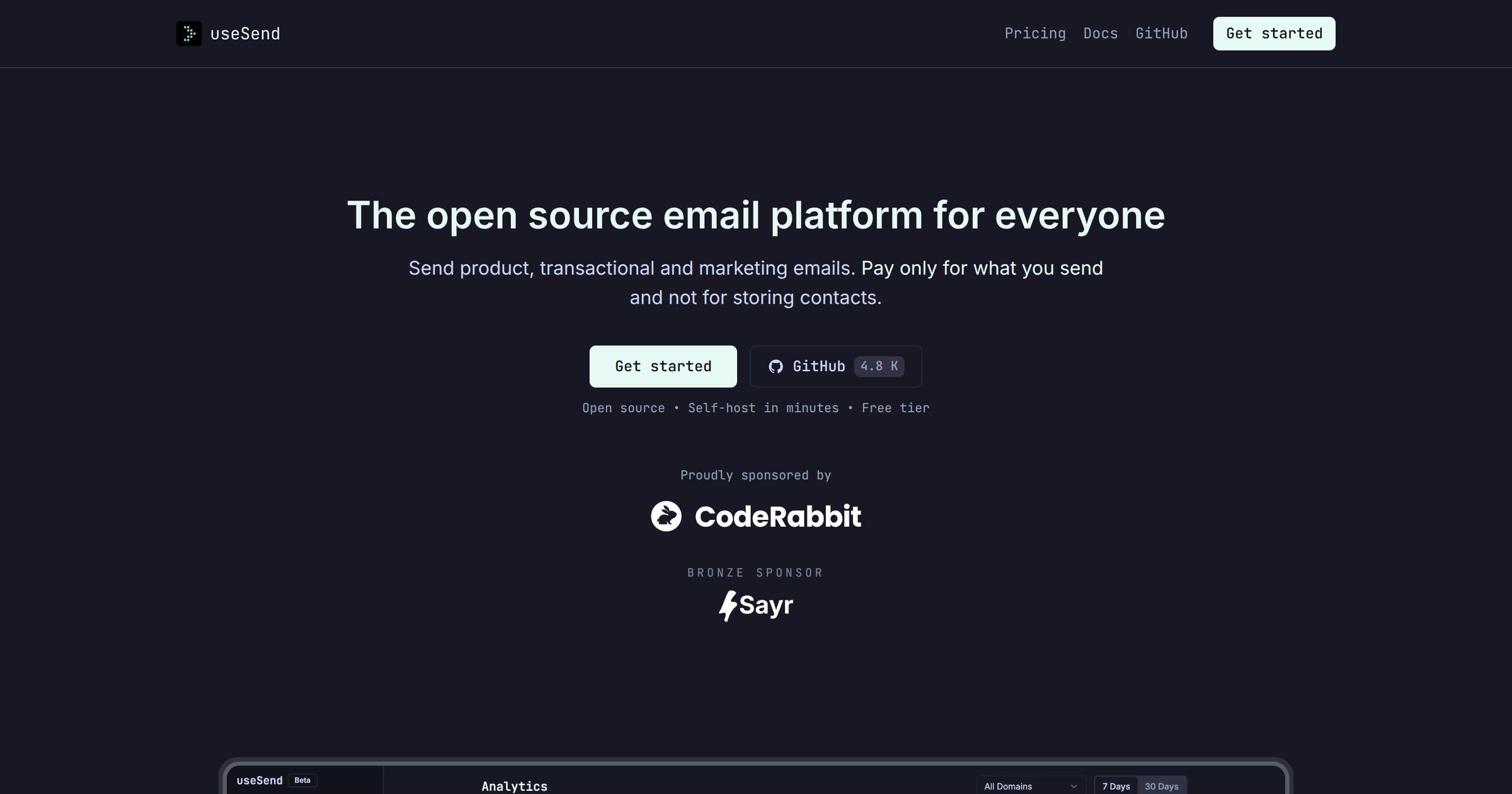
useSend
Self-hosted email platform for transactional and marketing sends.
Replaces Resend, Sendgrid, Postmark, Mailgun, Amazon Ses
Who it's for
useSend's REST API and typed SDKs (TypeScript, Python, Go) cover the standard transactional email flow: account verifications, password resets, and event notifications. The SMTP relay also works for apps that already send via SMTP without an API integration.
Your app sends very high volumes and needs deliverability consulting, IP warming support, or dedicated IPs out of the box. Commercial transactional email services include those features; useSend's deliverability depends on your own Amazon SES reputation, which you need to build and maintain.
useSend supports contact lists and the visual campaign editor needed for newsletters. Teams like Papermark (30,000+ subscribers) have used it in production. The free cloud tier covers up to 3,000 sends per month; heavier senders benefit most from the self-hosted path where send costs are only SES rates.
Your team needs an extensive automation and workflow builder with conditionals, A/B testing, and deep CRM integrations. useSend covers basic campaign sending and contact management; it does not currently offer full marketing automation.
Teams already on AWS who need delivery analytics, contact management, and an API layer on top of SES without building those themselves. useSend adds the full sending stack while keeping SES as the actual delivery mechanism, with no additional per-contact fees on top of SES costs.
You have no existing AWS footprint and are starting from scratch. Setting up an AWS account, verifying SES domains, and managing DMARC/SPF records takes additional work before useSend's features are accessible.
The problem
Most commercial email platforms charge per contact stored, not just per email sent. As a subscriber list grows, the monthly bill scales with it even when send volume stays flat. Teams running newsletters or product updates on tools like Resend, Mailgun, or Postmark also face vendor lock-in: their sending history, suppression lists, contact data, and templates live on the provider's infrastructure. If pricing changes or a plan is discontinued, there is no self-hosted path out. For developers who already have AWS credentials, Amazon SES itself is inexpensive but bare: it offers delivery but no dashboard, no campaign editor, no analytics, and no contact management. Building those layers on top of SES takes time and ongoing maintenance. useSend was built to fill that gap, giving teams the full sending stack with SES handling delivery.
How it works
Tracks deliveries, opens, clicks, bounces, and unsubscribes in real time through a searchable log. Filter by domain, status, or API key and export results. Campaign performance is visible per send, making it straightforward to identify deliverability issues or top-performing campaigns.
Design campaigns with a Notion-like WYSIWYG editor that works in major email clients. Reuse templates and brand styles, and personalize content with variables. The editor is built on tiptap and jsx-email and is published as a separate open source package at usesend/useSend.
Manage contacts, lists, and consent in one place. Import and export contacts, track per-list subscription status, and automatically update contacts from bounces and complaints. The suppression list is auto-populated from bounces and complaints and is manageable via import, export, or API.
Provides a drop-in SMTP relay that works with any app or framework without requiring API integration. Documented specifically for use with services like Supabase that need an outgoing SMTP endpoint. Existing apps that already send via SMTP can point to useSend with no code changes.
Official SDKs are available for TypeScript, Python, and Go. Each wraps the REST API for sending emails with typed request and response objects. Authentication uses a Bearer API key prefixed with 'us_', and the base URL is app.usesend.com.
The Schedule API allows delayed or time-specific email sends. Webhooks let your application react to delivery events (delivered, bounced, opened, clicked) in real time. Both features are marked as implemented in the README feature checklist alongside transactional mail and SMTP.
Features
- Real-Time Delivery Analytics
- Visual Marketing Email Editor
- Contact Management with Suppression List
- Drop-In SMTP Relay
- Typed SDKs for TypeScript, Python, and Go
- Schedule API and Webhook Support
How to install
Self-host useSend using Docker; images are published to DockerHub and GitHub Container Registry, and a Railway template is available for one-click deploy.
docker pull usesend/usesendRecommended for this setup
Strengths
- No per-contact storage fees: useSend's pricing charges only for emails sent, not for how many contacts you store. The free cloud tier allows up to 3,000 email sends per month. This contrasts with paid platforms like Mailgun and Resend that charge contact-based monthly fees even when send volume is low.
- Amazon SES delivery at SES rates: useSend routes sends through Amazon SES, the same infrastructure many paid email APIs use internally. Self-hosters pay SES directly at SES pricing rather than a marked-up commercial rate. Teams already on AWS keep everything within one provider and can use existing SES domain verifications.
- Active project with 4,700+ GitHub stars: Created in March 2024, the repository had 4,783 stars and 446 forks as of November 2026, with the last push on October 31, 2026. The project participates in Hacktoberfest to attract contributors. Community adoption includes teams at Coolify, Papermark, and doras.to.
Trade-offs
- Requires Postgres, Redis, and AWS credentials to self-host: The Docker deployment requires a Postgres database, Redis for queuing, and Amazon SES credentials including AWS account setup and domain verification. This is not a zero-dependencies install. Teams without existing AWS infrastructure need to configure SES before useSend's features are accessible.
- Inbound email not yet supported: The README's feature checklist marks inbound email as planned but not yet implemented. Teams that need to receive and parse inbound mail cannot use useSend for that use case today.
- Beta status: API surfaces may change: The README notes the project is currently in beta. Under active development since 2024, some configuration formats and API details may change between releases. Teams running useSend in production should track release notes.
Tech stack
FAQ
Yes. useSend uses Amazon SES as its delivery layer, so you need an AWS account with SES enabled. The self-hosted path also requires Postgres, Redis, and your SES credentials as environment variables. The cloud-hosted tier manages SES credentials on your behalf.
The cloud-hosted free tier allows up to 3,000 email sends per month, up to 100 per day, one contact book, one domain, and one team member. Self-hosted deployments have no built-in send limits beyond what your Amazon SES account allows.
Yes, useSend is licensed under AGPL-3.0. You can run it on your own infrastructure for internal or commercial use. The AGPL copyleft provision applies if you distribute a modified version as a network service to others: in that case, you must publish your modifications. Running it internally for your own team does not trigger this requirement.
Yes. useSend supports both use cases from one installation. Transactional emails are sent via the REST API or SMTP relay. Marketing emails are built with the visual campaign editor and scheduled or sent to contact lists. On the cloud tier, transactional emails cost $0.0004 each and marketing emails cost $0.001 each.
Not yet. The README marks inbound email as a planned but not yet implemented feature. As of October 2026, useSend handles outbound sending only. Teams that need inbound email parsing should evaluate other tools for that specific need.