
Mole
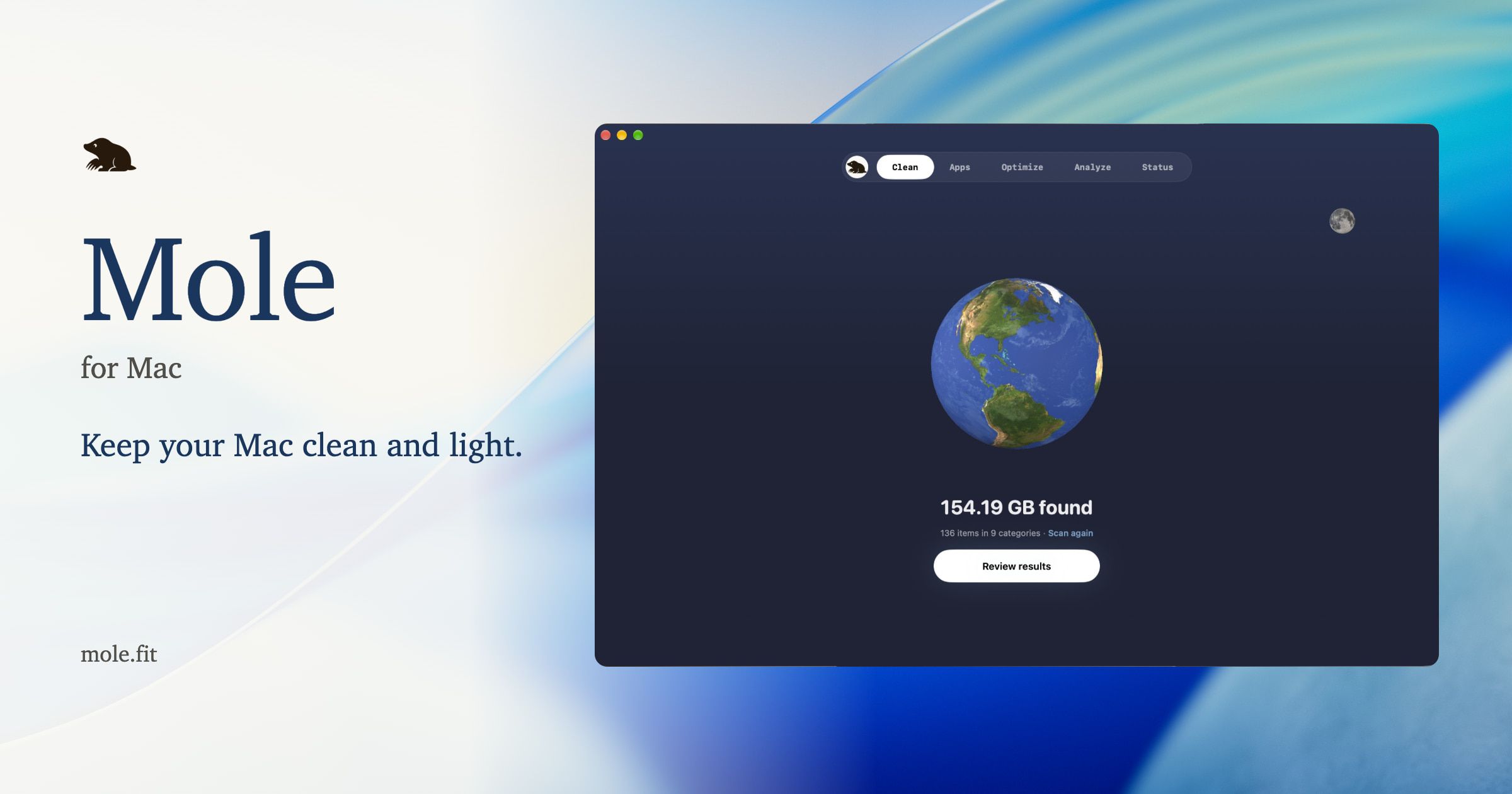
Free CLI and native app for Mac cleanup, uninstall, and disk analysis
Replaces Cleanmymac X, Cleaner One Pro, Cleanmymac, Daisydisk, Istat Menus, Sensei
Who it's for
Running Claude Code, Codex, or Cursor daily generates gigabytes of session logs, worktrees, and model caches. `mo clean` covers these in its general pass, and the Moon module in the Mac app reviews them separately with explicit confirmation before removal.
You are not running AI coding tools and your disk pressure comes mainly from media files or large project directories. `mo analyze` can still locate them, but a simpler tool may be enough for the cleanup step.
Mole's JSON output (`mo status --json`, `mo analyze --json`) and dry-run flags make it easy to wire into shell scripts, cron jobs, or AI agent tasks. `mo purge` cleans project build artifacts across configured scan directories in a single pass.
You need a graphical interface for non-technical teammates. The free CLI has no GUI. The paid Mac app covers that use case.
Mole's free CLI covers clean, uninstall, analyze, and live system status in a single open source tool, replacing what CleanMyMac X and similar paid tools charge for. The $19 native Mac app adds the full GUI, tested leftover database for 800+ apps, fan controls, and the AI cleanup module.
You rely on fully automatic scheduled cleanup with no user interaction. Mole's cleanup is review-based by design and requires confirmation before deleting files.
A cron job running `mo clean` weekly keeps developer Macs from accumulating stale caches between manual sessions. `mo history` logs all cleanup activity for later review, and `MO_NO_OPLOG=1` disables logging if you prefer no audit trail.
Your organization requires enterprise MDM or remote deployment policies. Mole is a personal Mac tool with no MDM integration.
The problem
Mac disk space erodes steadily. App caches pile up in Library folders, development tools leave build artifacts across the filesystem, and uninstalled apps drop LaunchAgents and preference files that macOS never cleans automatically. The challenge is worse for developers using AI coding tools. Codex sessions, Claude Code worktrees, LLM tool caches, and npm or pnpm stores can consume tens of gigabytes without any single file being obviously disposable. Commercial Mac cleaners exist, but they are paid, proprietary tools that cannot be audited, extended, or wired into automated maintenance workflows the way an open source CLI can.
How it works
Removes app caches, browser caches, developer tool artifacts, and stale AI tool data from Claude Code, Codex, and Cursor. The Moon module in the Mac app reviews AI sessions one by one before removal. `mo clean --dry-run` shows the full list and sizes before any file is touched.
Removes apps together with their LaunchAgents, preference files, and support directories. Shows each item with its size before deletion, routes files to Trash by default, and keeps personal data unless you opt in. Tested leftover mappings cover 800+ Mac apps in the native Mac app.
Opens a terminal treemap of disk usage with arrow-key and Vim navigation, filtering, and multi-selection. Drill into any folder, then jump back from the path bar. External drives are excluded from the overview by default and can be analyzed separately with `mo analyze /Volumes`.
Shows CPU, memory, GPU, disk I/O, network traffic, temperature, fan speed, and per-process breakdowns in real time. Battery status covers your Mac, a paired iPhone or iPad, and Bluetooth accessories. JSON output is available for scripting with `mo status --json`.
Runs bounded maintenance for Finder, DNS cache, Quick Look thumbnails, icon services, and system databases in a single `mo optimize` pass. Tasks that are unnecessary or unsafe at the moment are skipped with a reason. A whitelist protects paths or volumes you want excluded.
The Moon module in the native Mac app reviews Codex sessions not opened in months, cleanable Claude Code worktrees, and AI CLI tools no longer in use. Caches are preselected for removal. Sessions and tools require your confirmation. The Moon entry can be hidden in Settings.
Features
- Deep Cache Cleanup
- App Uninstaller with Leftover Review
- Interactive Disk Analyzer
- Live System Stats Dashboard
- macOS Maintenance
- AI Tool Cleanup
How to install
Install the CLI via Homebrew or use the shell script for macOS versions Homebrew no longer supports.
brew install mole

curl -fsSL https://raw.githubusercontent.com/tw93/mole/main/install.sh | bash
Recommended for this setup
Strengths
- Free CLI under GPL-3.0: The terminal CLI is entirely free and GPL-3.0 licensed. Run it on any macOS 12 or later Mac, script it into cron jobs or AI agent tasks, and extend it without licensing fees. Users have reported recovering anywhere from 8 GB to over 140 GB in a single `mo clean` run.
- Dry-Run Preview Before Deletion: Every destructive command (`clean`, `uninstall`, `purge`, `installer`, `slim`) accepts `--dry-run`, which shows exactly what would be removed with file counts and sizes before anything is deleted. This makes it safe to run on unfamiliar machines and confirms scope before committing.
- Built for AI Coding Workflows: Mole identifies and groups caches, sessions, and orphaned CLI installs from Claude Code, Codex, Cursor, Ollama, and similar tools, separating them from general app caches so you review them before removal. Few Mac cleanup tools account for AI tool residue at this level of specificity.
- Active Development with Large Community: Over 72,000 GitHub stars, 2,500 forks, and 148 contributors as of October 2026. Weekly commits, multilingual README coverage across eight languages, and only 14 open issues relative to adoption signal a well-maintained project.
Trade-offs
- Free Tier Is Terminal-Only: The GPL-3.0 CLI has no graphical interface. Users who prefer point-and-click operation need the $19 native Mac app. The Homebrew install uses a custom tap (`brew install tw93/tap/mole` in some sources, `brew install mole` in others), which some users find less obvious than a standard formula.
- Native Mac App Is Not Open Source: The Mac app at mole.fit is a paid product. Its graphical layer is not published separately from the CLI repository. Only the CLI is GPL-3.0 licensed. Teams who need to audit or modify the full GUI must work from the CLI codebase alone, which covers the core operations.
- macOS Version Requirements: The CLI requires macOS 12 or later and supports both Intel and Apple Silicon. The native Mac app requires macOS 14 or later, excluding older Intel machines still on macOS 12 or 13. Use the shell script install path when Homebrew no longer supports your macOS version.
Tech stack
FAQ
The terminal CLI is free and GPL-3.0 licensed, with no usage limits. The native Mac app costs $19 one-time and includes a graphical interface, tested leftover mappings for 800+ apps, AI cleanup for coding tool sessions, fan controls, and free lifetime updates. The CLI alone covers most developer cleanup needs.
Every destructive command supports `--dry-run`, which shows exactly what would be removed before anything is deleted. Mole validates paths, protects system-owned locations, and routes uninstall deletions to Trash by default. Cleanup activity is logged in `~/Library/Logs/mole/operations.log` and reviewable with `mo history`.
Mole's free CLI covers the same core categories as CleanMyMac: cache cleanup, app uninstall with leftovers, disk analysis, and live system stats. CleanMyMac is a paid, proprietary Mac cleaner. Mole's native Mac app is a one-time $19 purchase and adds AI tool cleanup for Claude Code, Codex, and Cursor sessions.
Yes. The CLI supports both Intel and Apple Silicon Macs running macOS 12 or later. The native Mac app requires macOS 14 or later. A Windows CLI is available separately on the windows branch of the same repository.
Yes. The free CLI's `mo clean` command picks up AI tool caches in its general cleanup pass. The Moon module in the native Mac app goes further, reviewing Codex sessions, Claude Code worktrees, Cursor caches, and orphaned AI CLI tool installs separately, with explicit confirmation before each removal.