
Lowcoder
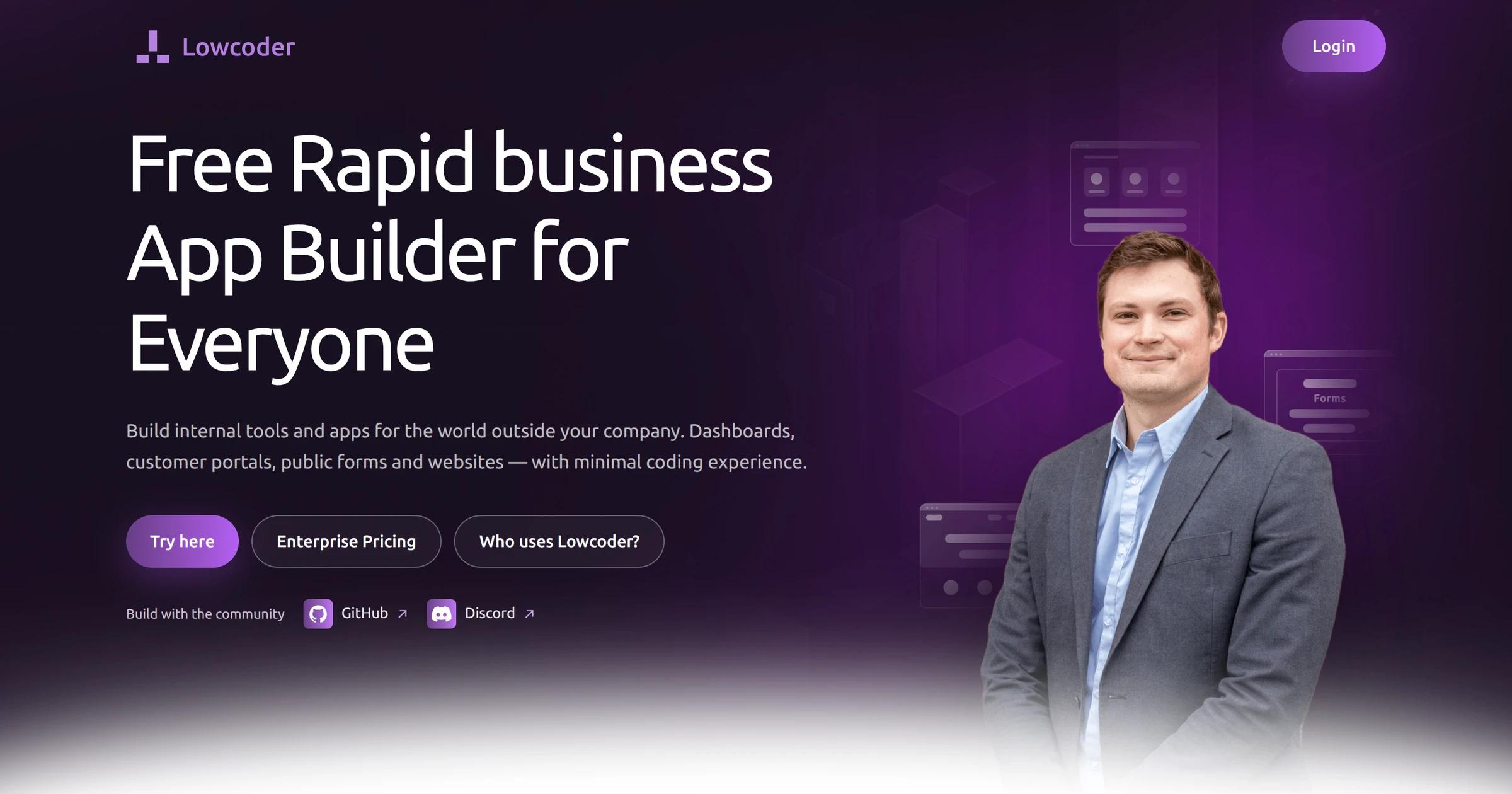
Low-code app builder with 120+ components, self-hostable
Replaces Retool, Ui Bakery, Jet Admin, Superblocks, Dronahq
Who it's for
Connect existing PostgreSQL, MySQL, or MongoDB databases, place table and form components, configure filters and action buttons, and ship a working admin panel in hours. Changes take effect without a deploy step or build cycle, so iterating on feedback is fast.
If your admin requirements are met by an existing BI tool or a simple CRUD interface, Lowcoder's setup overhead may outweigh its value for a one-off panel.
Build dashboards, CRM views, inventory tools, and ticketing interfaces on your own infrastructure. The per-instance enterprise pricing means adding more users does not increase the license bill, making Lowcoder cheaper than per-seat tools as team size grows.
If your organization resists managing container infrastructure, the operational overhead of running Lowcoder may outweigh the savings over per-seat commercial tools.
Design customer-facing forms, onboarding workflows, and self-service portals. The native embedding SDK lets you drop a Lowcoder app into a client's existing website without an iFrame, so the portal keeps the host site's styling and URL structure.
If a client needs a fully bespoke UI with no shared component framework, hand-coded React will give tighter control than any visual builder.
Build student administration tools, enrollment forms, and cross-department workflows on a single visual builder. Southern Methodist University uses Lowcoder in production for campus-wide administrative and public-facing apps under a tool they call Webframe.
If your institution has procurement rules around AGPL-licensed software or requires vendor support SLAs, review Lowcoder's enterprise contract options before adopting at scale.
The problem
Building internal tools is expensive when done from scratch and costly when rented from commercial services. Retool, Superblocks, and similar tools charge per seat, so a tool used by 50 internal staff quickly runs into thousands of dollars per month. For teams with data privacy requirements, the cloud-only constraint of most commercial services is a separate blocker: sensitive operational data cannot leave the organization's infrastructure. The technical effort to build even a basic admin dashboard without a low-code tool is high. Frontend developers must wire up databases, design component layouts, handle state, and manage updates manually. Most internal tools don't justify that investment, so teams either build shortcuts that break, or pay commercial licensing they outgrow.
How it works
The component library includes form inputs, tables, charts, kanban boards, and specialized widgets for rapid app development. Components are configured visually without writing layout code, and custom components can be built as plugins and published to npm under the lowcoder-comp namespace for community sharing.
Connects to PostgreSQL, MySQL, MongoDB, Redis, Elasticsearch, REST APIs, SMTP, and more. Connections are configured in the visual builder and query results bind directly to component properties. WebSocket data sources enable real-time streaming updates so apps reflect live data without manual refreshes.
Lowcoder apps embed directly into external HTML pages and React apps using the native SDK, without an iFrame wrapper. The embedded app can share CSS context with the host page and communicate through defined JavaScript interfaces. Most low-code tools use iFrame embedding, which creates hard style and communication boundaries.
WebRTC-based video meeting components let teams build conferencing tools inside a Lowcoder app. Meeting sessions sit alongside other app panels, so users can discuss a case, update its records, and take action without switching to a separate tool.
RBAC governs who can view, edit, or administer apps and data sources within a workspace. Permissions are managed per workspace through member groups, so teams can scope access to the right people without sharing credentials or exposing configuration.
Component groups that repeat across apps are saved as modules and re-embedded without copying configuration. The query library stores reusable data queries the same way, reducing duplication when multiple apps connect to the same databases or APIs.
Features
- 120+ Built-in UI Components
- 60+ Data Source Connectors
- Native Website Embedding Without iFrame
- Video Meeting and Collaboration Components
- Role-Based Access Control
- Reusable Modules and Query Library
Recommended for this setup
Strengths
- Per-Instance Enterprise Pricing: Lowcoder's enterprise edition is priced per server instance at €459/month or €4,990/year, not per user. A team of 50 internal users pays the same as a team of five. Retool and Superblocks both use per-user billing, where the cost scales with every person who needs access to the tool.
- Full AGPL-3.0 Source Access: The entire codebase, including the enterprise edition, is published under AGPL-3.0 on GitHub (1,627 stars, 317 forks). Teams can audit the code, modify it, and run it on their own infrastructure. Internal commercial and team use is permitted without restriction under AGPL-3.0.
- Active and Maintained Repository: The repository received its last push on 2026-11-04. The project continues from the abandoned Openblocks codebase and has maintained regular development. The Discord community and GitHub Issues are the primary support channels.
- Flexible Layered Layout System: Unlike tools that use a fixed column grid, Lowcoder supports layer-based layouts closer to design software. This allows precise positioning and styling to match company brand guidelines. Global themes apply changes across all apps at once.
Trade-offs
- AGPL-3.0 Restricts Reselling as a Hosted Service: AGPL-3.0 permits internal use with no restriction: teams can run Lowcoder on their own servers, modify it, and use it commercially for their own organization. The restriction applies when you offer Lowcoder as a managed hosted service to external customers: that triggers the requirement to publish source changes. Agencies planning to resell a Lowcoder-based product need to review this with counsel or use the enterprise contract.
- 206 Open Issues on GitHub: As of 2026-11-05, the repository carries 206 open issues. Lowcoder covers many features across a wide surface area (video meetings, native embedding, mobile publishing, streaming data), so teams should review the open issue list before committing to production use in their specific area.
- Self-Hosting Requires Container Infrastructure: The documented deployment path is Docker Compose or Helm Charts. Teams without container infrastructure experience need to set that up before running Lowcoder in production. The free community cloud at app.lowcoder.cloud avoids this overhead but moves data to a third-party host.
Tech stack
FAQ
The community edition is free and runs on your own infrastructure with no seat limits. A free community cloud is also available at app.lowcoder.cloud. The enterprise edition starts at €459 per instance per month or €4,990 per year, priced per instance rather than per user. AI and support services are billed separately.
Lowcoder is AGPL-3.0 licensed. You can run it on your own servers, modify it, and use it commercially for internal teams without restriction. If you modify the source and offer it as a hosted managed service to external customers, AGPL-3.0 requires publishing those changes. The enterprise edition is also AGPL-3.0, not a separate proprietary tier.
Lowcoder is AGPL-3.0 open source with per-instance enterprise pricing; Retool is a proprietary service with per-user billing. Lowcoder supports native website embedding without an iFrame and includes video meeting components that Retool does not offer. Retool has a more mature integration ecosystem and a managed cloud with uptime guarantees that Lowcoder does not yet match.
Yes. Lowcoder has a React-based native embedding SDK that lets you embed an app directly in any HTML page without an iFrame. The embedded app can communicate with the host page through defined JavaScript interfaces. This differs from most low-code tools, which rely on iFrame embedding and face hard CSS and communication boundaries.
Lowcoder supports Docker Compose for single-server deployments and Helm Charts for Kubernetes environments. The official documentation at docs.lowcoder.cloud describes a five-minute Docker install path. A free community cloud is also available for teams that prefer not to manage their own infrastructure.