
Grist
Relational spreadsheet with Python formulas, self-hosted on SQLite.
Replaces Airtable, Smartsheet, Coda
Who it's for
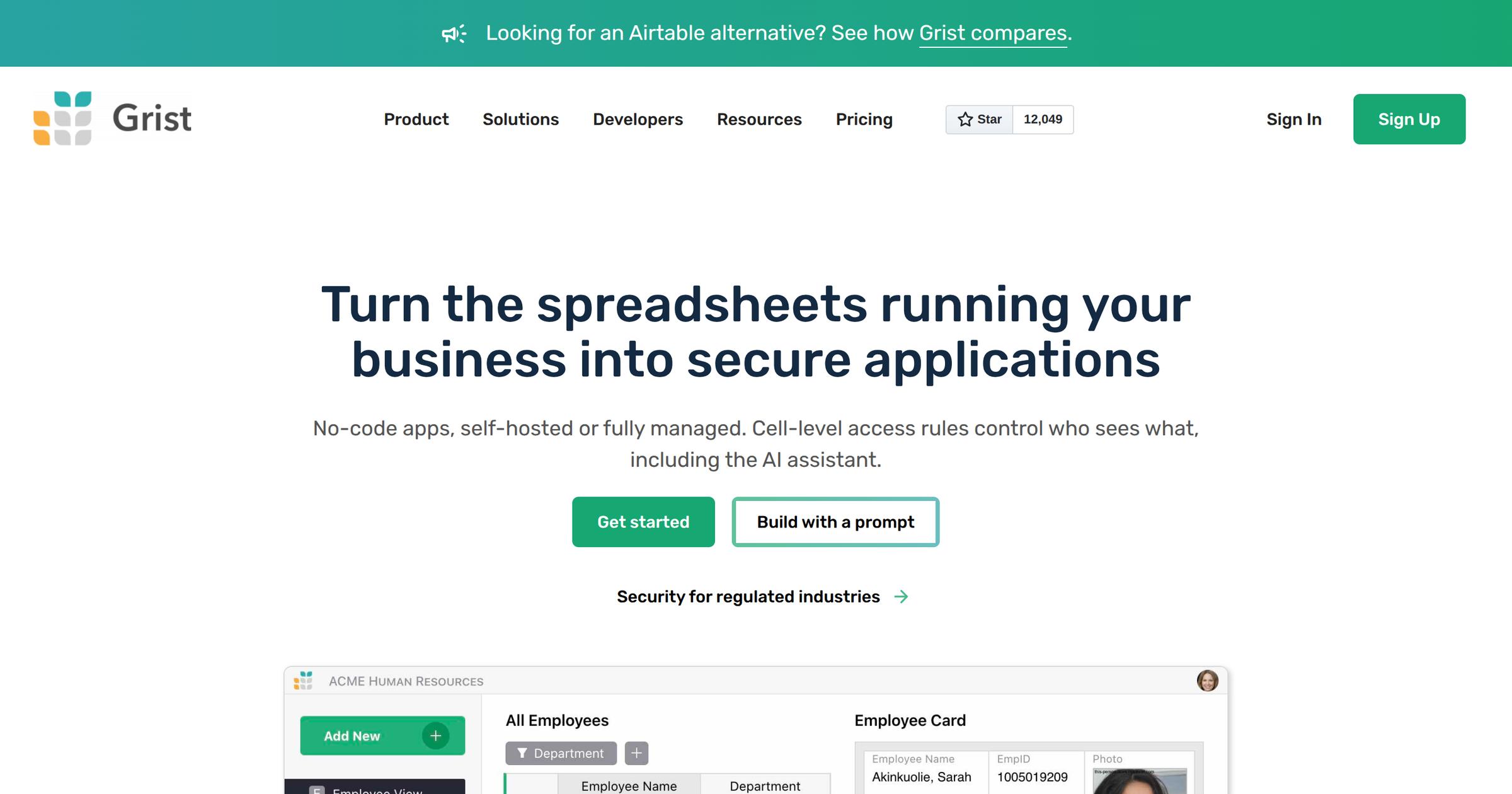
Grist replaces the ad-hoc spreadsheet stack that operations teams accumulate when their data needs relational references, form-based input, and access rules. A single Grist document can hold multiple related tables, a form for data entry, and filtered views that show each team member only their relevant rows.
If the team's primary need is project tracking (Gantt charts, task dependencies, sprint boards) rather than structured record management, Grist is not the right fit.
Healthcare, government, and financial services teams that cannot send data to a third-party cloud can run Grist on their own servers with no outbound data transfer. Row-level access rules and cell-value-based permissions support compliance requirements without a custom application build.
If your compliance review allows SaaS tools and your team lacks capacity to maintain a Docker deployment, starting with the hosted getgrist.com tier lets you evaluate Grist before committing to self-hosting.
Grist provides a grid UI backed by a relational schema, so non-technical users can query and edit records without a custom admin interface. The REST API and webhook support let developers wire Grist documents into existing pipelines, while the Python formula layer keeps business logic close to the data.
If the data model is simple enough for a standard CRUD app and the team has resources for a proper backend, a dedicated database with a frontend framework gives more programmatic control than Grist's grid UI.
Grist lets analysts write Python directly in column formulas, with access to the full standard library and Excel-compatible functions. Cross-table lookups work by reference column rather than by cell address, so formulas remain readable as the dataset grows. The AI formula assistant can explain and generate formulas from plain-language descriptions.
If the analysis requires a full computational environment (Jupyter notebooks, pandas workflows, multi-dataset joins in memory), Grist's Python is column-scoped, not a free-form notebook. Use a proper data science environment for that work.
The problem
Spreadsheets are the default tool for structured data in most organizations, but they break down in predictable ways: no cross-table references without formula gymnastics, no per-row or per-column access control, no typed columns, and files that become unmanageable once multiple people edit them. The result is duplicated data spread across dozens of sheets, broken lookups, and no audit trail. Databases fix the structural problems but require SQL knowledge and a developer to build any user-facing interface. Most teams end up stuck between the two: too much data for a spreadsheet, not enough engineering support for a traditional database. Grist closes this gap by giving teams a typed, relational data model inside a grid UI they already know how to use.
How it works
Every column in a Grist table can hold a Python formula with access to Python's full standard library, plus a set of Excel-compatible functions. An AI formula assistant (configurable to work with OpenAI, Llama, or any OpenAI-compatible endpoint via OpenRouter) can generate and explain formulas in plain language. A formula timer helps identify which calculations are slowing down large documents.
Access rules control what each user can see and edit, down to individual rows and columns. Rules can be based on cell values and user attributes, so the same document can show different views to different collaborators. Partial views can be shared with third parties without exposing the underlying schema.
Every Grist document is stored as a standard SQLite file on the server. Any tool that can read SQLite can read the numeric and text data from a Grist file, so you are never dependent on a proprietary export format for access to your own data. The format also makes backups straightforward: a copy of the file is a complete, restorable backup.
Grist documents can hold multiple linked widgets on a single page: grid tables, card views, charts, pivot tables, calendar views, and summary tables. Widgets can be linked so that selecting a row in one widget filters the content of another, enabling data exploration without writing any code. Custom widgets can be built externally and embedded in the layout.
The Grist REST API has an interactive console and covers documents, tables, records, and attachments. Configurable outgoing webhooks support column-specific triggers and formula conditions so external systems can react to data changes. SCIM support enables standard user and group provisioning, contributed by the French government's DINUM agency.
Features
- Python formulas with the full standard library
- Row, column, and table access rules
- SQLite-backed portable document format
- Linked widget dashboards with chart and card views
- REST API, webhooks, and SCIM provisioning
How to install
Self-hosting Grist requires Docker; mount a local directory at /persist to keep data between container restarts.
docker pull gristlabs/grist
docker run -p 8484:8484 -v $PWD/persist:/persist -it gristlabs/grist
Recommended for this setup
Strengths
- Apache-2.0 license with no per-seat pricing: Grist-core is Apache-2.0 licensed and free to self-host with no per-seat fees. Unlike Airtable and Smartsheet, which are cloud-only proprietary services, a self-hosted Grist deployment has one cost: the server. Teams of any size can use grist-core without a licensing conversation.
- Python formulas instead of a proprietary formula language: Airtable uses its own custom formula language with a limited function set. Grist gives full Python in every column, including the standard library, so complex lookups, string manipulation, date arithmetic, and custom business logic stay in the spreadsheet rather than in a separate script.
- Data portability through the SQLite format: Every document is a standard SQLite file on disk. Any SQLite reader can open it and access the data directly, without an export step or a Grist installation. This means you can migrate between hosting providers, open documents locally with a SQLite GUI, or write scripts against the data format without depending on the Grist API.
- Active development with government-level contributions: The French government's ANCT and DINUM agencies have contributed heavily to grist-core, adding SCIM user provisioning, S3-compatible external attachment storage, HTTP long polling for restrictive networks, accessibility features meeting WCAG AA, and localization into 20+ languages. The project has 12,048 GitHub stars and was last updated on 2026-11-04.
Trade-offs
- Several enterprise features are only in the paid edition: Grist-core does not include audit log streaming, SSO via OIDC or SAML, advanced admin controls for large installations, the broader Grist Assistant AI (beyond formula help), automations, the built-in MCP server, or OAuth app registration. Organizations that need any of these will need to self-host the full Grist edition or use the hosted service. Organizations with less than 1 million USD in total annual income, revenue and funding combined may request a free activation key for the full edition.
- 641 open issues in the grist-core tracker: The grist-core issue tracker carries 641 open issues, which reflects active use and ongoing feedback but also indicates a backlog. Users running production workloads should review the open issues for bugs relevant to their use case before committing to self-hosting. The project is actively maintained (last pushed 2026-11-04) but issue resolution can lag behind user-reported bugs.
- First-run setup requires a boot key from container logs: New Docker installs redirect to a Quick Setup screen before the site is usable. Getting past the first screen requires copying a generated boot key from the container's startup log. The setup is well-documented in the first-run guide, but it adds a step compared to tools that start in a fully open state by default.
Tech stack
FAQ
Yes. Grist-core is Apache-2.0 licensed and free to self-host with no seat count limits or usage fees. The hosted service at getgrist.com offers a free tier for individuals and small organizations. The commercial full edition (which adds audit streaming, SSO, automations, and other enterprise features) can be self-hosted at no cost by organizations with less than 1 million USD in total annual income, revenue and funding combined, who may request a free activation key.
The main differences are deployment model, formula language, and data portability. Grist can be self-hosted on your own infrastructure under Apache-2.0; Airtable is cloud-only. Grist uses full Python formulas; Airtable uses a custom formula language. Grist stores documents as portable SQLite files; Airtable's data is in Airtable's cloud. Grist also supports direct import from Airtable to ease migration.
Yes. Grist has a built-in import path specifically for Airtable. It reads your Airtable bases and converts them to Grist documents, preserving table structure and field types. The import is documented in the official Grist support site. After import, you can self-host the documents or continue on the hosted service.
Audit log streaming, SSO via OIDC or SAML, advanced admin controls for large installations, the full Grist Assistant AI (beyond the formula-only assistant), automations (trigger-based email and webhook workflows), the built-in MCP server, OAuth app registration, invite notifications, and document change and comment notifications. These are not in grist-core but are available in the full Grist edition. Organizations with less than 1 million USD in total annual income, revenue and funding combined may request a free activation key for the full self-hosted edition.
Grist-core is the open source edition you self-host under Apache-2.0. The hosted service at getgrist.com runs the full Grist edition, which includes the enterprise features listed above. The hosted service has a free tier and paid plans. If you self-host grist-core, you run on your own infrastructure at no cost; if you upgrade to the full self-hosted edition, you get the enterprise features and can apply for a free activation key if your organization qualifies.