
Gortex
Knowledge graph for AI coding agents over MCP
Replaces Augment Code, Gitnexus
Who it's for
Teams running Claude Code, Cursor, or Windsurf on repositories with hundreds or thousands of files can install Gortex once and immediately reduce the tokens each agent session consumes. The graph answers blast-radius, caller, and interface questions in one call instead of a series of file reads.
The codebase is small enough that file-read costs are negligible.
Security engineers can use `trace(taint)` to run pattern-driven source-to-sink sweeps across the codebase without loading a sandbox. `search(ast)` runs cross-language tree-sitter S-expression searches with bundled detectors for SQL string concatenation, weak crypto, and hardcoded secrets.
The team already uses a dedicated SAST platform that covers their language stack.
Platform teams managing multiple services can use Gortex's cross-repo contract detection to find orphan HTTP routes, unmatched Kafka topic producers and consumers, gRPC service mismatches, and Temporal workflow inconsistencies across repositories without maintaining a separate schema registry.
The organization uses a managed API gateway or service mesh that already tracks contract drift.
Engineering teams can run `gortex review` in CI to get line-anchored BLOCK/REVIEW/APPROVE findings from a graph-grounded rulepack (NPE, thread-safety, N+1, logic errors) before human review. The graph context is used to drop false positives that purely syntactic linters would emit.
The problem
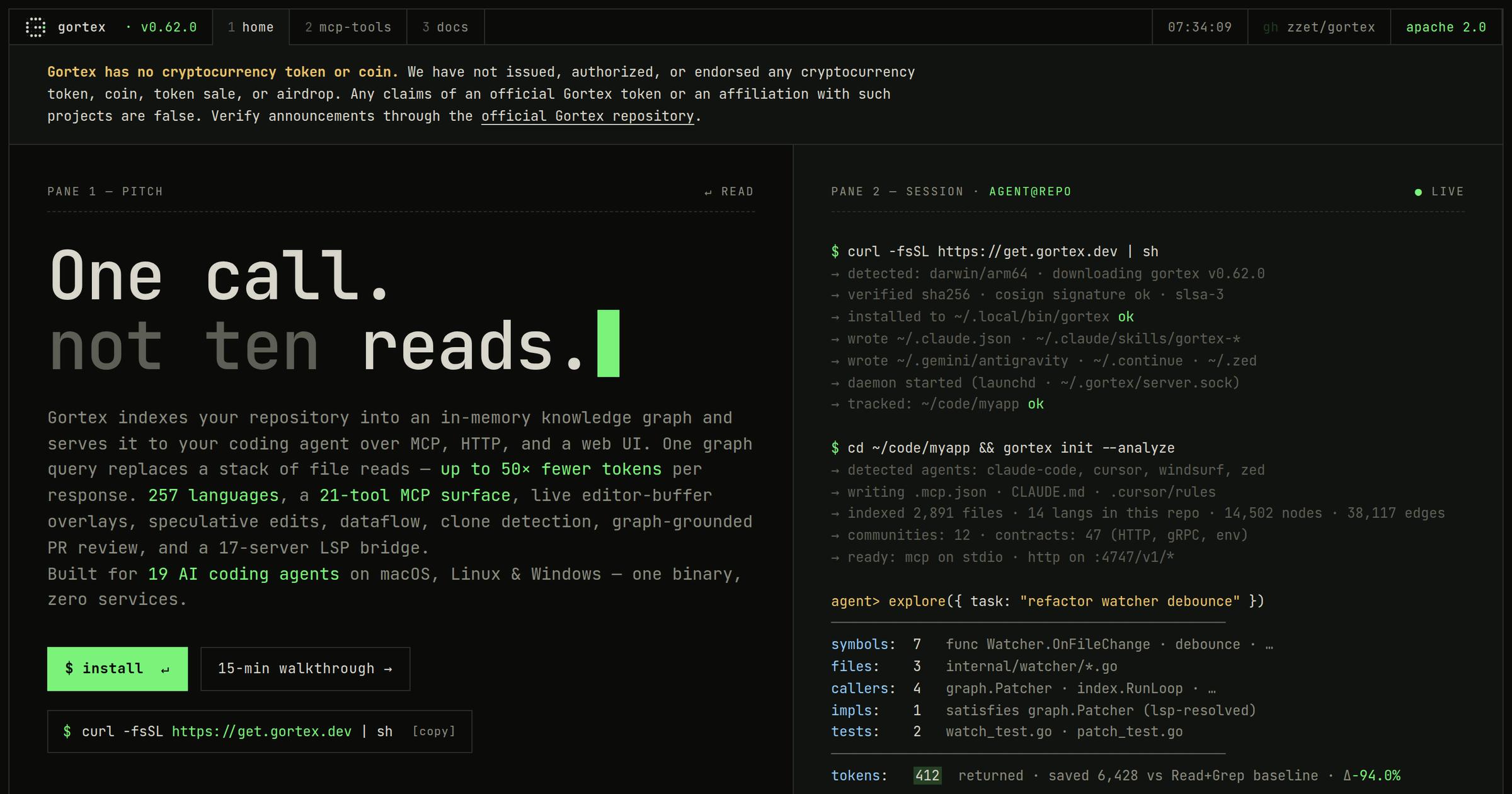
AI coding agents waste most of their context budget re-reading source files. A routine edit in Claude Code or Cursor typically issues half a dozen Read calls, a Grep, and one or more Globs before it has enough context to act — burning thousands of tokens on content the agent will never use. There is no efficient way for an agent to ask "what calls this function, what does it satisfy, and what breaks if I change it?" without scanning multiple files manually. Gortex solves this by pre-indexing the repository into a queryable knowledge graph so agents can retrieve exactly that context in a single call.
How it works
Gortex builds a graph of files, symbols, imports, call chains, field accesses, error contracts, SQL tables, channels, goroutines, config keys, log events, Kubernetes resources, dbt models, and more. A precomputed depth-3 reach index makes blast-radius queries O(seeds × reach), safe to run on every edit.
Named agents receive a compact 21-tool surface by default (explore, search, read, relations, trace, analyze, change, edit, and 16 resources). The full 175-tool catalogue is available via a single `tools_search` call. Instruction profiles (core, localization, full) and the GORTEX_TOOLS environment variable tune the surface further.
About 30 bespoke tree-sitter grammars provide deep resolution for major languages; about 60 regex extractors cover niche and legacy languages; about 165 forest-backed parsers handle the long tail with signature-only extraction. Jupyter and Databricks notebooks are indexed cell-by-cell, and custom grammars can be added via .gortex.yaml.
Shadow-graph sessions stage unsaved editor buffers so every subsequent tool call reads through a per-request view layered on the immutable base graph. `change(preview)` turns an LSP WorkspaceEdit into an impact report without touching disk; `change(simulate)` runs an ordered sequence with per-step diagnostics and a cumulative blast-radius rollup.
Gortex is wired to gopls, tsgo, pyright, rust-analyzer, clangd, jdtls, kotlin-language-server, omnisharp, ruby-lsp, phpactor, sourcekit-lsp, and others. `session(subscribe)` pushes diagnostics deltas over MCP; `change(code_actions)` and `refactor(fix_all)` apply LSP-supplied fixes atomically.
A deterministic correctness rulepack (NPE, thread-safety check-then-act, N+1, logic-error) runs over a changeset, graph-grounded to drop false positives, and emits line-anchored findings with a BLOCK / REVIEW / APPROVE verdict. `gortex prs` triages open PRs by blast radius and merge-order conflicts; `gortex review` runs the rulepack from the CLI.
Features
- In-memory knowledge graph
- 21-tool MCP facade
- 257-language three-tier extraction
- Live editor overlays and speculative execution
- 17-server LSP bridge
- Graph-grounded PR review
How to install
# macOS / Linux curl -fsSL https://get.gortex.dev | sh # Windows (PowerShell) irm https://get.gortex.dev/install.ps1 | iex # One-time machine setup (MCP wiring, skills, slash commands) gortex install # Start the background daemon and add a repo gortex daemon start --detach cd ~/projects/myapp && gortex init --analyze
Recommended for this setup
Strengths
- Zero external dependencies: The graph, indexer, LSP bridge, watcher, semantic search engine, MCP server, and HTTP server all run in a single ~20 MB static binary. No database to provision, no container to orchestrate, no network required to get started. The semantic search default uses a baked 3.8 MB GloVe-50d table with no model download.
- Measured token savings: The website publishes a concrete benchmark showing a 94% token reduction on a representative edit loop (11,480 tokens without Gortex versus 688 with it). Published semantic search eval scores are R@1 42.3%, R@5 55.1%, exact R@5 96.8%. `gortex savings` reports per-call and cumulative savings priced against any supported model.
- Strong supply-chain security: Every release is Sigstore-signed with SLSA Level 3 build provenance. The installer verifies SHA256 and cosign before writing the binary to PATH. The project is tracked on the OpenSSF Scorecard and was 0/91 on VirusTotal at the time of documentation.
- One install wires 19 agents: `gortex install` writes user-level MCP configuration, skills, and slash commands for Claude Code, Cursor, Windsurf, Kiro, VS Code/Copilot, Continue.dev, Cline, OpenCode, Codex CLI, Gemini CLI, Zed, Aider, Kilo Code, OpenClaw, Hermes, Antigravity, Oh My Pi, Pi, and Kimi in a single command. `gortex init` then writes the per-repo config and community routing blocks.
Trade-offs
- Memory footprint on very large repositories: The knowledge graph lives in process. Indexing the Linux kernel (70,333 files) takes about 3 minutes and peaks at 5.07 GB of heap on Apple Silicon. Projects at that scale need a machine with sufficient RAM; the daemon holds one graph per tracked repo.
- CGO build requirement: The default build requires CGO for the tree-sitter C bindings. Building from source needs Go 1.26 and a C toolchain. The distributed binaries are pre-built, but teams building from source in environments without CGO available will need to adjust.
- LLM-dependent features are opt-in but not free: The semantic search default runs fully offline on baked GloVe-50d vectors. Optional features — MiniLM, Ollama, OpenAI embeddings, the ask agent (9 LLM providers), and the AI-ranked PR queue — require external API keys or a locally running model server.
Tech stack
FAQ
No. The graph, indexer, semantic search, LSP bridge, MCP server, and HTTP server all run in-process in a single static binary. No network is required to get started. Optional features such as OpenAI embeddings or the LLM-based ask agent require external API keys, but the default configuration is fully offline.
Gortex is MCP-native. Running `gortex install` writes user-level MCP configuration for every supported agent detected on the machine. `gortex init` then writes per-repo config and community routing blocks (CLAUDE.md, .cursor/rules, .windsurfrules, GEMINI.md, and so on) for each detected agent.
257 languages through three tiers: about 30 bespoke tree-sitter grammars for deep resolution (Go, TypeScript, Python, Rust, Java, C#, Kotlin, Swift, C, C++, Ruby, Elixir, OCaml, and others), about 60 regex extractors for niche and legacy languages, and about 165 forest-backed signature-only parsers. Jupyter and Databricks notebooks are indexed cell-by-cell. Custom grammars can be added via .gortex.yaml.
Memory scales with repository size. Indexing the zzet/gortex repository itself takes 52 MB. microsoft/vscode (10,762 files) peaks at 580 MB. torvalds/linux (70,333 files) peaks at 5.07 GB. The daemon holds one graph per tracked repository and restores from an on-disk snapshot in about 200 ms on restart.
Apache License 2.0, free for commercial use with a patent grant. Copyright 2024-2026 Andrey Kumanyaev.