
Freescout
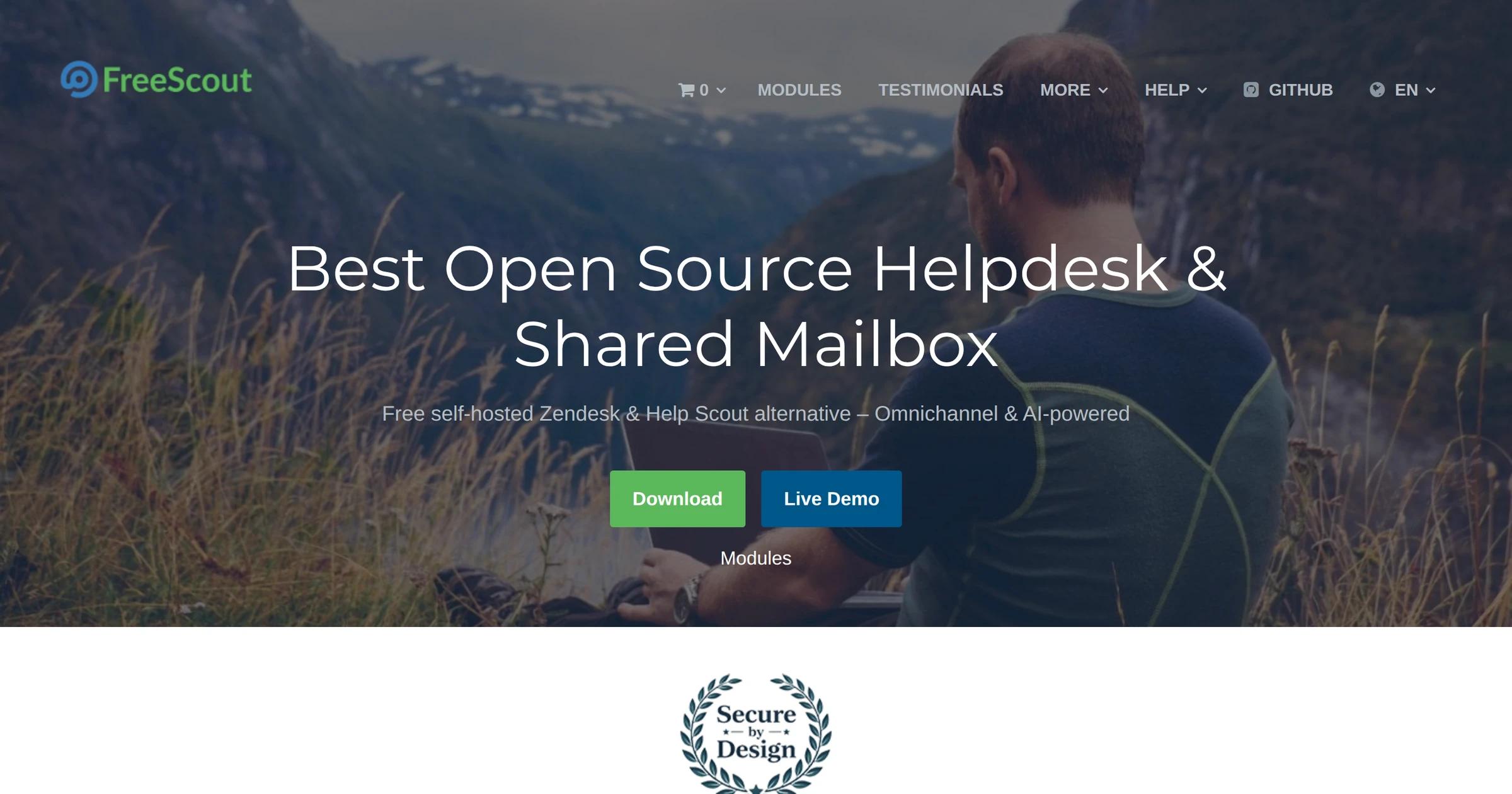
Self-hosted help desk with unlimited agents and no per-seat fees.
Replaces Help Scout, Zendesk, Freshdesk, Front
Who it's for
FreeScout covers email ticketing, assignment, internal notes, collision detection, and notifications, which are the core features most small support teams use daily on Help Scout or Zendesk. Moving to a self-hosted FreeScout eliminates the per-seat bill while keeping the same workflow.
Skip if your team is not comfortable managing a PHP/MySQL server or paying a managed hosting provider. The savings only materialize if you can handle uptime and updates.
Separate mailboxes let agencies run distinct support queues per client from a single FreeScout installation, with agents assigned to specific mailboxes. Clients never see each other's tickets. The unlimited agent model means adding a client account does not trigger a new seat charge.
Skip if each client requires complete data isolation in separate databases or separate deployments. FreeScout's mailbox separation is logical, not physical.
The module system adds WhatsApp, Telegram, Facebook, Slack, and Live Chat alongside standard email into the same ticket queue. Agents work from one inbox regardless of channel. This suits teams where customers contact support through multiple channels and agents need context across all of them.
Skip if you need native integrations to CRMs or billing systems out of the box. FreeScout connects via Zapier and Make, but deep CRM sync requires a module or custom work.
Every ticket, customer email, and agent note stays on the server you control. FreeScout makes no outbound connections to external services unless you install a module that does. For businesses with legal, regulatory, or customer commitments about where support data is stored, that is the simplest architecture.
Skip if data residency requirements mandate a certified provider (SOC 2, HIPAA, ISO 27001). FreeScout carries no compliance certifications; you are responsible for your own infrastructure's compliance.
The problem
Help desk software charges per agent. As a team grows, the per-seat model means the monthly bill rises with every new support rep added, with no flat-rate option on tools like Help Scout or Zendesk's standard tiers. Teams that want to give everyone on staff access to the support queue face a direct tradeoff between headcount and software cost. The practical result is that many teams keep support inboxes small, hand off to a shared Gmail account, or accept feature-stripped free tiers that lack assignment, collision detection, or proper reporting. Email threads get lost. Two agents reply to the same customer. Internal notes pile up in a separate chat tool. The workflow breaks down in ways that affect customer experience before the team is large enough to justify a paid seat for everyone involved.
How it works
Centralizes customer conversations from email (SMTP, IMAP, POP3), WhatsApp, Telegram, Facebook, Slack, and Live Chat into one queue. Agents see all channels in the same interface without switching between apps. Channel integrations come through FreeScout's module system, which also supports Microsoft Office 365 and Google Workspace OAuth authentication.
No seat limits on agents, no caps on tickets or mailboxes. The entirety of FreeScout's functionality is available to every agent, including assignment, internal notes, collision detection, and notifications. Teams commonly run multiple mailboxes per installation to separate support queues by product, department, or client.
Official and community modules add capabilities beyond the core: WhatsApp, Telegram, Live Chat, S3 storage, Zapier, Make (Integromat), and more. The module system means the core stays lightweight while teams add only what they need. A developer community maintains a range of community modules alongside the official set.
An AI integration module enables reply drafting with AI assistance from within the conversation view. The feature is modular, so teams that prefer not to use it can skip the module entirely. This keeps the core help desk install light for teams that do not need AI-assisted drafting.
FreeScout's Progressive Web App installs from the browser on iOS, Android, macOS, and desktop. It supports Web Push notifications, so agents receive alerts for new conversations and assignments without needing a native app. Native Android and iOS apps are also available for agents who prefer them.
FreeScout includes a browser-based installer that handles database setup and initial configuration, and a web updater for applying new versions without shell access. This makes FreeScout accessible on shared hosting plans where SSH is unavailable, since it only requires PHP and MySQL running on a standard web host.
Features
- Omnichannel inbox
- Unlimited agents, tickets, and mailboxes
- Module system for extended functionality
- AI-powered reply drafting
- Progressive Web App with push notifications
- Web-based installer and updater
Recommended for this setup
Strengths
- No per-agent pricing: flat infrastructure cost: Commercial help desks charge per seat; FreeScout has no seat limit. Every agent gets full access at no incremental cost, so the software bill stays flat as the team grows. The only costs are infrastructure and, optionally, a managed hosting fee.
- Runs on shared hosting with no minimum resources: FreeScout is a pure PHP/MySQL application with no minimum CPU or RAM requirements. Per the README, it runs on shared hosting plans, not just VPS or cloud servers. That makes it accessible to smaller teams and agencies with existing hosting infrastructure who cannot justify a dedicated server.
- Actively maintained with a low open issue count: The repository had 4,639 stars at time of research, with the last commit on 2026-11-04. The open issue count was 17, excluding pull requests. For a PHP help desk with 743 forks, a 17-issue backlog indicates an actively maintained codebase.
- AGPL-3.0 permits free internal commercial use: AGPL-3.0 permits running FreeScout internally for any commercial purpose at no cost, including handling customer support for a commercial product. The restriction applies only when distributing a modified version as a hosted service to others: they must release source changes. Internal use has no such restriction.
Trade-offs
- AGPL-3.0 blocks resale as a managed service: If you plan to offer FreeScout as a hosted help desk service to paying customers, the AGPL-3.0 license requires publishing your source modifications. Managed service providers and SaaS companies reselling a hosted FreeScout instance cannot do so as a closed proprietary offering. Teams running it internally for their own customer support are not affected.
- PHP web server setup required: FreeScout requires Nginx or Apache, PHP 7.4-8.x, and MySQL 5.0+, MariaDB, or PostgreSQL. That is straightforward for teams with PHP hosting experience or a panel like cPanel, but it adds setup work for teams whose infrastructure runs Node.js or Python stacks. Docker images are available, but initial configuration still requires understanding the PHP web stack.
- No managed SaaS option from the project: FreeScout has no managed cloud tier from the project itself. Teams that want a fully managed support inbox with no infrastructure responsibility will need to use a third-party managed host like Pikapods or Cloudron, or run it on a VPS they maintain themselves. Uptime, backups, and updates are the team's responsibility.
Tech stack
FAQ
The core help desk is free: AGPL-3.0 licensed, no seat limits, and all core ticketing features (email via SMTP/IMAP/POP3, assignment, internal notes, collision detection, reports) included at no cost. Some channel and authentication modules require a separate one-time purchase from freescout.net/modules with lifetime per-instance licenses: Live Chat ($13), WhatsApp integration ($4), Telegram integration ($4), and SAML SSO ($10). You pay only for the server and any optional modules you choose. The AGPL-3.0 license permits internal commercial use without restriction.
Any server or shared hosting plan with Nginx or Apache, PHP 7.4-8.x, and MySQL 5.0+, MariaDB 5.0+, or PostgreSQL. FreeScout has no minimum CPU or RAM requirements, so it runs on even modest shared hosting. A web-based installer handles initial configuration, and a web updater applies future releases without shell access.
FreeScout's website lists a migration tool at freescout.net/migrate that imports from other help desks. The specifics of supported formats and ticket history import depend on the migration tool, so check the documentation for your current platform before committing to the move.
Yes. FreeScout supports modern OAuth authentication for both Microsoft Office 365 and Google Workspace, in addition to standard SMTP, IMAP, and POP3 connections. OAuth is the recommended path for accounts where basic authentication has been disabled by the email provider.
Yes. FreeScout has native Android and iOS apps, and a Progressive Web App that installs from the browser on any device with Web Push notification support. Both the mobile apps and the PWA support the same functionality and modules as the web version.