
fmt
Fast, type-safe C++ formatting that replaces printf and iostreams
Replaces —
Who it's for
Databases, network servers, and message brokers format large volumes of log and diagnostic output per second. fmt handles high-throughput formatting without becoming a bottleneck: it is adopted in ClickHouse, Ceph, redpanda, and Envoy for exactly this reason, where both correctness and throughput are non-negotiable.
If your backend is written in Python, Go, or Rust, those languages have built-in formatting that does not need fmt. This library is specifically for C++ codebases.
Game engines require fast, low-overhead string formatting for debug output, logging, and UI text. fmt is used in 0 A.D., GemRB, and Grand Mountain Adventure. Its compile-time checking reduces the chance of format bugs that only surface under specific player or timing conditions.
Skip if your engine already bundles a formatting library with comparable performance. Adding fmt to a codebase with established formatting conventions requires a migration effort and buy-in from the full team.
clang-tidy v18's `modernize-use-std-print` check can automatically convert `printf` and `fprintf` calls to `fmt::print`, making a controlled migration feasible at scale. The format specifier syntax is close enough to `printf` that the learning curve is low for developers coming from a C background.
If your codebase is entirely C (not C++), fmt requires C++ compilation. For pure C projects, safer `printf` alternatives written in C are a better fit.
The library compiles on Linux, macOS, and Windows across GCC, Clang, and MSVC with consistent output across platforms. The header-only mode and zero-dependency footprint make it practical for embedded targets where binary size, build system complexity, and reproducibility matter.
If your embedded environment cannot compile C++14 or later, fmt requires at minimum a C++14-capable compiler. Very constrained bare-metal targets without an OS may need further evaluation of memory and stack overhead.
The problem
C++ has always had a formatting problem. `printf` is fast and familiar but type-unsafe: passing the wrong argument type causes undefined behavior, and there is no compile-time checking in C++17 and earlier. `std::cout` and `std::ostringstream` (IOStreams) are type-safe but verbose, slow to compile, and slow at runtime, particularly for floating-point output where they can be 20-30x slower than a well-implemented library. Boost.Format adds type safety and a Python-like syntax but at a steep performance cost: nearly 9x slower than `printf` in benchmarks, and linking it adds hundreds of kilobytes to the binary. The result is that C++ projects face a genuine tradeoff: write safe code slowly, write fast code unsafely, or pull in a heavy dependency with its own performance ceiling. Format string errors caught only at runtime cause crashes and security vulnerabilities, as format string attacks via `printf` are a documented vulnerability class. Teams working on databases, game engines, network servers, and systems software feel this most acutely, where both performance and correctness are non-negotiable.
How it works
Uses `{}` placeholder syntax inspired by Python's `str.format()`, with support for positional arguments for localization. Format specifiers follow the same rules as Python's format mini-language, making the API immediately familiar to developers who work across both languages.
Implements both the C++20 `std::format` and C++23 `std::print` standards, making fmt a production-ready preview of the C++ standard library's formatting direction. Code using fmt can migrate to `std::format` with minimal changes when the target compiler supports it.
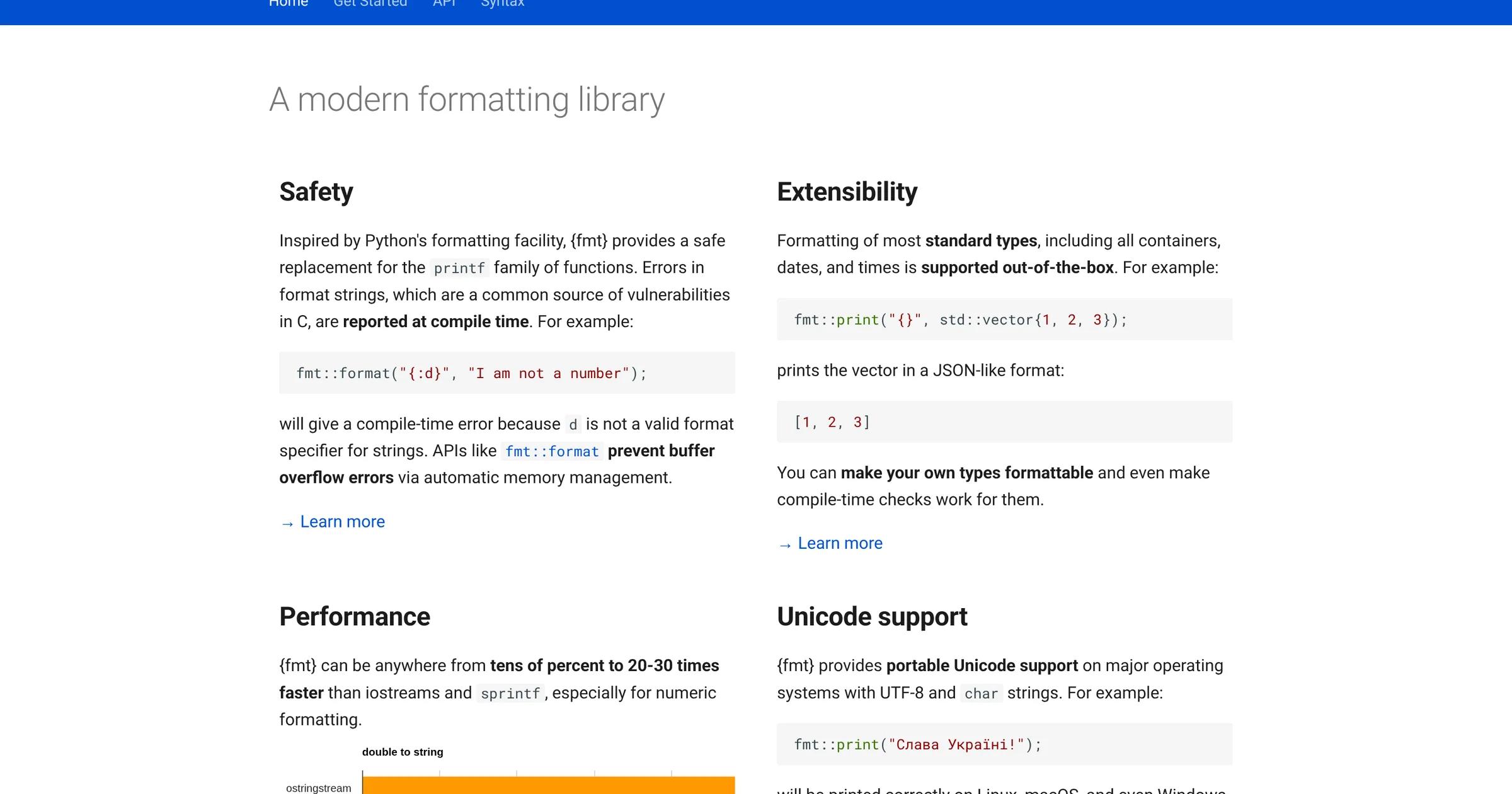
In C++20 mode, format errors are caught at compile time rather than at runtime. Passing `{:d}` (integer format specifier) for a string argument generates a compiler error, preventing the class of runtime crashes that `printf` type mismatches cause. This is enforced by the type system with zero runtime overhead.
In published benchmarks, `fmt::print` runs in 0.44s versus `printf` at 0.66s and Boost.Format at 3.89s for 2 million formatted writes. For floating-point output, fmt is 20-30x faster than `std::ostringstream` and `sprintf`. The Dragonbox algorithm handles IEEE 754 floating-point formatting with correct rounding and shortest-representation guarantees.
The minimum configuration consists of three files: `base.h`, `format.h`, and `format-inl.h`. Enabling the `FMT_HEADER_ONLY` macro switches to a fully header-only deployment with no compiled library required. There are no external dependencies beyond a C++ compiler and standard library.
Optional headers add formatting for `std::chrono` dates and times (`fmt/chrono.h`), STL containers and ranges (`fmt/ranges.h`), colored and styled terminal output (`fmt/color.h`), and high-performance file I/O up to 9x faster than `fprintf` (`fmt/os.h`). Each header is self-contained and included only when needed.
Features
- Python-style format API with positional arguments
- C++20 std::format and C++23 std::print implementation
- Compile-time format string checking
- Benchmarked faster than printf and Boost.Format
- Header-only and dependency-free configuration
- Extension headers for chrono, ranges, and color output
Recommended for this setup
Strengths
- Fastest of all common C++ formatting alternatives: Benchmarked against `printf`, IOStreams, Boost.Format, and Folly Format, fmt is the fastest: 50% faster than `printf`, 9x faster than Boost.Format, and 20-30x faster than `std::ostringstream` for floating-point output. The Dragonbox algorithm provides correct rounding and shortest-representation guarantees without sacrificing throughput.
- Adopted across high-stakes production systems: Used in MongoDB, ClickHouse, MariaDB, PyTorch, Envoy (Lyft), Apple FoundationDB, Salesforce Analytics Cloud, Windows Terminal (Microsoft), spdlog, and Kodi. Continuous fuzz testing via OSS-Fuzz and an OpenSSF Best Practices badge reflect production-grade reliability maintained across more than a decade of active development.
- Small binary footprint and short compile times: With an optimized build, fmt produces a binary of 54 KiB, identical to `printf` and a fraction of Boost.Format's 530 KiB. Compile time for a medium-sized project (100 translation units) is around 5 seconds versus 55 seconds for Boost.Format and 28 seconds for IOStreams. Small footprint matters on embedded and mobile targets.
- MIT license with no external dependencies: The MIT license allows use in commercial and proprietary projects with no copyleft restrictions. There are no external dependencies, so integrating fmt requires no changes to the build system beyond adding the source files or a single CMake target. The library compiles clean at high warning levels (`-Wall -Wextra -pedantic`).
Trade-offs
- C++ only: no bindings for other languages: This is a C++ library. Python, Rust, Go, and other language ecosystems have their own built-in formatting that does not depend on fmt. If your project is polyglot, each language handles formatting independently and fmt provides no benefit outside the C++ layer.
- Compile-time checking requires C++20: Format string validation at compile time is available only in C++20 mode. Projects targeting C++17 or earlier get the runtime API but lose the compile-time error detection that prevents format string mismatches. Upgrading the C++ standard is often constrained by toolchain, platform, or codebase requirements outside a team's immediate control.
Tech stack
FAQ
Not directly, but it is the basis for the `std::format` facility in C++20 and `std::print` in C++23. The C++ committee adopted fmt's design for the standard. You can use fmt today on C++14/17 compilers as a backport of those facilities, then migrate to `std::format` when your toolchain supports it.
Yes. The library is MIT licensed, which allows unrestricted use in commercial, proprietary, and closed-source projects. You must include the license notice in your distribution, but there are no copyleft conditions, no revenue-based terms, and no restrictions on modification or redistribution.
In published benchmarks on macOS with Clang, `fmt::print` runs in 0.44 seconds versus `printf`'s 0.66 seconds for 2 million formatted writes, roughly 50% faster. For floating-point output specifically, fmt is 20-30x faster than `std::ostringstream` and `sprintf`. The Dragonbox algorithm handles IEEE 754 formatting with correct rounding and round-trip guarantees.
Yes, portable Unicode support is a listed core feature. Output is consistent across platforms including Windows terminals with Unicode enabled, as demonstrated by the library's color output examples with multi-language strings (Latin, Cyrillic, and CJK in the same program).
Both provide Python-style formatting syntax for C++ with type safety. The practical differences are substantial: fmt is about 9x faster in runtime benchmarks (0.44s vs 3.89s), compiles 11x faster on a medium project (5s vs 55s), and produces binaries 10x smaller in optimized builds (54 KiB vs 530 KiB). fmt also has zero external dependencies, whereas Boost.Format requires the Boost library set.