
Flue Framework
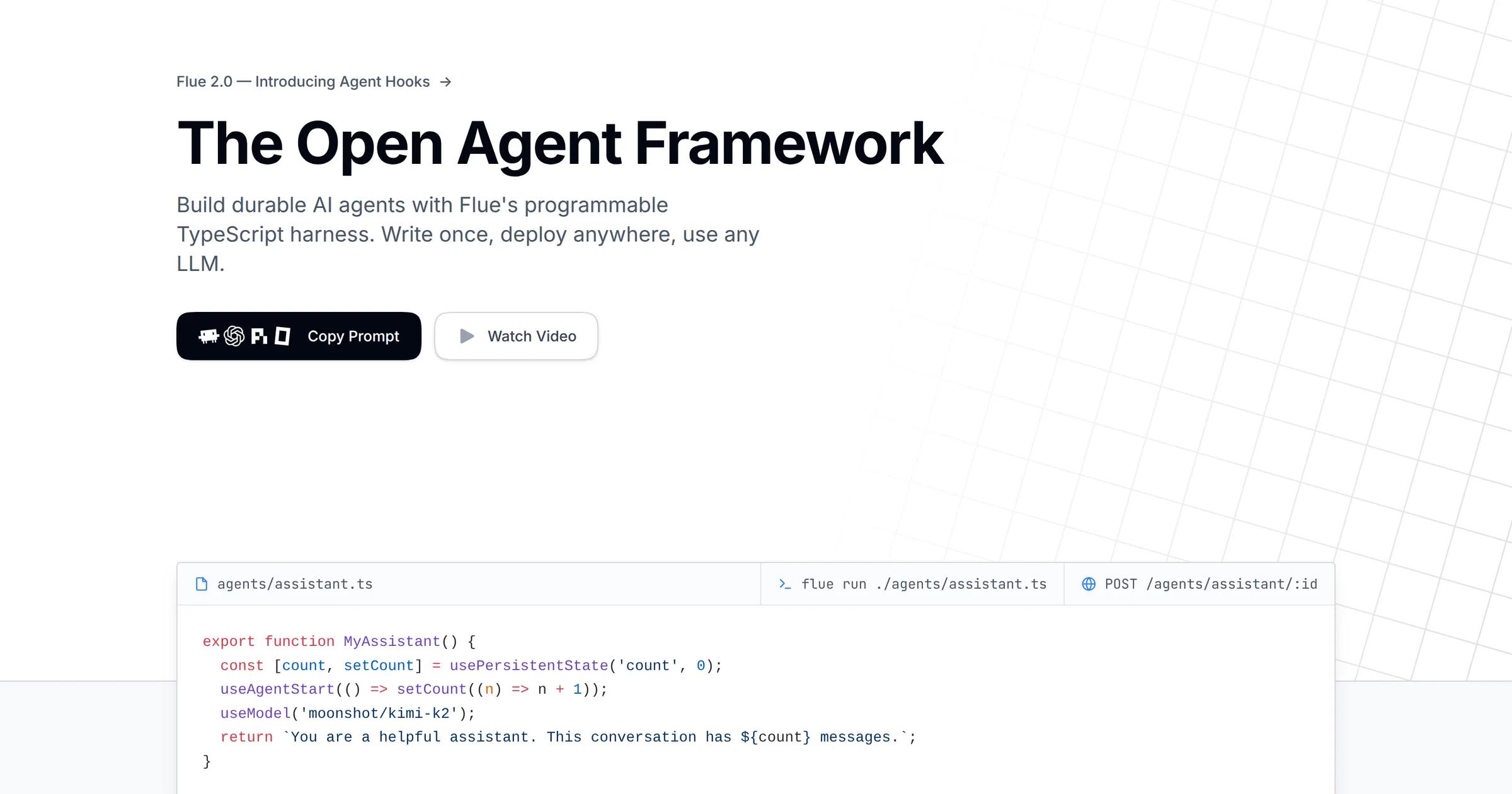
Build powerful, autonomous agents with TypeScript.
Replaces Claude Managed Agents, Devin Ai, Github Copilot, Cursor
Who it's for
Use Flue when an AI agent needs to perform product-specific work such as code execution, workflow automation, or API calls inside controlled boundaries.
You only need a hosted support chatbot or a simple prompt wrapper. A managed chatbot platform will be faster to launch.
Use Flue to move from loose experiments toward a framework with clearer execution structure and deployment expectations.
Your team has already standardized on a mature Python agent framework and does not want a TypeScript runtime.
The problem
AI agent prototypes often start as a prompt, a tool list, and a pile of glue code. That works for demos, but it breaks down when teams need repeatable execution, sandboxing, deployment control, and clear boundaries around what an agent can do. The larger risk is operational trust. If an agent can write files, call APIs, or run jobs, developers need a framework that treats execution as product infrastructure rather than a loose script hidden inside an app.
How it works
Build agents in TypeScript, so application teams can keep agent logic close to their existing Node and web development stack instead of splitting orchestration into a separate Python-only service.
The project positions itself as a sandbox agent framework, which makes it a fit for workflows where model output needs controlled runtime boundaries before it touches user data or production systems.
Flue focuses on packaging agent behavior into a programmable harness that can move beyond local experiments into hosted product workflows.
Features
- TypeScript agent framework
- Sandbox-oriented execution
- Deployable agent harness
Recommended for this setup
Strengths
- Built for product engineers: TypeScript support fits teams already building web apps and backend services in the same language. That reduces context switching when an agent becomes part of a product workflow.
- Apache-2.0 source availability: The GitHub repository reports Apache-2.0 licensing, giving teams a clear path to inspect and adapt the framework before building agent infrastructure around it.
Trade-offs
- Framework adoption work: Flue is not a finished agent product. Teams still need to design prompts, tools, runtime permissions, and deployment patterns before it creates value in production.
Tech stack
FAQ
Flue Framework is used to build AI agents with programmable execution behavior. It is aimed at developers who need more control than a hosted chatbot builder provides.
Flue is designed around TypeScript, so it fits Node and web application teams best. Teams using other runtimes should check whether its deployment model fits their stack.
Flue can replace custom agent harness work for some teams, but it should be evaluated as an agent framework rather than a direct one-for-one replacement for every LangChain workflow.