
Fider
Self-hosted feature voting board for product teams.
Replaces Canny, Uservoice, Featurebase, Nolt, Aha Ideas
Who it's for
Gather feature requests from active users, let the vote count reveal real priorities, and close the loop with status updates as requests move through your roadmap. Fider replaces ad-hoc email collection or a kanban board that only your team can see.
Skip if your roadmap decisions are driven primarily by enterprise client contracts rather than user votes: a feedback board adds limited value when a handful of large accounts set direction.
The Fider website identifies mobile app companies and game developers as target users. A public voting board lets your player or user community feel heard between releases, surfaces which pain points and feature gaps matter most, and reduces support volume from repeated requests.
Skip if you are pre-launch with no user base yet: a feedback board needs an active community to generate meaningful signal.
Internal teams can use Fider to collect and prioritize ideas from staff rather than external users. The same voting and status workflow applies: team members submit ideas, vote, and see status updates as requests are addressed. The board can be kept private.
Skip if you need threaded task assignment or approval workflows alongside feedback collection: Fider is a voting board, not a task manager.
The problem
Product teams receive feedback from multiple directions at once: users email support, comment in app stores, post in community forums, and open support tickets. Without a single place to collect and weigh these ideas, teams end up guessing what to build next. The highest-volume requests get lost in email threads, and quieter but high-value feedback never surfaces at all. The harder problem is prioritization. Any team can collect feedback; figuring out which requests represent a real need for the most users, versus a vocal few, requires visibility across the whole request pool. Spreadsheets and kanban boards can track requests, but they give users no ownership and no way to signal what matters most.
How it works
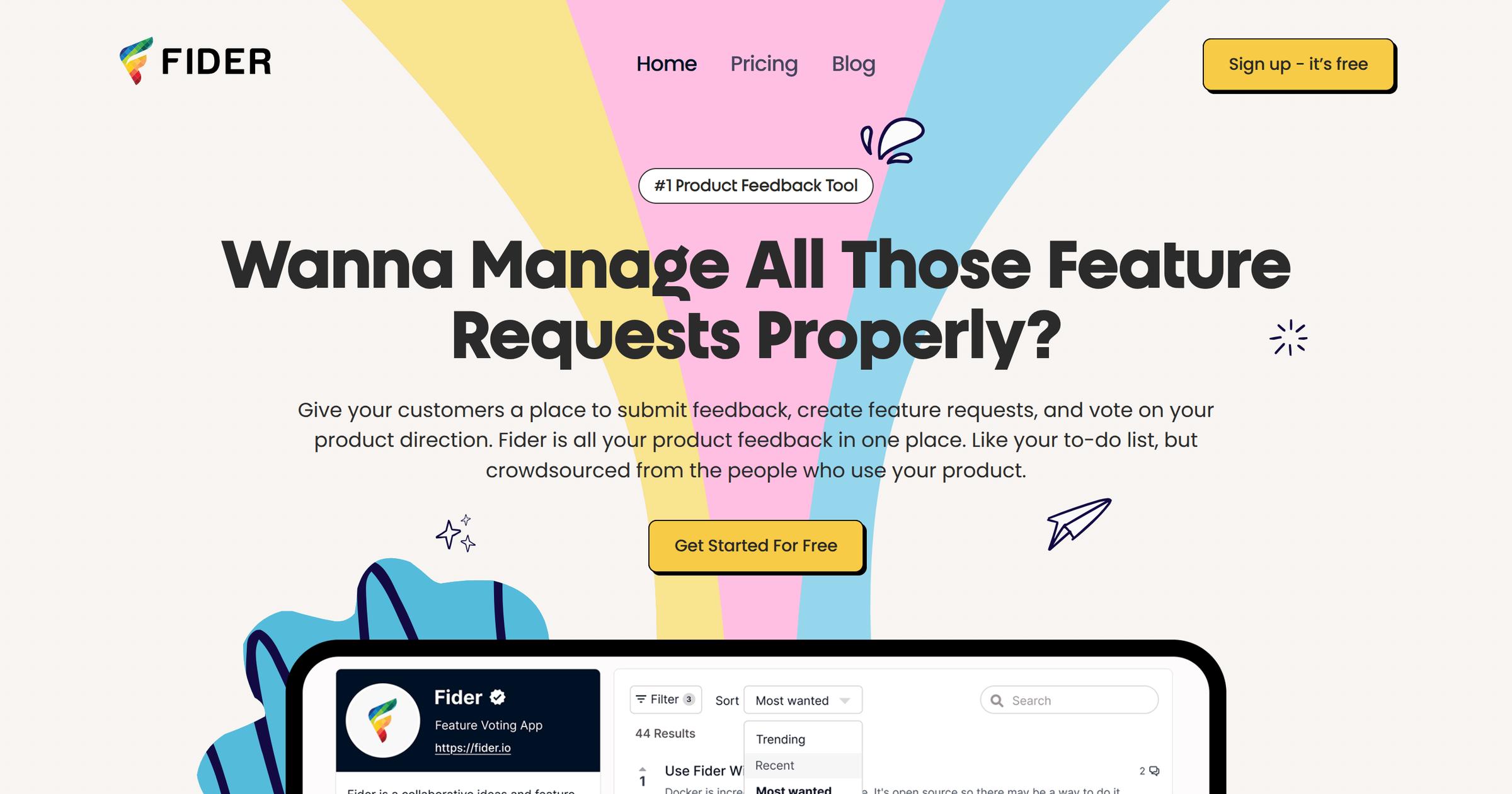
Users submit ideas directly to your Fider board and vote on what matters most to them. The vote count surfaces your highest-priority requests without manual filtering through emails or spreadsheets. Each request gets its own discussion thread where users add context and teams can respond.
Every feature request on the board has its own comment thread, so users can elaborate on their need, ask questions, and follow the conversation. Teams post status updates directly in the thread, and users who voted receive notifications when the status changes.
Mark requests as planned, in progress, complete, or declined. Voters receive a notification when the status changes, closing the feedback loop without any additional manual outreach. This keeps users informed and reduces repeat submissions for the same feature.
Fider ships with multi-language support so your feedback board works for international user bases without a separate localized setup. The official website lists multiple languages as part of the base feature set available to all users.
Teams can run Fider as a managed cloud service maintained by the Fider team, or self-host it on their own servers at no cost. The self-hosted path is documented at docs.fider.io/self-hosted. The managed cloud option removes the need to manage updates and patches.
Features
- Voting board for feature requests
- Per-request discussion threads
- Status updates with voter notifications
- Multi-language interface
- Cloud or self-hosted deployment
Recommended for this setup
Strengths
- Free forever when self-hosted: The self-hosted version of Fider is AGPL-3.0 licensed and costs nothing to run on your own infrastructure. Unlike paid feedback tools with per-seat or per-user pricing, the core voting and feedback functionality has no usage caps on the self-hosted path.
- Active, long-running project: Fider has been in continuous development since January 2017, with 4,600 GitHub stars and 876 forks. The last commit landed on November 4, 2026, indicating active maintenance. With 29 open issues, the backlog is manageable for a project of this size.
- Focused scope: feedback and voting: Fider covers the core feedback collection and prioritization flow without bundling project management, roadmapping, or CRM features you may not need. Teams that want a dedicated tool for this specific job, rather than a module inside a larger product, benefit from that focus.
- Affordable Pro plan for managed hosting: The managed cloud Pro plan adds content moderation and SEO indexing at $25 per month, as documented on the product website. Teams can run the self-hosted free tier indefinitely and upgrade only if the managed service's advanced features become necessary.
Trade-offs
- AGPL-3.0 restricts redistribution as a managed service: AGPL-3.0 permits running Fider for internal use or for your own users at no cost. If you modify Fider and offer it as a hosted service to paying customers, AGPL-3.0 requires you to publish the source of your changes. Teams building a managed feedback product on top of Fider need to review this restriction before proceeding.
- 250-item cap on the free cloud tier: The free managed cloud tier has a fair-use limit of 250 feedback items, as documented on the product website. High-volume boards that exceed this limit need the Pro plan at $25/month or a self-hosted setup.
- No built-in roadmap or project management: Fider handles feedback collection and voting but does not include roadmap views, sprint planning, or task tracking. Teams that want feedback and project management in one tool will need to integrate Fider with a separate system or choose a broader commercial platform.
Tech stack
FAQ
Yes. The self-hosted path is AGPL-3.0 licensed and costs nothing to run on your own servers. You manage your own updates and have no usage limits beyond what your infrastructure supports. The managed cloud service has a free tier capped at 250 feedback items and a Pro tier at $25 per month.
Both collect feature requests and let users vote on priorities. Canny is a proprietary, fully managed service with paid plans. Fider adds a self-hosted, free path under AGPL-3.0, so teams with data ownership requirements or tight budgets have an option Canny does not offer. Canny's strength is its native integrations with project management and changelog tools; Fider's is cost and data control.
For most self-hosting use cases, AGPL-3.0 is permissive: you can run Fider internally or for your own users without restriction and without publishing your source code. The share-alike clause applies only if you distribute or offer a modified version of Fider as a hosted service to external customers. Internal deployments and standard self-hosting are unaffected.
Yes. The official Fider website notes that Fider works for internal teams collecting and organizing ideas from staff. The same voting board and status workflow applies: team members submit ideas, vote, and see status updates as requests are addressed. The board can be set to private to keep it internal.