
bb
Multi-agent IDE coordinating Claude Code, Codex, Cursor, and more.
Replaces Conductor, Factory Ai
Who it's for
A team can dispatch a Sentry triage to Claude Code, a module TypeScript port to Codex, and a release notes draft to Pi, all simultaneously, each in its own worktree thread. bb keeps the working trees separate so the team sees each job's status and output without manually managing branch conflicts.
Skip bb if your team runs one agent at a time and has no need for parallel worktree isolation. Sequential single-agent workflows gain nothing from bb's orchestration layer and add unnecessary setup complexity.
bb's plugin system lets you add integrations with a prompt: a Linear panel, a custom agent skill, or a Slack trigger. The result is a personalized workbench that reflects your actual workflow. Because it is MIT-licensed, you can fork it and ship a custom build to your whole team.
Skip bb if you are satisfied with a single agent and have no interest in building or installing custom plugins. The added complexity of bb's orchestration layer is unnecessary for single-agent, single-task work.
The bb CLI and HTTP API let any external program spawn a thread: a nightly changelog generator triggered by a cron job, a CI bot that opens a triage thread on a test failure, or a Slack command that kicks off a code review. Each thread runs in the bb sidebar so engineers can follow or steer the work.
Skip bb if your automation use case is a one-off or low-frequency script with no need for human oversight. bb's orchestration layer adds infrastructure worth maintaining only when agent work runs regularly.
The problem
AI coding agents are most valuable when they can work in parallel on a codebase, but most setups serialize that work. When two agents edit the same files simultaneously, the results conflict and require manual resolution. Teams end up running agents one at a time, losing the parallelism that makes agent-assisted development faster. The friction comes from coordination overhead. Teams must decide which agent runs next, switch context between threads, and stitch together outputs from separate sessions that did not share a working tree. Some paid orchestration services handle this, but they run agents on remote servers under the vendor's billing model, with no local access to the agent context from your own machine.
How it works
Each agent runs in its own git worktree, so five agents can work in parallel on the same repository without file conflicts. Work runs in threads you can follow live, steer at any point, or hand off to another agent. This is the core architectural choice that makes parallel agent work reliable rather than collision-prone.
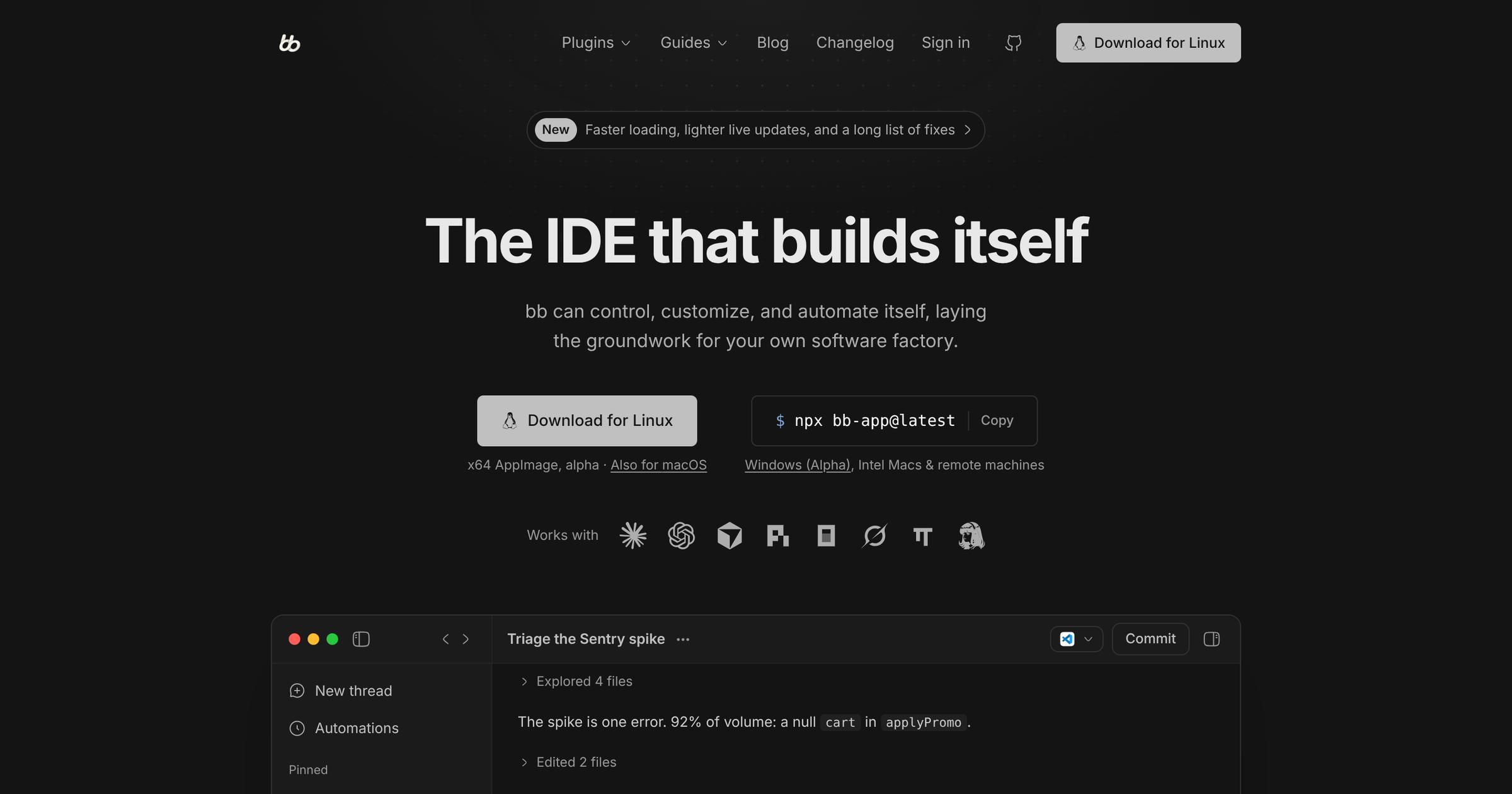
bb supports eight named agent integrations: Claude Code, Codex, Cursor, Pi, OpenCode, Grok, omp, and Hermes. Each runs on your own provider subscription, billed directly by that provider. You can dispatch the same task to different agents, or have one agent spawn and manage another inside bb.
Almost anything in bb can be changed with a single prompt. The GitHub integration, agent memory, scheduled jobs, and remote access are all plugins built with the same extension mechanism available to any bb user. A new Linear panel can be added by describing it: bb builds the plugin, registers the panel and CLI command, and the agents can use it immediately.
The same CLI the agents use is open to any program you write: a shell script, a cron job, or a bot in Telegram, Signal, or Slack. Each can spawn a thread that appears in the bb sidebar. The HTTP API provides the same access over the network, so external systems can trigger and monitor agent work without manual intervention.
bb runs local-first. It uses the provider subscriptions you already pay for, billed by those providers, not bb. There is no per-seat fee from bb itself. The macOS desktop app (Apple Silicon) is the recommended path; a Linux AppImage and Windows installer are in alpha, with npx available on all platforms.
Features
- Git worktree isolation per agent thread
- Support for Claude Code, Codex, Cursor, Pi, OpenCode, Grok, omp, and Hermes
- Plugin system built on the same extension tools users have
- CLI and HTTP API for external automation
- Runs on your machine on existing provider subscriptions
How to install
Install bb via npx on any platform; macOS Apple Silicon users can download the signed desktop app from GitHub Releases: https://github.com/get-bb/bb/releases/latest
npx bb-app@latestRecommended for this setup
Strengths
- MIT license with no bb billing: bb is MIT-licensed end to end. Fork the repo, customize the agents, tools, and UI, and deploy it across your whole organization. You run it on your existing Claude Code, Codex, or Cursor subscriptions; bb itself adds no per-seat or usage fee. Unlike proprietary orchestration services, there is no vendor to negotiate with for custom deployment terms.
- Provider subscriptions stay with the provider: Each agent runs on your own provider subscription and is billed by that provider directly. If you already pay for Claude Code or Codex, bb does not add another billing relationship. This also means you get the full model capabilities from each provider rather than a managed-tier API with usage caps set by a third party.
- Every interface surface is a first-class access point: bb treats the desktop app, web app, CLI, and HTTP API as equal entry points. A shell script, a cron job, or an external bot can spawn a thread the same way the desktop UI can. This means agent work integrates with existing build systems and notification pipelines without special adapters or vendor approval.
Trade-offs
- Early-stage with 642 open issues: bb is in active development, created in February 2026. The core architecture is stable, but the README notes that workflows and surfaces are still evolving. With 642 open issues on GitHub, users should expect incomplete features, API changes, and rough edges in areas outside the core agent dispatch and worktree flow.
- macOS Apple Silicon is the only fully stable desktop target: The signed desktop app runs on macOS Apple Silicon. The Linux AppImage and Windows installer are labeled alpha in the README, with the note to 'expect problems.' Intel Mac users are directed to the npx path instead. Teams running Windows or Linux as their primary development environment should test the npx route and check issue reports before committing bb to production agent workflows.
- Requires pre-authenticated provider CLIs before use: bb uses the provider CLI you already have authenticated. Setting up Claude Code, Codex, or Cursor credentials is a prerequisite before those agents can be dispatched. This is not especially difficult, but bb is not a zero-step install for someone who has never configured any AI coding agent. First-time setup requires working through each provider's own authentication flow.
Tech stack
FAQ
No. bb coordinates those agents rather than replacing them. Claude Code, Codex, Cursor, Pi, OpenCode, Grok, omp, and Hermes all run inside bb, each in their own thread. bb is the orchestration layer; the agents do the actual coding work on your provider subscriptions.
Yes. bb is MIT-licensed and free to run. You need existing subscriptions to the AI coding agents you want to use (Claude Code, Codex, Cursor, etc.), billed by those providers directly. bb itself adds no licensing fee. Download the desktop app from GitHub Releases or install via npx.
The macOS desktop app (Apple Silicon) is fully supported. Linux (x64 AppImage) and Windows (x64 installer) are in alpha as of November 2026, with the README noting to 'expect problems.' Intel Mac users and anyone on a non-Apple-Silicon machine can run bb via npx bb-app@latest on any platform that has Node.js.
bb does not bill for agent usage. Each agent runs on your own provider subscription and is billed by that provider directly. If you use Claude Code, Anthropic bills you. If you use Codex, OpenAI bills you. bb connects them into one orchestration interface without adding its own usage charges.
Yes. bb has a plugin system where almost any integration can be added with a prompt. The website shows an example of building a Linear panel: describe the integration, bb builds the plugin, registers the panel and CLI command, and the agents can use it immediately. The GitHub integration, agent memory, scheduled jobs, and remote access are all built as plugins using the same mechanism.