
Stoat
Self-hosted group chat with servers, voice, and bots.
Replaces Discord, Slack, Microsoft Teams
Who it's for
Stoat replicates the Discord server model: channels, roles, bots, and voice. A project that currently runs its Discord for contributor coordination can migrate to a self-hosted Stoat instance and maintain the same structure, without handing member data to Discord.
Your community has tens of thousands of members and no one to manage a self-hosted backend. The managed stoat.chat service works, but very large communities may hit scaling limits that a small team cannot quickly address.
Teams that cannot use Slack due to data residency requirements, such as those in healthcare, education, or regulated industries, can run Stoat on their own infrastructure. Channels, role permissions, and cross-platform sync cover the core Slack use case at zero per-seat cost.
Your team needs tight integration with the Microsoft 365 suite, calendar invites, or document co-editing from within the chat interface. Stoat covers messaging and voice but not office productivity integrations.
Stoat's public REST API and WebSocket server are the same interfaces used by its official clients. Bot support extends to group DMs. Developers building a custom client or an automated moderation bot have a fully documented API to work against, with no undocumented workarounds required.
Your bots depend on Discord's or Slack's existing app ecosystems and third-party integrations. Stoat's bot ecosystem is smaller; porting complex existing bots requires rewriting them against the Stoat API.
Stoat is free to self-host under AGPL-3.0, with no per-seat fees. For a school club, non-profit organization, or small research team, running Stoat on a modest server avoids both Discord's data handling and commercial per-member billing.
Your organization lacks technical staff to maintain a self-hosted server. The setup complexity and ongoing maintenance of MongoDB, Redis, and other services requires at least one person comfortable with Docker Compose and Linux administration.
The problem
Community chat tools create a dependency that is easy to underestimate until it becomes a problem. Discord's terms of service allow it to scan message content, link user behavior to advertising, and change policies without meaningful recourse for server owners. Slack charges per active member and withholds message history behind paid plans. Microsoft Teams requires a Microsoft account for every member. For teams building on these commercial services, member data, moderation logs, and message history all live on third-party infrastructure with no guaranteed export or continuity. The situation is worse for privacy-sensitive communities: a school, a healthcare team, or a regulated business that runs its internal communication on Discord or Slack is accepting terms those platforms wrote. When pricing changes or a policy update affects your community, your only option is migration under pressure.
How it works
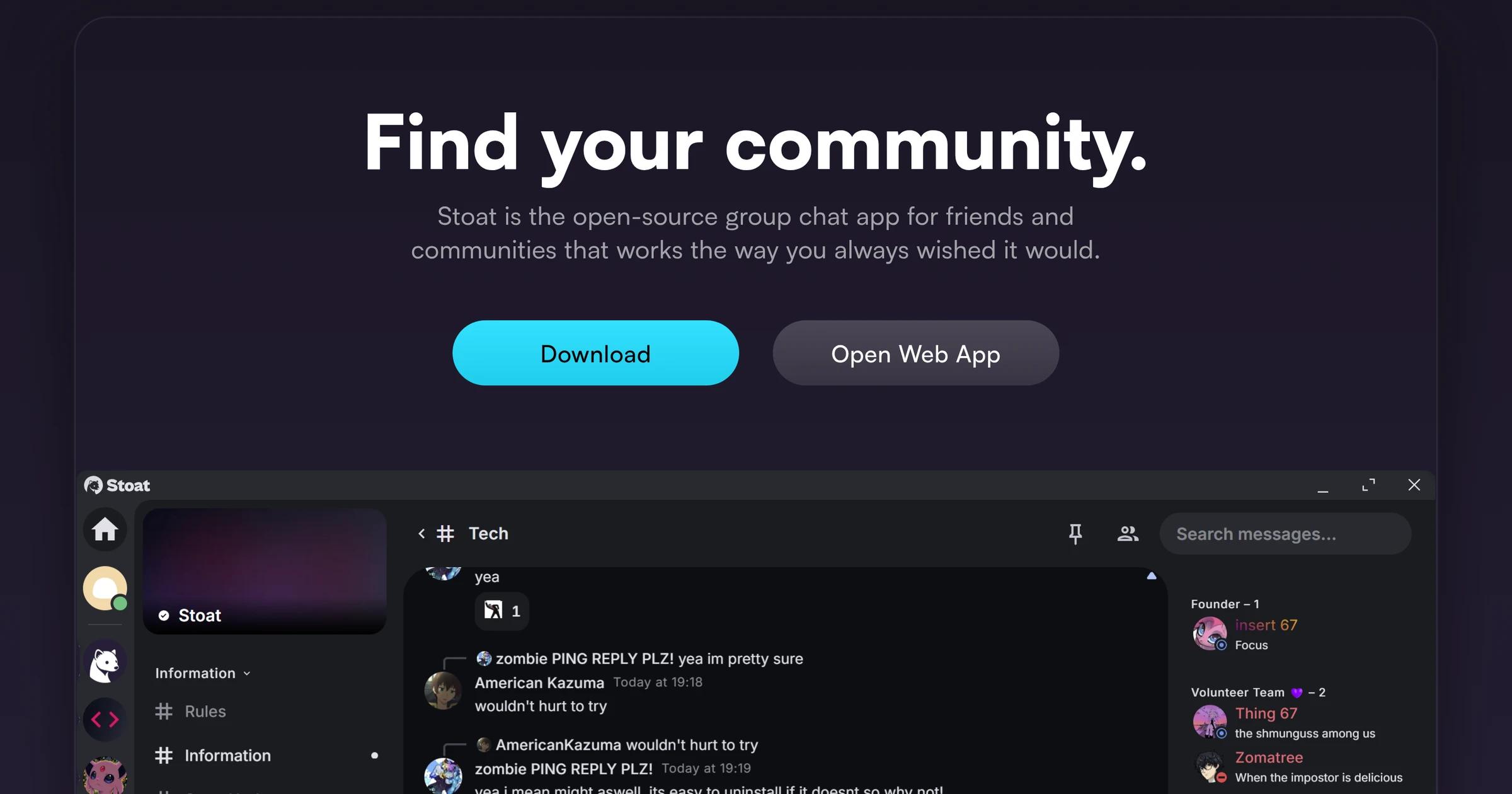
Stoat organizes communication into servers, each with text channels, voice channels, and a role hierarchy. Members join servers, get assigned roles, and see only the channels their permissions allow. The setup mirrors Discord's model closely enough that Discord communities can migrate without retraining members.
Voice channels support real-time audio in any server. Group DMs scale to 50 members, support bots, and work for ad-hoc calls or project collaboration without spinning up a full server. Both features are included at no cost and require no subscription.
Official clients are available for Windows, macOS, Linux, Android, and iOS, plus a web app. All sync the same account, conversations, and settings across devices, covering the full client surface that Discord provides without requiring a third-party account to sign up.
Stoat's REST API and WebSocket events server are the same APIs used by the official clients. Developers can build bots, custom clients, or integrations against a fully documented interface. Bot support extends to group DMs, not just server channels.
Custom emojis, animated avatars, server-specific profile pictures, profile banners, and a 20MB file upload limit are all available without a subscription. Stoat does not gate standard features behind a paid plan the way commercial chat platforms do.
Server owners manage communities through a role-based permissions system and moderation tooling. The same set of tools applies whether a server has ten members or thousands, with consistent role assignment and channel visibility controls at any community size.
Features
- Discord-style servers and channels
- Voice chat and group DMs
- Cross-platform clients
- Public API for bots and custom clients
- No subscription required for core features
- Role-based permissions and moderation tools
How to install
Self-hosting the Stoat backend uses Docker Compose and the mise tool manager to build and run the server.
git clone https://github.com/stoatchat/stoatchat stoat-backend
cd stoat-backend
mise install
mise build
Recommended for this setup
Strengths
- Full feature parity without subscription gating: Features that commercial chat platforms lock behind subscriptions, such as animated avatars, profile banners, custom emojis, and higher file upload limits, are free for all Stoat users. The 20MB upload limit applies without any subscription. For community members used to freemium models, Stoat's flat free tier is a meaningful difference.
- Complete data ownership under AGPL-3.0: AGPL-3.0 permits running the full Stoat backend on your own infrastructure for internal use without licensing fees. No commercial platform can change their terms and affect your deployment. Member data, message history, and moderation logs stay on servers you control.
- Rust backend with low memory overhead: The backend is written in Rust, which delivers low memory overhead and predictable performance under concurrent connection load. This matters for self-hosters running Stoat on modest VPS hardware alongside other services.
- No advertising or data mining: Stoat has no ad network, no behavioral tracking, and no investor board to serve. The website states this explicitly: no ads, no data mining, no partnerships with third parties. For communities that formed specifically to avoid surveillance capitalism, this is the baseline requirement.
Trade-offs
- Self-hosting requires multiple backend services: Running Stoat yourself means operating MongoDB, Redis, MinIO (S3-compatible file storage), and RabbitMQ alongside the Rust backend. The development guide uses Docker Compose via the mise tool manager. This is not a single-command deployment; teams without Docker Compose experience will find the setup non-trivial.
- AGPL-3.0 restricts managed service resale: AGPL-3.0 permits self-hosting for personal, team, or internal organizational use, including internal commercial use. It prohibits offering Stoat as a managed hosting service to others without publishing your modifications under the same license. Teams running it for their own community are unaffected; businesses considering resale as a service need to review the terms.
- 103 open issues and a small core team: The GitHub repository carried 103 open issues as of November 2026. With a smaller team than Discord or Slack, bug triage and feature additions move more slowly. Users accustomed to rapid iteration from commercial platforms may find the cadence slower.
Tech stack
FAQ
Yes. Stoat is AGPL-3.0 licensed and the full backend source is on GitHub. Self-hosting requires running the Rust backend alongside MongoDB, Redis, MinIO, and RabbitMQ. The README documents a development setup using Docker Compose and the mise tool manager. There is no single-command production deployment documented in the official repo; expect to invest time in a proper server configuration.
AGPL-3.0 permits you to run Stoat on your own infrastructure for personal, team, or internal organizational use, including internal commercial use. The restriction applies to distribution: if you modify Stoat and offer it as a hosted service to others, you must publish your modifications under the same AGPL-3.0 license. Running Stoat for your own community or team is unrestricted.
Yes. Stoat is the same platform that used to be called Revolt. The project changed its name in October 2025 after a cease-and-desist over the Revolt trademark, and announced it in a post titled "Here's a big change. Long Live Stoat!".
Yes. Stoat supports voice channels in servers and voice in group DMs. The development setup references LiveKit as the voice infrastructure. Group DMs on Stoat support up to 50 members and include voice, making them suitable for ad-hoc calls and small-team collaboration.
The Stoat backend is written in Rust and requires MongoDB as the primary database, Redis for caching, MinIO (S3-compatible) for file storage, and RabbitMQ for message queuing. The backend is split across multiple services: a REST API server, a WebSocket events server, a file server, and a proxy server. The minimum supported Rust version is 1.86.0.