
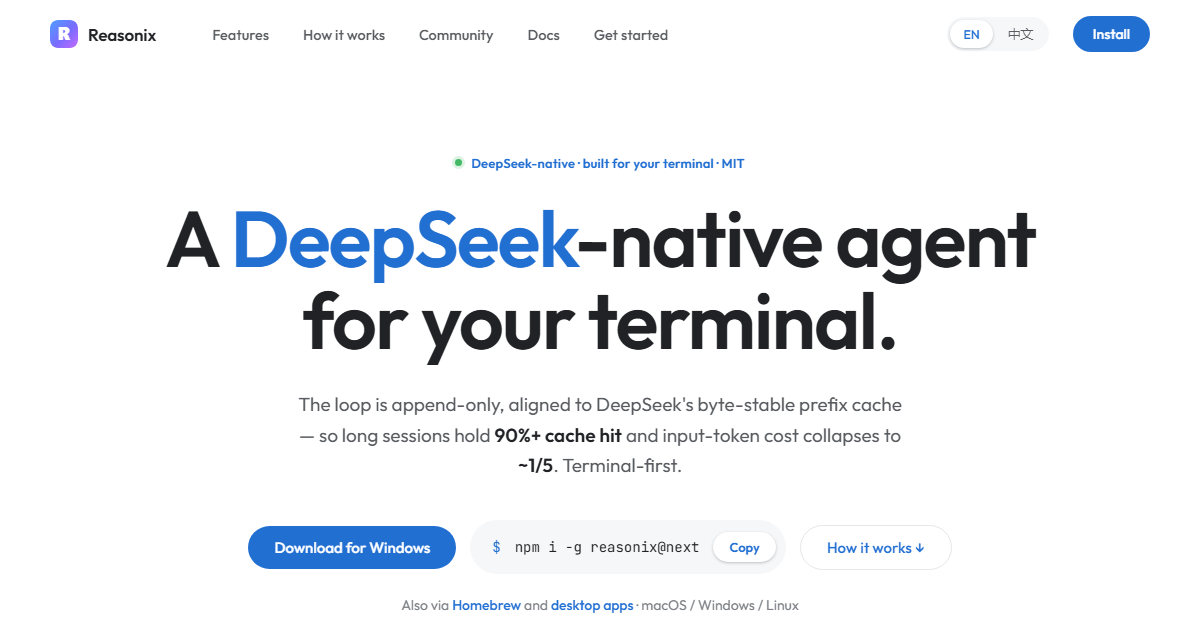
Reasonix
Open-source AI coding agent you can leave running locally.
Replaces Claude Code, Github Copilot, Cursor, Blitzy
Who it's for
A developer who wants an AI assistant to autonomously tackle coding tasks, from adding new features to refactoring existing code, while maintaining full control and auditability over the changes made by the agent.
The developer prefers manual coding exclusively or has a strong distrust of AI for generating or modifying production code.
A team lead or senior developer who needs to efficiently review AI-generated code. Reasonix's per-turn checkpoints and plan mode allow them to understand the agent's thought process, approve changes incrementally, and easily revert unwanted modifications.
The team has strict policies against using AI for code generation or prefers traditional, human-only code review processes.
A developer working with sensitive or proprietary codebases who requires an AI coding agent that runs entirely locally. Reasonix ensures their code never leaves their machine and is only sent to their self-configured model, addressing data privacy concerns.
The developer is comfortable with cloud-based AI coding assistants and their associated data handling and security policies.
A developer or team looking to integrate custom tools, scripts, or specialized subagents into their AI coding workflow. Reasonix's MCP and skills system allows for easy extension and customization of its capabilities to specific project needs.
The user only requires out-of-the-box functionality and has no interest in extending or customizing the AI agent's toolset.
The problem
Developers often struggle with integrating AI coding assistants into their workflow in a way that maintains control, auditability, and privacy, especially for long-running or complex tasks. Existing solutions might lack transparency into the AI's actions, make irreversible changes, or require code to be sent to external cloud services, raising security and data privacy concerns. Reasonix addresses these issues by providing a local, auditable, and highly controllable AI agent that empowers developers to leverage AI for coding without sacrificing oversight or data security.
How it works
Plan mode, granular permissions for tool calls, a workspace sandbox, and per-turn checkpoints ensure that long autonomous runs are always reviewable and reversible, allowing you to undo any turn without touching your commit history.
Interact with the same local Reasonix engine through multiple frontends: a full-screen terminal TUI, a visual desktop application, a local web UI in your browser, or directly within your editor (VS Code/VSCodium) over ACP.
Extend Reasonix's capabilities without forking by merging external tools into a single registry via MCP (Multi-tool Control Protocol) and running Markdown skills or subagents with their own isolated tool sets.
Distributed as a CGO-free Go binary, cross-compiled for macOS, Linux, and Windows (amd64/arm64), requiring no additional runtime installation and offering zero-friction deployment.
The engine runs entirely on your machine, using your own DeepSeek API key. Your code is sent only to the model you configured and nowhere else, ensuring privacy and data security.
Manages context efficiently by injecting a small stable environment summary at startup and pruning stale tool output before summary compaction, helping to keep token costs low across long sessions.
Features
- Auditable Autonomy
- Flexible Access Interfaces
- Extensible with MCP + Skills
- Single Go Binary Distribution
- Local-First & Private
- Cache-Aware Context Maintenance
How to install
npm i -g reasonix
Recommended for this setup
Strengths
- High Auditability and Control: Features like plan mode, granular permissions for reads, writes, and shell commands, a workspace sandbox, and per-turn checkpoints provide developers with full oversight and the ability to undo changes at any point.
- Versatile User Interfaces: A single local engine supports multiple interaction methods including a desktop app, terminal TUI, local browser UI, and editor extensions, catering to diverse developer preferences and workflows.
- Zero-Friction Deployment: Packaged as a single, self-contained Go binary with no runtime dependencies, making installation and cross-platform deployment straightforward across macOS, Linux, and Windows.
- Enhanced Privacy and Security: Operates locally with a 'bring your own key' model, ensuring sensitive code remains on the user's machine and is not sent to third-party services beyond the configured model, adhering to MIT license principles.
- Extensible Architecture: Supports custom tools and subagents via MCP over stdio, SSE, and HTTP, allowing users to expand its capabilities and integrate specialized functionalities without modifying the core codebase.
Trade-offs
- External Model Dependency and Cost: Reasonix requires users to bring their own DeepSeek API key (or other OpenAI-compatible endpoint), meaning there's an external cost and dependency on a third-party LLM service.
- Manual Authentication for Web UI Exposure: While the browser UI runs locally, if users wish to expose it externally via a tunnel or remote port, they must manually configure token or password authentication for security, which is not enabled by default.
- Initial Setup for Editor Integration: The VS Code and VSCodium extensions do not bundle the CLI; they require Reasonix 1.0+ to be installed and configured locally first, adding an extra step to the setup process for editor users.
Tech stack
FAQ
You can install Reasonix via npm (`npm i -g reasonix`), Homebrew (`brew install esengine/reasonix/reasonix` for macOS/Linux), or by downloading the native desktop app installer for macOS, Windows, or Linux from the official website.
Reasonix is DeepSeek-native and tuned for DeepSeek's prefix cache, but it is config-driven and supports any OpenAI-compatible endpoint as a configurable provider, allowing flexibility in model choice.
Yes, Reasonix is open-source under the MIT license and is developed publicly. It ensures privacy by running the engine locally on your machine and requiring you to bring your own API key, so your code only goes to your configured model and nowhere else.
Yes, Reasonix is designed for extensibility. You can extend it without forking by using MCP (Multi-tool Control Protocol) to merge external tools into its registry and by creating Markdown skills and subagents with their own isolated tool sets.
Reasonix provides several features for reviewability: a plan mode that requires approval before writing, granular permissions for each tool call, a workspace sandbox to limit command scope, and per-turn checkpoints that allow you to revert to any previous state without affecting your Git history.