
Pixelle-Video
Create videos in minutes with AI automation
Replaces Invideo Ai, Runwayml
Who it's for
Pixelle-Video gives researchers a complete topic-to-video workflow to inspect and modify. It fits experiments around automated ads, tutorials, product clips, and social video generation.
Use RunwayML or a hosted editor if your team needs reliable production output with minimal setup.
Agencies can use the project as a starting point for controlled internal workflows where prompts, model choices, and intermediate assets stay under their own process.
Skip it if non-technical creators need a polished timeline editor, brand controls, and support.
The problem
Short-form AI video production usually combines many small tasks: writing a script, generating visuals, creating narration, choosing music, and composing the final edit. Managed tools hide those steps, which is convenient until a creator needs to adjust prompts, swap models, or run the workflow privately.\u000A\u000ATeams experimenting with AI video also face cost and reproducibility issues. If every generation runs through a hosted product, it becomes harder to inspect the pipeline, tune individual stages, or keep drafts inside a controlled environment.
How it works
Pixelle-Video coordinates script generation, visual generation, narration, music, and composition from one topic prompt. That makes it useful for testing end-to-end short-video workflows instead of isolated model demos.
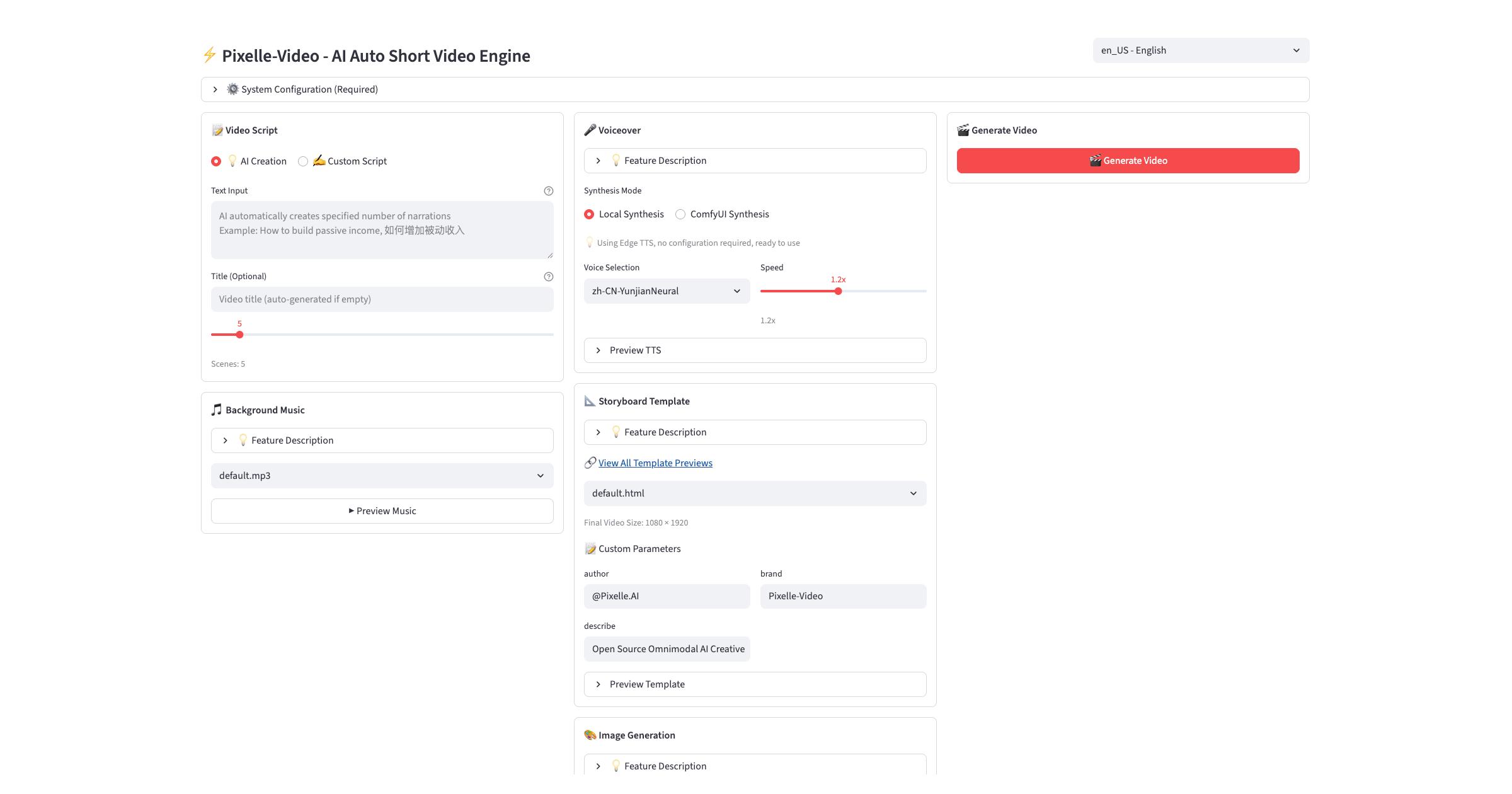
The project exposes workflow controls through a Streamlit app. Creators and developers can run the pipeline locally while still using a browser-based interface.
Because the project is available under Apache-2.0, teams can inspect and modify the separate script, image, audio, and rendering steps. That matters when the default creative flow is not enough.
Features
- Topic-to-video pipeline
- Streamlit control interface
- Composable generation stages
Recommended for this setup
Strengths
- Open video workflow for experimentation: Pixelle-Video is better suited to pipeline research than closed AI video products. Developers can study how each stage works and adapt pieces for their own creative automation.
- Permissive license for adaptation: Apache-2.0 licensing gives teams room to modify and use the code commercially under standard notice terms. That is useful for agencies and AI labs building internal video-generation workflows.
Trade-offs
- Research workflow, not polished editor: Pixelle-Video is not a full replacement for a commercial video editor or a polished hosted AI video suite. Teams should expect setup, model dependencies, and output tuning.
- Documentation has language and maturity limits: The official site and repository include Chinese-language materials and a fast-moving AI workflow. English-only teams may need extra setup time to validate dependencies and customize prompts.
Tech stack
FAQ
Pixelle-Video generates a short-video workflow from a topic, including script content, scene visuals, narration, music, and final composition. It is designed as an automated pipeline rather than a manual editor.
Yes. The GitHub repository reports Apache-2.0 licensing. Teams should still review dependencies and model terms because AI generation workflows often rely on external models or services.
Pixelle-Video can replace RunwayML for teams experimenting with self-hosted AI video pipelines and source-level customization. RunwayML remains stronger for polished hosted generation, creative UI, and production support.