
PatchMon
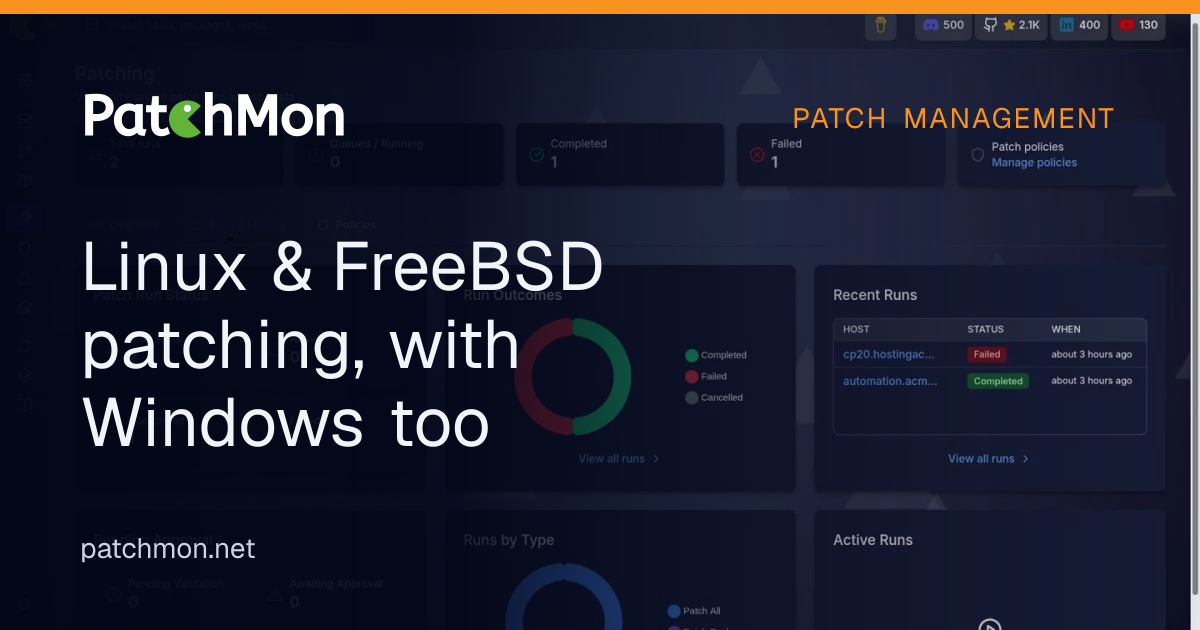
Patch management for Linux, FreeBSD, and Windows
Replaces Automox, Ninjaone, Action1, Manageengine Patch Manager Plus
Who it's for
Teams running Ubuntu, RHEL, Debian, Arch, Alpine, and FreeBSD alongside each other can see all pending updates in one queue and apply patch policies without maintaining separate Ansible playbooks per distro.
Your fleet is entirely Windows-native or managed through an existing enterprise patch tool like WSUS or SCCM.
The approval workflow, full audit trail, and scheduled OpenSCAP CIS benchmark reports provide the evidence layer auditors ask for — approver identity, packages changed, and compliance scores over time — without manual spreadsheet assembly.
Your compliance framework requires a commercial vendor with formal certifications the open source project does not carry.
The Community Edition is free under AGPLv3 and deployable via Docker Compose or a one-command Proxmox LXC script. Proxmox auto-enrolment and getHomepage integration fit the typical self-hosted stack.
Your homelab server cannot meet the 2 vCPU, 2 GB RAM minimum for the control plane.
PatchMon directly targets teams currently SSH-ing into hosts one by one to run package updates. The one-line agent install command, centralized pending-update view, and scheduled patching replace that manual workflow without requiring Ansible expertise.
Your team already has a mature Ansible or Puppet-based patching pipeline and primarily needs a reporting layer rather than a replacement.
The problem
Operations teams managing Linux fleets typically piece together SSH loops, Ansible playbooks, and spreadsheets to track what is patched and what is not. There is no single view of pending updates across distros, no approval gate before production changes, and no audit trail when a compliance review asks for evidence of who patched what and when.
How it works
Preview the exact package transaction on a target host before anything touches production. The full plan is captured per host so the approver can see what would change before authorising the run.
Require sign-off before production patches execute. Every run is logged with the approver, targeted hosts, packages changed, exit code, duration, and outcome — exportable for SOC 2, ISO 27001, or internal review.
APT, DNF, YUM, APK, Pacman, zypper, FreeBSD pkg, and Windows Update are all surfaced in a single pending-updates queue. Patch policies support immediate, delayed, or fixed maintenance windows.
Run CIS benchmark scans against servers and Docker Bench assessments against container hosts on a schedule. Compliance scores are tracked over time with rule-level results and remediation steps for each failure.
Open a terminal or RDP session for any host directly from the dashboard. Connections route through the agent's outbound link so neither SSH nor RDP needs to be broadly exposed on managed hosts.
The Go agent initiates all traffic to the PatchMon server over HTTPS and WSS. No inbound ports are required on monitored hosts, no VPN, and no SSH or WinRM exposure.
Features
- Dry-run validation before every patch
- Approval workflows with audit trail
- Seven package managers in one view
- OpenSCAP and Docker Bench compliance scanning
- Browser-based SSH and RDP with no exposed ports
- Outbound-only agents
How to install
mkdir patchmon && cd patchmon bash -c "$(curl -fsSL https://raw.githubusercontent.com/PatchMon/PatchMon/refs/heads/main/docker/setup-env.sh)" docker compose up -d
Recommended for this setup
Strengths
- Single binary, no external Node runtime: The PatchMon server is one Go binary with the React frontend embedded. Docker Compose deployment needs one container and PostgreSQL plus Redis — no separate Node process at runtime.
- Same codebase for Cloud and self-hosted: The Community Edition and PatchMon Cloud run identical code. Teams can self-host under AGPLv3 and audit every line, or hand infrastructure management to PatchMon Cloud with UK, EU, and US data residency options.
- Live patch streaming over WebSocket: Agent stdout and stderr stream to the browser in real time during a patch run. A run can be stopped mid-flight from the dashboard.
- Proxmox LXC auto-enrolment and 34+ integrations: Proxmox LXC containers can be auto-enrolled, and the platform integrates with Ansible inventory, getHomepage widgets, Slack, Discord, ntfy, webhooks, and a full REST API with Swagger docs at /api-docs.
Trade-offs
- Minimum server requires 2 vCPU, 2 GB RAM, 15 GB disk: Self-hosting the control plane carries a fixed infrastructure cost. Very small homelab setups running on a single low-memory device may find the resource floor a constraint.
- PostgreSQL and Redis are required dependencies: The self-hosted stack requires PostgreSQL 17 and Redis 7 (via Asynq). There is no embedded or SQLite mode for minimal deployments.
- Windows support is agent-only, not agentless: Windows hosts require the PatchMon agent installed. Unlike some enterprise patch tools that use WinRM or GPO-based deployment, PatchMon's Windows support depends on the agent binary being present on each host.
Tech stack
FAQ
Both run the same codebase. The Community Edition is free under AGPLv3 and self-hosted on your own infrastructure via Docker Compose or Proxmox LXC. PatchMon Cloud is a managed, isolated instance per customer with backups and uptime managed by the PatchMon team, priced at $1 (Starter), $2 (Plus), or $3 (Max) per host per month, with a 14-day free trial.
No. PatchMon agents initiate all traffic outbound to the PatchMon server over HTTPS and WebSocket over TLS. No inbound ports need to be opened on monitored hosts, and no VPN is required.
Linux distributions using APT, DNF, YUM, APK, Pacman, and zypper are supported, along with FreeBSD (pkg) and Windows (Windows Update). Agent binaries are available for amd64, arm64, arm, and i386 on Linux and FreeBSD, and amd64 and arm64 on Windows.
PatchMon runs OpenSCAP CIS benchmark scans against server hosts and Docker Bench for Security assessments against container hosts. Results include rule-level pass/fail status, severity levels, and remediation guidance, with compliance scores tracked over time.
The PatchMon server requires at least 2 vCPU, 2 GB RAM, and 15 GB disk. The self-hosted stack uses PostgreSQL 17 and Redis 7, both included in the official Docker Compose setup.