
Omnara
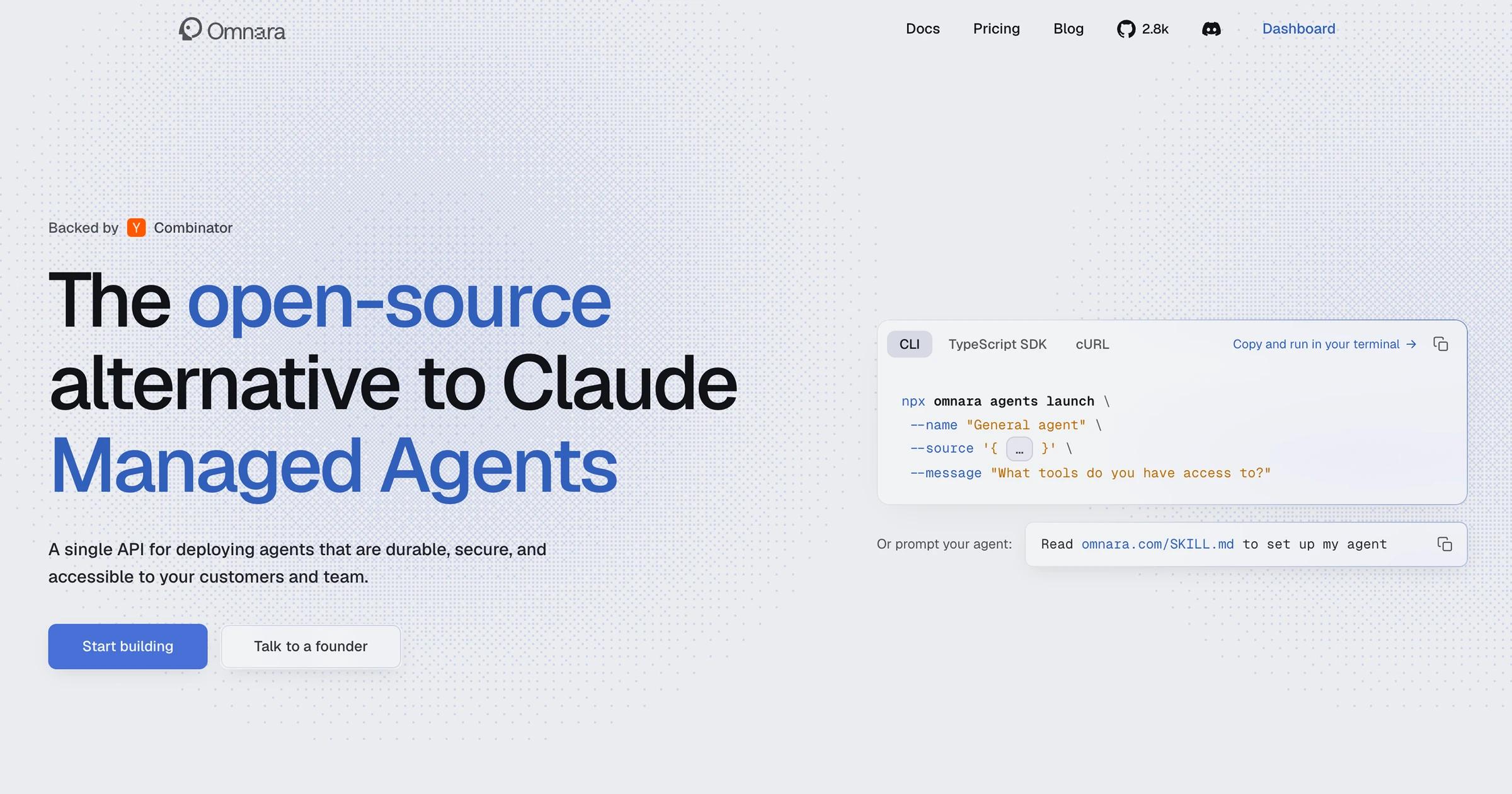
Open-source agent deployment API. Self-host or use Omnara Cloud.
Replaces Claude Managed Agents
Who it's for
Ship a product where your customers interact with AI agents directly. Access controls, audit trails, and durable execution ensure agents survive failures mid-session and customers see only their own data.
You only need internal tooling with no customer-facing agent interface.
Deploy agents that teams interact with through the Omnara dashboard or Slack connector. Per-project permissions let different teams see only their own agents and secrets.
You have no need for team-level agent collaboration or Slack integration.
Run agents for recurring tasks like code review, data processing, or report generation. Agent state persists through failures and machine restarts, so a long job finishes even after an outage.
Your use case involves only short, synchronous agent calls where durability is not a concern.
The problem
Building production-grade agent infrastructure from scratch takes months. You need durable execution so agents survive crashes and disconnects, a way to manage long-running jobs, access controls for teams and customers, and an audit trail for risky tool calls. Anthropic's Claude Managed Agents offers a managed solution, but it ties you to their infrastructure and proprietary platform. Organizations with data residency requirements, teams that need to run agents on their own machines, or developers who want to avoid vendor lock-in need a self-hostable alternative that delivers the same infrastructure primitives without the closed-platform constraints.
How it works
Agent state is committed atomically to PostgreSQL. When an agent crashes, disconnects, or the machine restarts, it picks up exactly where it left off. No lost progress, no manual recovery required.
Run agents on OpenAI, Anthropic, OpenRouter, LiteLLM, or any self-hosted endpoint compatible with OpenAI or Anthropic APIs. Bring your own API keys and switch providers without changing your agent code.
Use managed sandboxes from Blaxel, Daytona, Modal, or Unikraft, or connect your own laptops or VMs. An agent can run with no sandbox or use several at once, and you can add or remove machines while the agent is running.
Organizations and projects get role-based access management, encrypted scoped secrets, and human approval gates for risky tool calls. An append-only audit trail records every agent action for compliance and debugging.
Launch, steer, and observe agents through a REST API, TypeScript SDK, or CLI from one control plane. Your application controls who can use each agent, what input it receives, and how its output reaches users.
Connect HTTP MCP servers to extend agents with external tools and data sources. A first-party Slack connector lets teams launch and interact with agents directly from Slack without leaving their workflow.
Features
- Durable Agents
- Bring Any Model
- Computer-Use Sandboxes
- Access Controls and Audit Trail
- Agent-Ready APIs
- MCP Servers and Slack
How to install
Install and launch an agent with the Omnara CLI:
npx omnara login
npx omnara profiles create --name agent --file agent.yaml
Self-host with Docker Compose:
git clone https://github.com/omnara-ai/omnara.git
cd omnara
docker compose -f compose.yaml --profile app up -d
Recommended for this setup
Strengths
- Self-Hosted or Cloud: Run Omnara in your own VPC for full data control and compliance, or use Omnara Cloud for a managed experience. Self-hosted deployments can query agent history directly in PostgreSQL for analytics, evals, and training data.
- Open-Source (Apache 2.0): The full platform source is on GitHub under Apache 2.0. You can inspect, fork, or extend the platform without depending on Omnara's commercial continuity.
- Model-Agnostic with Your Own Keys: Bring your own API keys and run any model through a compatible endpoint. OpenAI, Anthropic, OpenRouter, LiteLLM, Ollama, and self-hosted models all work through the same platform.
- Access Controls Built In: RBAC, encrypted scoped secrets, human approval gates for risky tool calls, and an append-only audit trail are first-class primitives, not add-ons.
Trade-offs
- Early-Stage Platform: Omnara is a young project. APIs and platform behaviors are still evolving, and the ecosystem of integrations is smaller than established managed platforms.
- Self-Hosting Responsibility: Choosing the self-hosted path means you own the maintenance, updates, and uptime. Docker Compose is the supported setup; production infrastructure management is on your team.
- Smaller Community Than Closed Alternatives: Claude Managed Agents has Anthropic's engineering and support behind it. Omnara's community and documentation are growing but not yet at the same depth.
Tech stack
FAQ
Yes. Omnara is Apache 2.0 licensed. The full platform source is on GitHub at github.com/omnara-ai/omnara, including the server, CLI, and TypeScript SDK.
Claude Managed Agents is Anthropic's closed, managed platform for running long-running agents on their infrastructure. Omnara is the open-source alternative: self-hostable in your own VPC, model-agnostic, and Apache 2.0. Both offer durable sessions, sandboxes, access controls, and a session API. Omnara adds model flexibility and the option to run the whole stack yourself.
Any model through a compatible endpoint. Omnara supports OpenAI Responses, OpenAI Chat Completions, and Anthropic Messages APIs, which covers OpenAI, Anthropic, OpenRouter, LiteLLM, Ollama, and most self-hosted models.
Yes. Omnara self-hosts via Docker Compose. Self-hosted deployments can query agent history directly in PostgreSQL for analytics, evals, and training data. Use Omnara Cloud if you prefer a fully managed setup.
The software is Apache 2.0, so self-hosting is free. Omnara Cloud pricing had not been published as of this listing. You bring your own model API keys either way.