
modly
Generate 3D models from images or prompts, entirely offline
Replaces Meshy, Tripo Ai
Who it's for
Convert reference photos directly to GLB or OBJ meshes for Blender or Unity without a cloud service or credit budget. Generate variations freely, organize results in collections, and export to whichever format the downstream pipeline needs.
Your studio already has a cost-effective cloud pipeline with acceptable image privacy. The local GPU setup overhead may not be worth switching if a working managed workflow already covers your volume.
The Python CLI exposes health, model listing, workflow execution, and single-image-to-GLB generation as structured JSON commands. An agent or script can drive Modly headlessly on a local workstation, making it a local inference node in a broader AI generation system.
You need horizontal scale across multiple machines or cloud bursting. Modly runs on one local GPU and is not designed for distributed inference.
For prototyping physical products from in-progress photos, Modly keeps every image on your machine. No file reaches a third-party server. This matters when working under NDA, with pre-release product designs, or with images subject to data residency requirements.
Image confidentiality is not a concern and you prefer lower setup friction. If privacy is not a constraint, Meshy or Tripo AI offer faster onboarding with no local GPU needed.
Because Modly is free to run after setup, students and educators can experiment with multiple AI model extensions at any generation volume without accumulating service costs. Installing different extensions and comparing outputs on the same input is a concrete way to study model behavior.
Your course environment uses machines without a compatible NVIDIA GPU. Modly has no CPU inference path, so it cannot run on most cloud-based lab environments or older hardware.
The problem
Cloud-based 3D generation services price by the credit. A moderate generation volume adds up to a real monthly bill, and every input image reaches a third-party server. Queue times slow iteration, and any pricing or service change from the vendor disrupts your pipeline. For creators generating 3D assets regularly, the credit model creates a practical ceiling on experimentation. Each test generation carries a cost, which shapes workflow decisions around conservation rather than exploration.
How it works
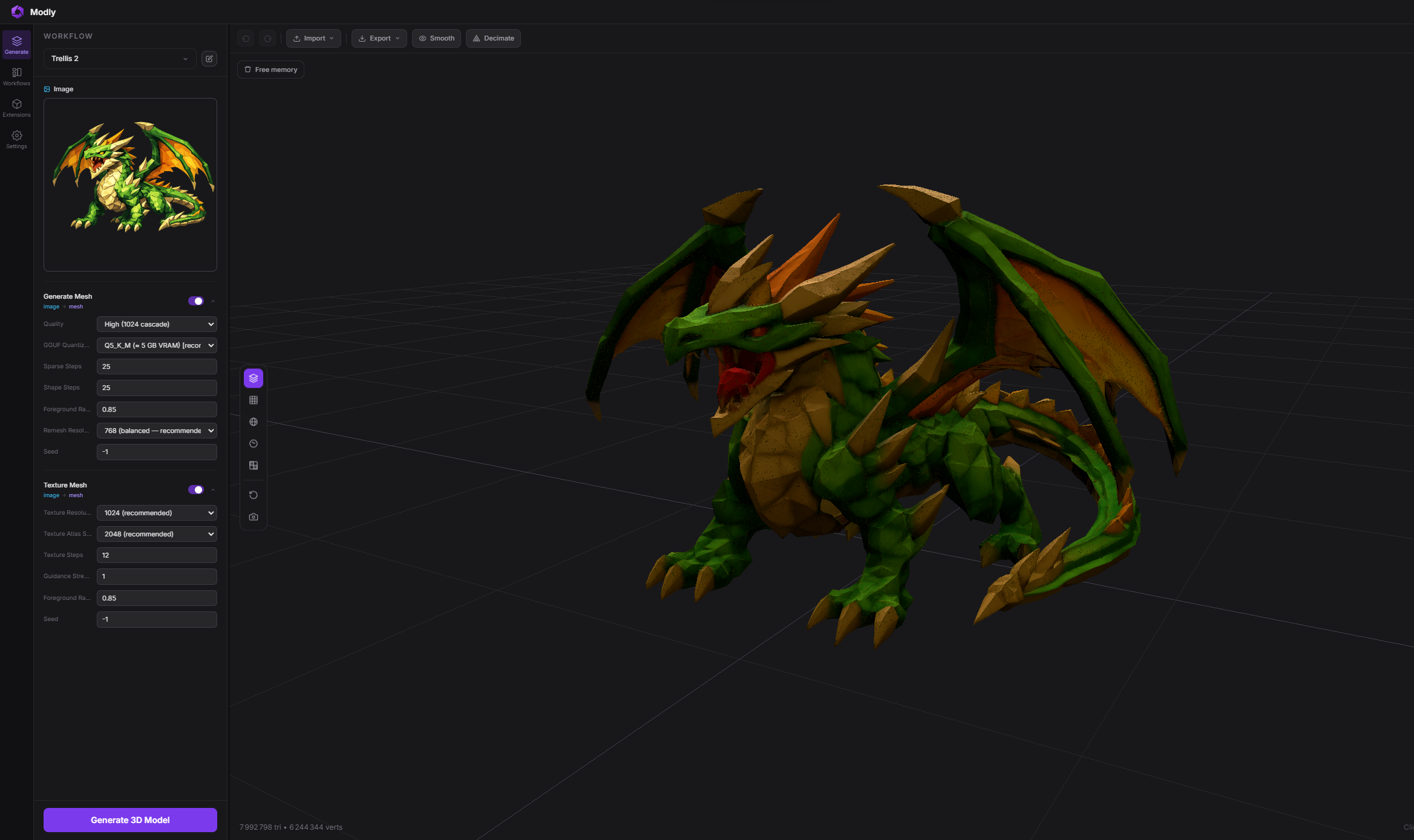
All AI model inference runs on your NVIDIA GPU. No network call is made during generation: your images and prompts never leave your machine. A typical workflow from image to textured mesh completes entirely offline, regardless of internet connectivity.
Each extension is a GitHub repository bundling an AI model and its runtime files. Official extensions include Hunyuan3D 2 Mini (balanced), Mini Turbo, Mini Fast, TripoSG, and Trellis2 GGUF. Install any extension by entering its repository URL in the app; model weights download separately on first use.
Generated meshes export as GLB, OBJ, STL, or PLY from within the app. GLB is optimized for real-time engines like Unity and Unreal Engine. STL is the standard for 3D printing. OBJ and PLY cover broader compatibility with DCC tools like Blender.
All generated models are organized into labeled collections. The workspace keeps every mesh accessible for re-opening, previewing, and re-exporting without regenerating. Generated meshes can also be smoothed and decimated in-app, with optimized results saved back to the workspace.
The bundled CLI (tools/modly-cli/agent.py) lets scripts and AI agents drive a running Modly instance without touching the UI. Canonical commands cover health checks, model listing, workflow execution, and single-image-to-GLB generation with structured JSON output on stdout.
Ships as a packaged installer for Windows (.exe), Linux (AppImage/.deb), and Apple Silicon macOS (.dmg). The app can also run from source after cloning. macOS uses native window controls; a live RAM indicator in the top bar monitors GPU memory during generation.
Features
- Local GPU inference with no cloud dependency
- Extension system for swappable AI models
- Four 3D export formats
- Collections and workspace organization
- Python CLI for scripted and agent-driven generation
- Cross-platform desktop installer
How to install
Install Modly from source using Node.js after cloning the repository.
git clone https://github.com/lightningpixel/modly
cd modly
npm install
npm run dev
Recommended for this setup
Strengths
- Unlimited generations at zero marginal cost: After installing the app and one model extension, every generation is free. Unlike Meshy or Tripo AI where each mesh costs credits from a subscription plan, the only ongoing cost is your GPU's electricity. High-volume workflows become practical without any budget management.
- Images never leave your machine: All inference runs locally on your NVIDIA GPU. Nothing is uploaded during a generation run. For workflows handling client images, unreleased product designs, or data subject to residency rules, this is a structural guarantee built into the architecture.
- Model flexibility via the extension system: The extension system decouples the app from any single AI model. When a better open source model is released, an extension can wrap it and be installed in one click. You keep pace with the state of the art without waiting for a cloud provider to update its backend.
- Active development with strong community traction: The repository reached over 7,500 GitHub stars and 714 forks within six months of its March 2026 launch. Regular extension releases, a public v0.5 roadmap covering AI mesh editing and a plugin editor, and an active Discord community indicate sustained development momentum.
Trade-offs
- NVIDIA GPU required; no CPU or AMD/Intel GPU support: All current model extensions target NVIDIA hardware. The app does not run inference on CPU or on AMD and Intel GPUs. macOS support is limited to Apple Silicon. Machines without a compatible NVIDIA GPU cannot generate any meshes, which rules out most cloud-based development environments.
- MIT license with attribution requirement for forks: Self-hosting, modification, distribution, and commercial use are all permitted. The license adds one condition specific to forks: any application derived from Modly must credit the original project and its creator in the UI or documentation. Using the app itself and its generated meshes commercially carries no such restriction.
- macOS limited to Apple Silicon hardware: The official macOS build targets Apple Silicon only. Intel Mac users cannot run the .dmg installer. The README documents this explicitly. Linux AppImage and Windows .exe cover Intel-architecture hardware, so Intel Mac developers need a separate machine or a Linux environment to run Modly.
Tech stack
FAQ
No. All generation runs on your local NVIDIA GPU. Once you have installed an extension and downloaded its model weights, Modly works entirely offline. Input images and prompts are never sent to any server during a generation run.
Modly requires an NVIDIA GPU. The minimum VRAM depends on the model extension: lighter options like Hunyuan3D Mini Fast are optimized for lower-end hardware, while TripoSG and Trellis2 GGUF perform better with more VRAM. AMD GPUs, Intel integrated graphics, and CPU-only machines are not currently supported.
Modly uses an MIT license with one additional condition: if you fork the project and build a new application from it, you must credit the original project and its creator in your app's UI or documentation. Running Modly as-is, modifying it for private use, using it commercially, and using the generated 3D meshes in commercial work are all permitted without restriction.
Modly exports GLB, OBJ, STL, and PLY. GLB is suited for real-time 3D engines like Unity and Unreal Engine. STL is the standard format for 3D printing. OBJ and PLY cover broader compatibility with DCC tools like Blender.
Yes. The license permits commercial use of the app and of the 3D models it generates without restriction. The attribution requirement applies only when you fork the source code to build a derivative application, not to commercial use of the output files.