
List-of-OpenSource-Programs
Curated list of open source internships with stipends and timelines.
Replaces —
Who it's for
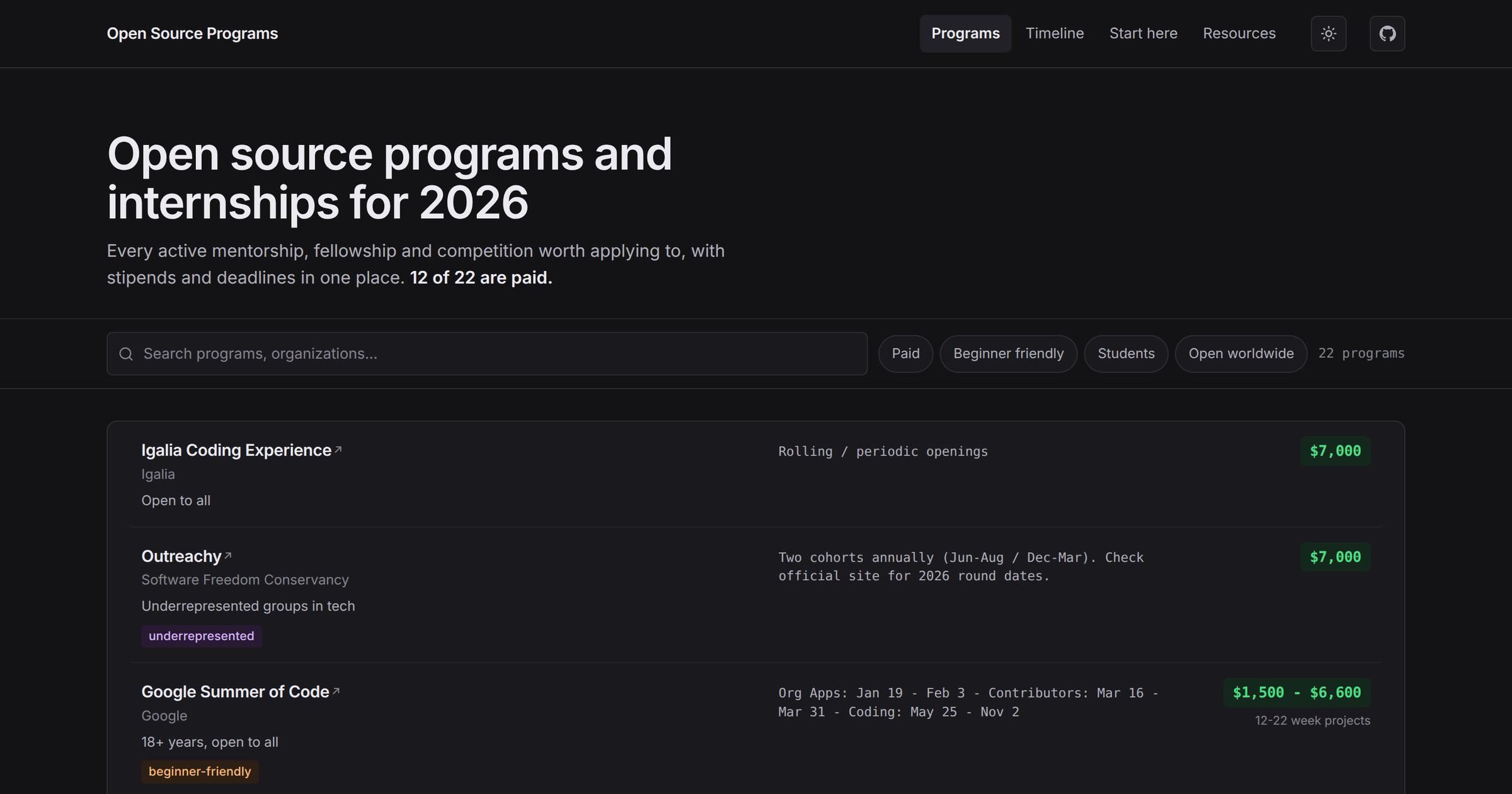
The paid filter and stipend-per-program view help students compare 12 funded options in one pass: GSoC, Outreachy, LFX, Igalia, Summer of Bitcoin, MLH Fellowship, and others. The 2026 timeline shows which programs overlap and which require sequential applications, so a student can plan a multi-program application strategy without visiting each program site first.
If you are looking for traditional corporate internships with employer-driven selection and HR recruiting pipelines, a general job board serves that better. This directory lists only open source contribution and mentorship programs.
The beginner-friendly filter surfaces programs specifically designed for contributors new to open source: LFX Mentorship, Season of KDE, Djangonaut Space, and Hacktoberfest. Each card lists whether the program is beginner-friendly, so a first-time contributor can narrow the full list to their readiness level in one filter click.
If you already have significant open source contribution history, the beginner-focused programs may not add career value. Advanced contributors targeting GSoC or Outreachy can apply directly without filtering to beginner programs first.
Outreachy, one of the highest-paying programs listed at $7,000 and running two cohorts annually, specifically requires applicants from groups underrepresented in technology. The directory surfaces this upfront with eligibility notes, so contributors from these groups can find the programs most likely to accept them without scanning a dozen separate sites.
If you do not meet Outreachy's eligibility requirements for underrepresented groups, Outreachy will not be an option, but most other listed programs are open to all contributors regardless of background.
The problem
Students and early-career developers looking to contribute to open source for pay or career development face a fragmented information landscape: each program runs its own website with its own application timeline, stipend structure, and eligibility requirements. Finding which programs are currently accepting applications, which pay, and which welcome beginners requires cross-referencing dozens of separate pages across summerofcode.withgoogle.com, outreachy.org, mentorship.lfx.linuxfoundation.org, and others. The specific pain is timing. Missing the GSoC organization application window in January by one week means waiting another year. Missing the Outreachy contribution period carries the same cost. Without a consolidated reference, applicants track these dates in personal spreadsheets or miss them entirely. The 22-program spread means the annual open source program season runs from January through December, with meaningful application windows every two months.
How it works
Lists programs verified as active for 2026, including GSoC, Outreachy, LFX Mentorship, MLH Fellowship, Igalia Coding Experience, Summer of Bitcoin, and 16 others. Inactive or legacy programs are explicitly removed from the active list, so the directory reflects what is actually open for applications this year.
A one-click filter surfaces only programs that offer a stipend. Of the 22 listed, 12 are paid, with stipend ranges from $1,000 (LFX Mentorship minimum) to $7,000 (Outreachy and Igalia Coding Experience). Each program card shows the stipend range so contributors can compare options before reading further.
Three filters narrow the list by audience. Beginner-friendly programs include LFX Mentorship, Season of KDE, Djangonaut Space, and Hacktoberfest. Student filters surface programs that require enrollment. The worldwide filter removes region-specific programs like Code for GovTech (India only) and Taiwan Fellowship (Taiwan students only).
A month-by-month timeline covers major application windows from January through December 2026. It includes specific dates for GSoC organization applications (Jan 19 to Feb 3), contributor applications (Mar 16 to Mar 31), Season of KDE (deadline Jan 14), and Outreachy cohort periods, so contributors can plan applications across multiple programs.
Programs are categorized by type (paid mentorship, certificate or recognition, region-specific) and carry documented warnings about geographic restrictions. The MLH Fellowship entry notes limited or no availability for applicants in India and certain other regions in recent batches, sourced from official program notes.
Features
- 22 active programs for 2026
- Paid program filter with stipend ranges
- Eligibility filters: beginner, student, global
- 2026 timeline with specific application dates
- Region and eligibility notes per program
Recommended for this setup
Strengths
- Stipend amounts are specific, not generic labels: Each paid program card lists the actual stipend range rather than a generic 'paid' label. GSoC shows $1,500 to $6,600 depending on project duration (12 to 22 weeks), Outreachy shows $7,000 flat, and LFX Mentorship shows $1,000 to $6,600. This lets contributors evaluate programs by financial return before clicking through to any individual program site.
- Apache-2.0 license with open contribution model: The Apache-2.0 license lets anyone fork the repository, deploy their own version, or submit program updates as pull requests. With 39 forks and 507 stars on GitHub, the project is actively maintained: the last push was October 23, 2026, and the curation policy explicitly removes programs confirmed inactive for 2026.
- Region-specific warnings are stated, not omitted: The directory includes documented warnings about regional restrictions, such as the note that the MLH Fellowship has shown limited or no available matches for applicants in India and some other regions in recent batches. These are sourced from official program communications rather than inferred, which makes the eligibility guidance trustworthy.
Trade-offs
- Information is 2026-specific and requires annual updates: Stipend amounts, application timelines, and eligibility criteria change each year. The directory is scoped to 2026 programs, so entries become stale after program cycles close. As of its last push on October 23, 2026, it was current for active 2026 cycles, but a future visitor should verify individual program dates directly on each program's official site before applying.
- No deadline reminders or calendar export: The directory is a static reference with no account system, email reminders, or calendar export. Contributors who spot a relevant program must bookmark it or manually add deadlines to their own calendar. Deadline management stays entirely outside the tool.
Tech stack
FAQ
12 of the 22 listed programs offer a stipend. The paid programs include Google Summer of Code ($1,500 to $6,600), Outreachy ($7,000), LFX Mentorship ($1,000 to $6,600), Igalia Coding Experience ($7,000), Summer of Bitcoin ($3,000 in Bitcoin), MLH Fellowship (educational stipend), Code for GovTech (100,000 INR), and others. The remaining 10 programs offer community recognition, certificates, or mentorship without a stipend.
Most programs are open worldwide, but several have geographic or demographic restrictions. Code for GovTech and FOSSEE Summer Fellowship primarily target Indian students. Taiwan Fellowship accepts Taiwan students only. MLH Fellowship has shown limited availability for applicants in India and some other regions in recent batches. The directory's worldwide filter removes region-specific programs from the view.
Outreachy and Igalia Coding Experience both offer $7,000. Outreachy targets underrepresented groups in tech and runs two cohorts per year (June to August, December to March). Igalia is a worker-owned cooperative that offers rolling or periodic openings, open to all contributors. Google Summer of Code offers up to $6,600 for 22-week projects.
Yes. The repository is Apache-2.0 licensed on GitHub at github.com/yashisrani/List-of-OpenSource-Programs. You can fork it to deploy your own version, submit pull requests to add or update programs, or use it as the basis for a region-specific or language-specific variant. The project has 39 forks and was last updated October 23, 2026.
Most programs listed are language-agnostic. LFX Mentorship, GSoC, and Outreachy accept contributors across any open source project, regardless of language. A few programs are ecosystem-specific: Djangonaut Space targets Django contributors, Kubernetes Release Shadow Program targets Kubernetes SIG contributors, Season of KDE is KDE ecosystem focused, and sktime Mentoring targets time series machine learning contributors.