Kagent
Deploy and manage AI agents on Kubernetes
Replaces Amazon Bedrock Agentcore
Who it's for
Teams that already manage workloads with Kubernetes and want to deploy internal AI agents -- PR reviewers, incident commanders, Jira triage bots -- without leaving their existing toolchain or accepting shared-credential risk.
Your infrastructure does not run Kubernetes.
Organizations that need verifiable isolation between agents, default-deny egress, and credential injection policies auditable through standard Kubernetes RBAC and EgressPolicy resources before allowing agents to call internal APIs.
Your security requirements can be met by conventional container isolation.
Engineers building orchestration patterns where a coordinator agent routes work to specialist subagents -- cost optimizer, docs librarian, billing ops -- with each subagent running in its own sandbox and human approval gates before any production change.
Your workflows involve a single agent with no subagent delegation.
Platform teams operating dozens to hundreds of internal agents that are mostly idle, where the suspend-and-resume model of Agent Substrate eliminates the cost of holding a warm pod for each one at all times.
You are running a small number of agents with continuously high request volume.
The problem
Running AI agents as ordinary containers is expensive and insecure. A pod per agent pays for every idle minute while the agent waits on a model or a human, and containers share ambient credentials and open network access that agents -- which execute code you did not write -- should never have. Platform teams have no native way to deploy, govern, or observe agents using the Kubernetes tooling they already rely on.
How it works
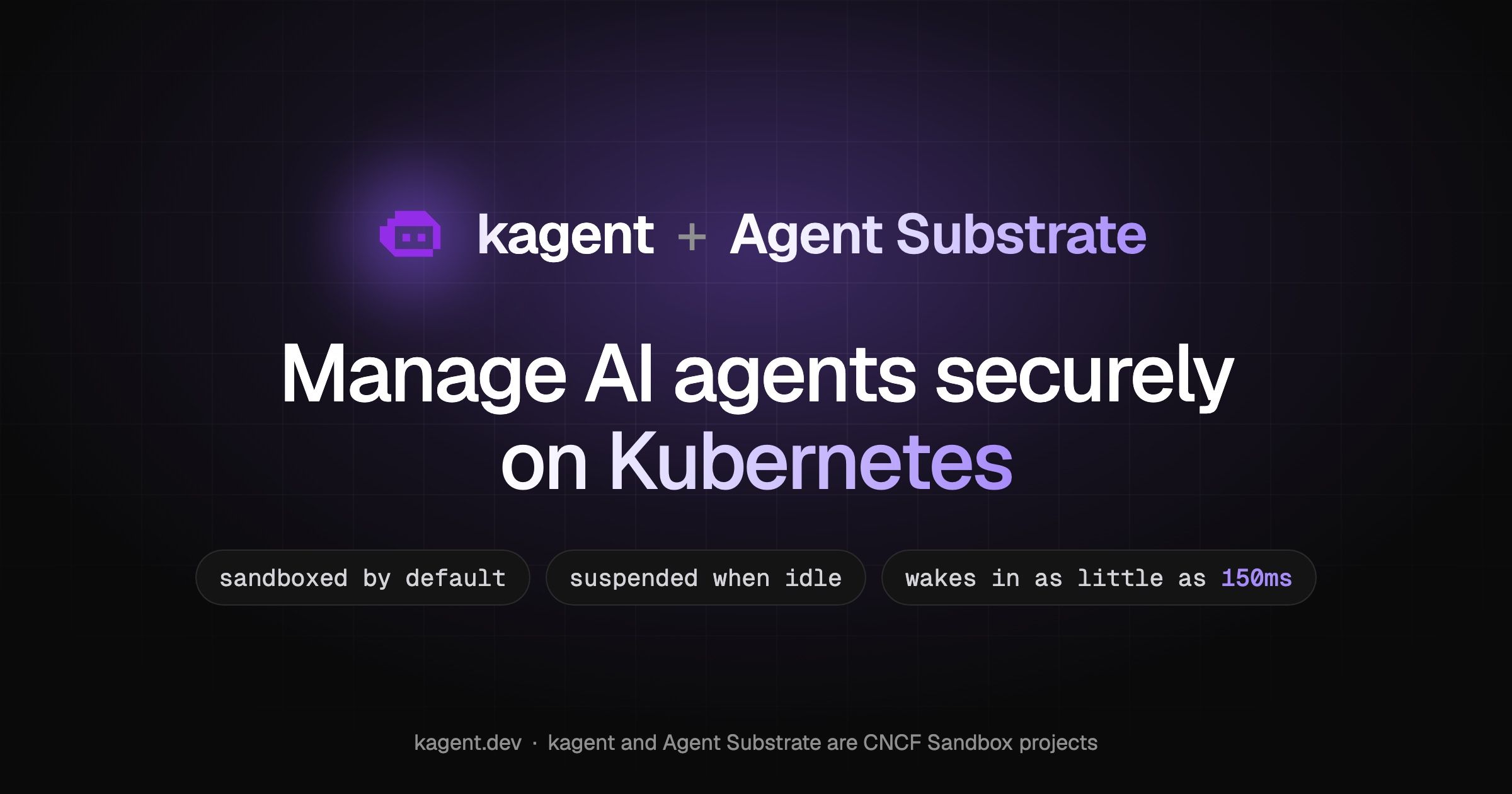
Agent Substrate snapshots a suspended agent to object storage when it goes idle and restores it onto any warm worker in as little as 150ms. The caller never notices, and the session, including pending approvals, remains intact across the sleep cycle.
Every conversation runs as its own gVisor sandbox or microVM, isolated from the host and from every other agent on the same worker. No ambient credentials exist inside the sandbox; the egress gateway injects secrets only for calls a matching EgressPolicy allows.
AgentTemplate, Harness, and Agent are kubectl-compatible custom resources. Agents are defined in YAML, stored in version control, and deployed through standard GitOps workflows without touching the Kubernetes API at request time.
LLM providers include OpenAI, Anthropic, Gemini, Vertex AI, Azure OpenAI, Amazon Bedrock, Mistral, and Ollama. A Harness can run kagent's own Go or Python ADK, Claude, Codex, or any container image that speaks the A2A contract.
Agents connect to any MCP server through RemoteMCPServer resources shared across agents. kagent ships a built-in MCP server with tools for Kubernetes, Istio, Helm, Argo, Prometheus, Grafana, and Cilium, alongside connectors for GitHub, Slack, Notion, Linear, Sentry, and Stripe.
An agent can be given other agents as subagent tools. The orchestrating agent hands off work; each subagent runs in its own sandbox and returns its result. Human approval gates can be inserted at any step before changes reach production.
Features
- Sub-second agent resume
- Sandboxed execution by default
- Kubernetes-native resource model
- Broad model and runtime support
- MCP tool ecosystem
- Multi-agent orchestration
How to install
helm install kagent oci://ghcr.io/kagent-dev/kagent/helm/kagent -n kagent --create-namespace
Recommended for this setup
Strengths
- High agent density at low cost: Agent Substrate packs many agents onto a small pool of warm workers and suspends idle ones to storage. The site reports 10x higher agent density compared to standard container runtimes, eliminating the per-idle-minute cost of a pod-per-agent approach.
- Structural zero-trust security: Credentials never enter a sandbox. The egress gateway injects secrets into outbound calls only when an EgressPolicy rule explicitly permits them. Each agent holds a certificate identity so policy decisions attach to the agent rather than the pod it happens to run on.
- Familiar operational model: Platform teams apply agent configuration with kubectl or any GitOps tool. OpenTelemetry tracing plugs into existing observability stacks, and sessions, tasks, and conversation history persist in PostgreSQL independently of the running agents.
- CNCF-backed open source: Both kagent and Agent Substrate are Apache 2.0-licensed CNCF Sandbox projects with public governance, a code of conduct, community meetings, and an OpenSSF Best Practices badge, reducing lock-in risk for adopters.
Trade-offs
- Kubernetes is a hard dependency: kagent and Agent Substrate are designed exclusively for Kubernetes environments. Teams running agents on bare VMs, managed container services without Kubernetes, or local developer machines will need a local cluster such as kind or a Codespace to evaluate it.
- Early-stage project: kagent is in active development with a public roadmap tracked on a GitHub Kanban board. APIs and resource definitions may change before a stable release, which is worth weighing for production use cases that require long-term API stability.
- PostgreSQL operational requirement: Session, task, and conversation persistence requires a running PostgreSQL instance. Teams that prefer stateless or fully managed backends will need to provision and operate this dependency alongside the cluster.
Tech stack
FAQ
Agent Substrate is an open-source, Kubernetes-native runtime for agents, originally created by Google and now a CNCF Sandbox project. kagent decides what an agent does (model, prompt, tools) through AgentTemplate resources; Agent Substrate decides where it runs, handling suspension, resumption, sandboxing, and worker scheduling through Harness resources. The two are separate projects with separate governance but are designed to work together.
Agent Substrate can resume a suspended agent in as little as 150ms. The actual time depends on the agent's size, the snapshot type, and the node's disk speed. The kagent website includes a calculator that estimates wake-up time along with the CPU, memory, and storage requirements for a given agent configuration.
Supported providers include OpenAI, Anthropic, Gemini, Vertex AI, Azure OpenAI, AI Foundry, Amazon Bedrock, Mistral, Ollama, and any OpenAI-compatible endpoint such as xAI or Hugging Face. A Harness can run kagent's own Go or Python ADK, Claude, Codex, or any custom container image that implements the A2A contract.
Sandboxes hold no API keys or ambient credentials. When an agent needs to call an external service, the egress gateway intercepts the outbound connection, checks it against the agent's EgressPolicy, and injects the credential only if a matching rule exists. Any connection with no matching rule is denied by default.
Yes. Both kagent and Agent Substrate are released under the Apache 2.0 license and are CNCF Sandbox projects. The source code is on GitHub at github.com/kagent-dev/kagent.