Hqtui
Zero-dependency terminal dashboards for 11 languages, one-import API.
Replaces —
Who it's for
Developers who ship server-side tooling and want a live metrics display, service status view, or interactive log inspector without running a web server. Hqtui provides the full widget set, the layout engine to arrange panels, and the input handling to wire up keyboard controls.
If the audience includes non-technical users, a web UI typically reaches them more reliably than a terminal dashboard. Hqtui is for operators who live in the terminal.
Teams running services in TypeScript, Go, Rust, and Python can share a visual language for in-terminal dashboards. The widget vocabulary, theming, and icon set are consistent across native ports, so a dashboard design decision generalizes across the stack.
If all services are in a language not among the native ports (TypeScript, Rust, Go, Python, Zig), the experimental binding path may add friction that a language-native TUI library avoids.
Open source CLI project maintainers who want a polished, branded terminal interface including live progress, theme selection, and icon rendering. The Braille graphics and adaptive pacing make interactive CLIs visually differentiated from raw output.
If the CLI output is consumed by scripts or piped to other tools, an interactive terminal UI adds no value. Hqtui is for tools where a human is watching.
Organizations that pay for hosted monitoring tools but need a subset of dashboards that must run air-gapped, on-premise, or inside a private network where outbound telemetry is restricted. A hqtui-based dashboard reads from local data sources and costs nothing to run.
If you need alerting, long-term retention, or multi-user shared views, a dedicated monitoring platform remains the right answer. Hqtui renders a live terminal view; it stores no data.
The problem
Building a polished terminal UI is harder than it looks. The standard options are raw ANSI escape sequences, which require manual coordinate tracking and produce output that breaks on resize; ncurses, which has complex bindings and limited modern language support; or existing Node.js terminal frameworks that require React as a dependency and treat the terminal as a simplified virtual DOM. Developers either accept a visually crude CLI or spend real time wiring up a custom rendering stack before writing a single line of application logic. For teams working across multiple languages, each ecosystem has a different terminal library with different APIs and no shared conformance model, so a dashboard built for one service cannot reuse components in another.
How it works
Tracks the terminal as four typed arrays. Each frame is diffed against the last: only changed character runs are flushed, with escape sequences deduplicated by tracking the terminal's pen state. At 160x50 cells, a 10%-changed frame outputs 2,639 bytes in 0.291ms on Bun; idle frames write nothing at all.
The TypeScript library has no npm runtime dependencies. The Rust, Go, Python, and Zig ports use only their language's standard library; each is a complete standalone that can be audited end-to-end. The rendering stack uses no ncurses, no browser DOM, and no libc bindings.
Every cell is a 2x4 pixel matrix, so a 40x10 terminal panel plots graphs at 80x40 resolution using Unicode Braille characters. 370 icons and 3,963 emoji ship built in, each resolving to a Nerd Font glyph, Unicode symbol, or ASCII character depending on what the terminal can render.
Panels, tables, trees, logs, meters, gauges, donuts, sparklines, graphs, tabs, modals, command palettes, and all input controls share the same fractional/percentage grid layout system. Sizes are numbers, percentages, fr values, auto, or min/max. No manual coordinate arithmetic in application code.
A headless renderer returns the terminal state as text, ANSI sequences, HTML, or a typed cell grid. Assert on specific widget values or layout results without a TTY, PTY, or screenshot diff. Standard test runners work without modification.
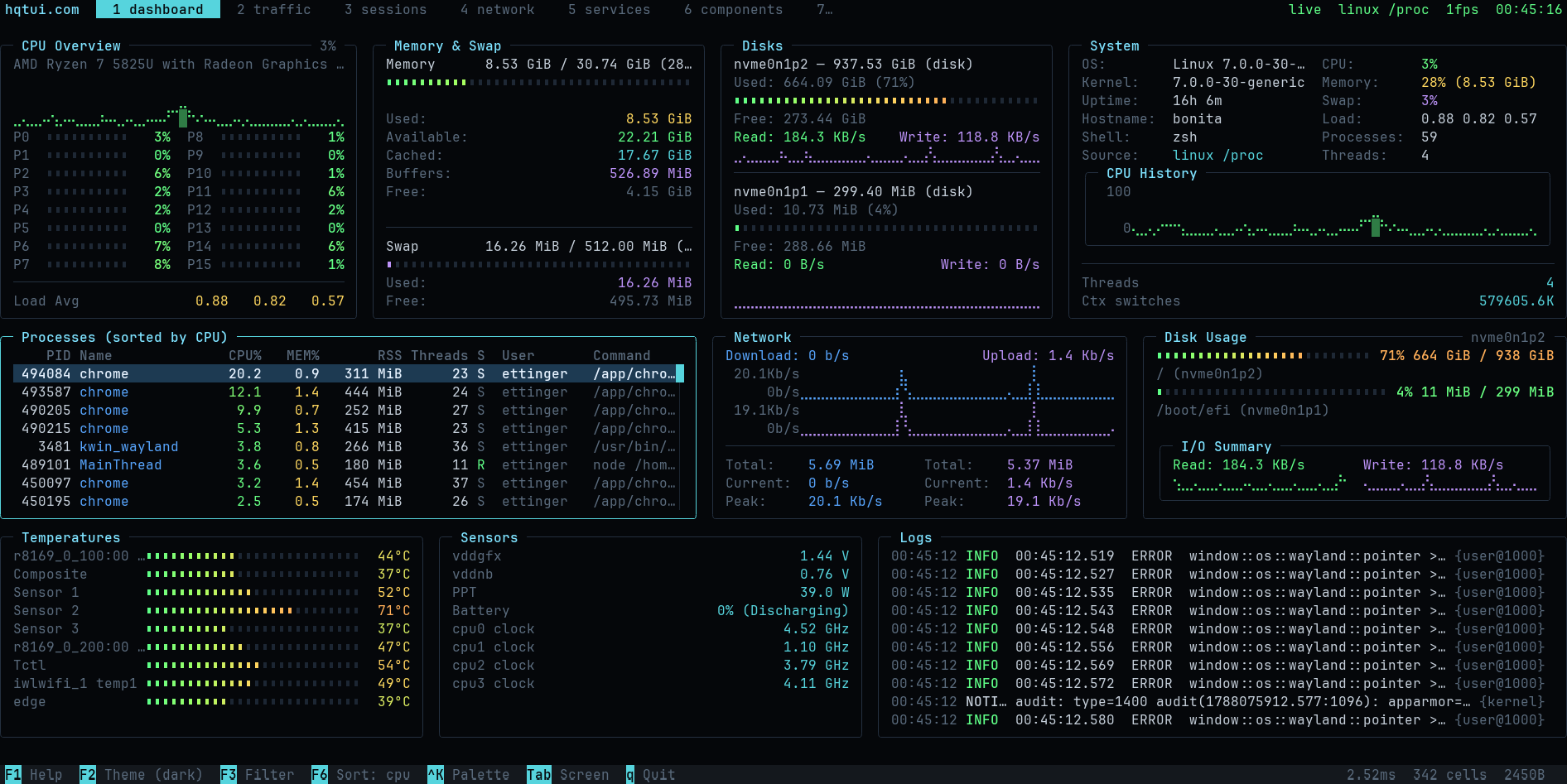
Full dashboard demos run in TypeScript, Rust, Go, Python, Zig, C++, Ruby, PHP, Perl, Nim, and COBOL via a single one-line curl command. The TypeScript reference runs on Bun, Node, and Deno. All demos check latest main, build in a private cache, and run without a manual clone.
Features
- Differential rendering with typed cell arrays
- Zero runtime dependencies across all native ports
- Braille graphics and built-in icon library
- Thirty widgets with a shared layout engine
- Headless testing without a TTY
- Eleven-language demo coverage
How to install
Install the TypeScript library with your package manager.
bun add @profullstack/hqtuiThe CLI runner installs the demo and standalone shell:
curl -fsSL https://hqtui.com/install.sh | shRecommended for this setup
Strengths
- MIT license with zero dependency surface: Every native port (TypeScript, Rust, Go, Python, Zig) is MIT licensed and ships with zero runtime dependencies. Teams can audit the full dependency chain of their terminal dashboard in minutes. No licensing fees for commercial or team use.
- Performance by construction: The screen is four typed arrays; nothing allocates per cell in the hot path. Benchmark: idle frame at 0.068ms, full 160x50 repaint at 0.393ms. The rendering budget comes from the architecture, so there is nothing to tune under normal load.
- Terminal restoration on any exit path: Ctrl+C, SIGTERM, uncaught exceptions, and rejected promises all restore the alternate screen, cursor, raw mode, and mouse tracking to their prior state. Terminal corruption from crashes is an explicit design consideration.
- Adaptive frame pacing: The renderer runs at 30fps by default, drops to 15fps over SSH, and idles at 0fps when nothing has changed. Dashboards running over slow connections or in background processes do not burn CPU for unchanged frames.
Trade-offs
- Very new project with an evolving API: Hqtui was first published in August 2026 and reached v0.12.0 as of this writing. The API has not yet stabilized across a full major version cycle. Adopters should expect some churn in widget APIs across minor versions during the early release period.
- Non-TypeScript ports vary in maturity: The Rust, Go, Python, and Zig ports are independent native implementations, while Ruby, PHP, Perl, and Nim are explicitly experimental bindings to the shared C engine. Teams in those languages should evaluate the current feature set before committing to hqtui as a production dependency.
- Requires a TTY: Hqtui produces terminal UI output for environments where a TTY is present and desired. Applications that need a web dashboard, mobile display, or desktop GUI window cannot use it. Output piped to another process or logged to a file loses all visual structure.
Tech stack
FAQ
Yes. The reference dashboard reads real metrics on Linux, macOS, and Windows with no native dependencies, per the project documentation. The demo script can also run in deterministic simulation mode on any platform for reproducible screenshots and benchmarks.
Hqtui degrades automatically based on what the terminal reports. Truecolor falls back to 256 colors, then 16 colors; Braille graphics fall back to block elements, then ASCII. Kitty, Ghostty, iTerm2, and WezTerm support inline PNG emoji rendering. Mouse tracking requires SGR mouse support, which most modern emulators provide.
Yes. The TypeScript package runs on Bun, Node, and Deno. The `bun add @profullstack/hqtui` install works for Bun; for Node use `npm install @profullstack/hqtui` or the equivalent; for Deno use `deno add`. The demo script accepts `--system typescript` and runs on any of the three.
Yes. Hqtui ships a headless renderer that returns the frame as text, ANSI sequences, HTML, or a typed cell grid. Standard test runners work without a TTY or PTY, so unit tests can assert on specific widget values or layout results without screenshot diffs.
TypeScript (the reference, runs on Bun/Node/Deno), Rust, Go, Python, and Zig are native implementations with no dependencies on the TypeScript core. C++ has a native demo over the shared C renderer with an experimental library API. Ruby, PHP, Perl, and Nim are experimental bindings to the shared C engine. COBOL writes fixed-width records that a TypeScript or Rust adapter renders.