
Happy
Open source AI coding orchestrator for Claude, Codex, Grok, Gemini.
Replaces Conductor
Who it's for
If you pay for Claude Pro or Codex and want to switch between them for different tasks without leaving the same interface, Happy unifies session management without adding a new subscription layer. You bring your credentials; Happy manages the sessions.
You use only one AI coding provider and have no need for multi-model switching. A single-provider workflow is simpler without the extra coordination layer.
Deploy the team relay server and invite colleagues into the same running agent session. Each participant authenticates as themselves and can steer the agent, which makes code review and pair programming with AI agents possible in real time.
You work solo or your team collaboration is already covered by a shared workspace tool. The multiplayer server requires infrastructure setup that solo developers do not need.
Start a Claude Code or Codex session at your desk and pick it up on iOS or Android without losing context. The mobile apps are end-to-end encrypted and rated 4.9 and 5.0 stars respectively, with the same session state you left on the desktop.
You work exclusively at a desk and do not need mobile access. The mobile sync layer adds relay server dependency with no benefit for desktop-only workflows.
With MIT licensing across all four repositories (mobile app, desktop app, agent runtime, relay server), you can fork any component and ship your own build. The agent runtime (happy-agent) is the open source runtime the desktop app uses, making it a starting point for custom agent integrations.
You need a stable, fully polished product and do not have engineering bandwidth to work with an actively developed codebase that has over 1,000 open issues.
The problem
AI coding tools have splintered into a subscription maze. Claude Code, Codex, Grok, and Gemini each come with their own interfaces, their own session contexts, and their own apps. Developers building seriously with AI spend time switching between these environments, losing agent context at each boundary, and still paying for the underlying model subscriptions regardless. Existing interface layers add a third bill on top: tools like Cursor and GitHub Copilot charge a per-seat fee for their own model wrappers. If you are already subscribed to Claude Pro, Codex, and Grok, you are paying for model access that Cursor's interface reroutes through its own infrastructure anyway. The waste is the interface layer itself, duplicating subscription costs you already carry.
How it works
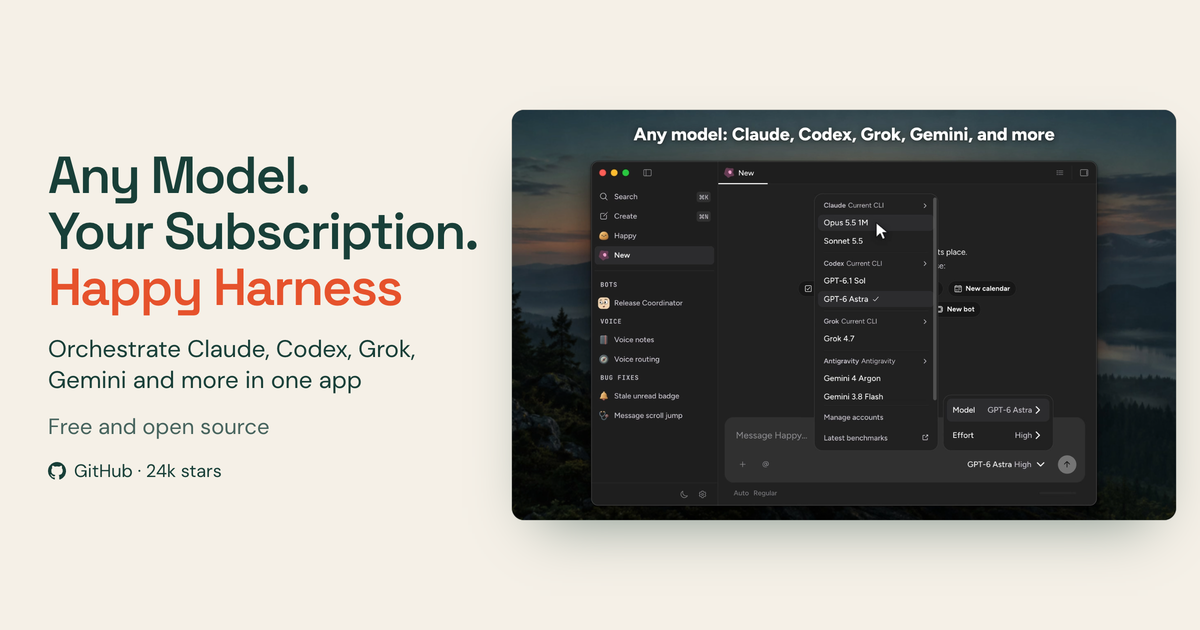
Run Claude Code, Codex, Grok, and Gemini from the same app. Assign each task the model that fits best, and delegate to subagents on any of them. Gemini runs through Antigravity; OpenCode and any Agent Client Protocol agent can plug in as an additional provider.
You authenticate directly with your Claude, Codex, or Grok accounts. Happy acts as the coordination layer; it does not resell model access or add a per-seat fee on top of your subscriptions. Gemini connects through your Google account via Antigravity.
The iOS and Android apps connect to the same agent sessions you started on the desktop. Data moving between your devices is encrypted in transit. The iOS app has 4.9 stars from over 1,000 App Store ratings; the Android app has 5.0 stars from over 3,100 Google Play reviews.
Deploy a team relay server and invite colleagues into the same agent session. Each participant signs in as themselves, shares the same project context, and can steer the running agent. Built for teams that want shared AI coding sessions without screen sharing.
Install the happy npm package to wrap Claude Code or Codex directly in your terminal. Start an agent with 'happy claude' for Claude Code or 'happy codex' for Codex, then continue the same session from your phone through the relay server. No desktop app required.
Features
- Multi-model agent switching in one interface
- Sign in with your existing model subscriptions
- End-to-end encrypted mobile sync
- Multiplayer sessions with a team server
- Terminal CLI for existing terminal workflows
How to install
Install the desktop app on macOS via Homebrew, or set up the CLI for terminal-first workflows.
brew install --cask slopus/tap/happy

npm install -g happy
Recommended for this setup
Strengths
- MIT license, no per-seat fee above model costs: The coordination layer itself is MIT licensed and free. Your only cost is the model subscriptions you already hold. Unlike Cursor or GitHub Copilot, which both charge a monthly per-seat fee for their interface layer, Happy adds no seat charge on top of your model subscriptions.
- 24,000+ GitHub stars, actively maintained: The repo crossed 24,386 stars with 2,096 forks since its July 2025 launch, and the project remains in active development. Four open source repositories cover the mobile app, desktop app, agent runtime, and relay server.
- Highly rated iOS and Android apps: The iOS app holds a 4.9-star rating from over 1,000 App Store reviews. The Android app holds a 5.0-star rating from over 3,100 Google Play reviews. Both apps sync the same desktop agent sessions with end-to-end encryption, which is uncommon among AI coding tools.
- Self-hostable relay server for team sync: The relay server (happy-server) that syncs sessions between desktop and phone is open source and self-hostable. Teams with strict data requirements can run the entire stack on their own infrastructure: the app, the relay, and the agent runtime.
Trade-offs
- Over 1,000 open GitHub issues: The project has accumulated 1,086 open issues since its July 2025 launch. For a tool at this stage, a high open-issue count reflects fast feature growth outpacing bug fixes. Teams running it in production should review open issues for their model integrations before relying on it for critical workflows.
- Mobile session sync requires a relay server: Continuing a desktop agent session on your phone requires the Happy relay server, either the hosted one or your own self-deployed instance. Self-hosting the relay introduces infrastructure overhead. Teams with strict data requirements should plan for running happy-server alongside the rest of the stack.
- Each model provider requires separate authentication: You must authenticate separately with each model provider you plan to use: Claude, Codex, and Grok each require their own active subscription. Gemini runs through Antigravity, adding an extra step. Developers new to these platforms will need active subscriptions before Happy provides value over a single-provider workflow.
Tech stack
FAQ
Yes, Happy itself is MIT licensed and free. Your costs are the model subscriptions you use (Claude, Codex, Grok, or Gemini via Antigravity); Happy adds no per-seat fee for the coordination layer. The desktop app is available for macOS, Windows, and Linux; the mobile app is on iOS and Android.
Yes. The relay server (happy-server) and agent runtime (happy-agent) are open source and self-hostable. Self-hosting the relay keeps your session sync data on your own infrastructure. The desktop and mobile apps connect to a self-hosted relay by configuration. Full self-hosting requires running multiple components: the relay server and optionally the agent runtime alongside your model connections.
Happy supports Claude Code (Anthropic), Codex (OpenAI), Grok (xAI), and Gemini via Antigravity. Any Agent Client Protocol (ACP) agent can also plug in as a provider. Each model requires its own active subscription from the respective provider; Happy acts as the coordination layer on top of those accounts.
Cursor and GitHub Copilot bundle their own model access and charge a per-seat monthly fee for their interface layer. Happy acts as a coordination layer, routing your sessions to the model accounts you already hold without adding model charges. The tradeoff is that Happy requires individual model subscriptions for each provider you want to use.
Happy has a desktop app for macOS (Intel and Apple Silicon), Windows, and Linux, available via Homebrew on macOS or direct download. The mobile app is on iOS (App Store, 4.9 stars) and Android (Google Play, 5.0 stars). An npm CLI (npm install -g happy) is available for terminal-first workflows that wrap Claude Code and Codex directly.