
Freehire
Open source job search with 3.3M+ postings direct from company boards.
Replaces Simplify Jobs, Theirstack
Who it's for
Freehire's faceted search filters by stack, seniority, work mode, and region over a deduplicated index sourced from company ATS platforms. Engineers can find roles matching their exact skill profile without triaging aggregator noise, and track applications in the same tool.
The user is not in a tech role or needs broad job categories outside software engineering. Freehire's source coverage skews heavily toward IT and tech roles.
The keyless public API and self-hostable stack make Freehire a data layer for custom recruitment applications. The typed HTTP API, Meilisearch index, and open schema let developers build filtered feeds, internal job boards, or hiring tools without crawling ATS platforms themselves.
The use case requires enriched company profiles, CRM integrations, or B2B data products. TheirStack or a commercial data provider is better suited to that workload.
The MCP server connects Claude Desktop and Claude Code to the full job catalogue. An agent can search postings, read facets, identify open roles matching a skill set, and track application status through the MCP protocol without requiring a manual browser session.
The agent framework does not support MCP. Direct API calls to freehire.me/api/v1/jobs work without MCP, but the conversational tool interface requires an MCP-compatible host.
Adding a company to Freehire's index is one row in the boards catalog submitted through the site form. Adding a new ATS platform is one adapter in the sources package that implements the shared Source interface. The project is fully open to PRs and issues with no contributor allowlist.
The company's ATS is already supported and the board is already in the catalog. Contributing value requires finding a gap in the 320 existing sources.
The problem
Most job boards recycle the same aggregator feeds. The same posting appears across a dozen sites under different titles, application links go stale, and salary ranges get dropped or rewritten as data passes through each middleman. Engineers searching by stack or seniority often find that filters are unreliable because the underlying data was never normalized from source. The deeper pain is invisible obsolescence. A posting can stay indexed for weeks after the role closes at the company's own ATS. Candidates submit applications against positions that are no longer open, with no feedback and no signal that the window has passed.
How it works
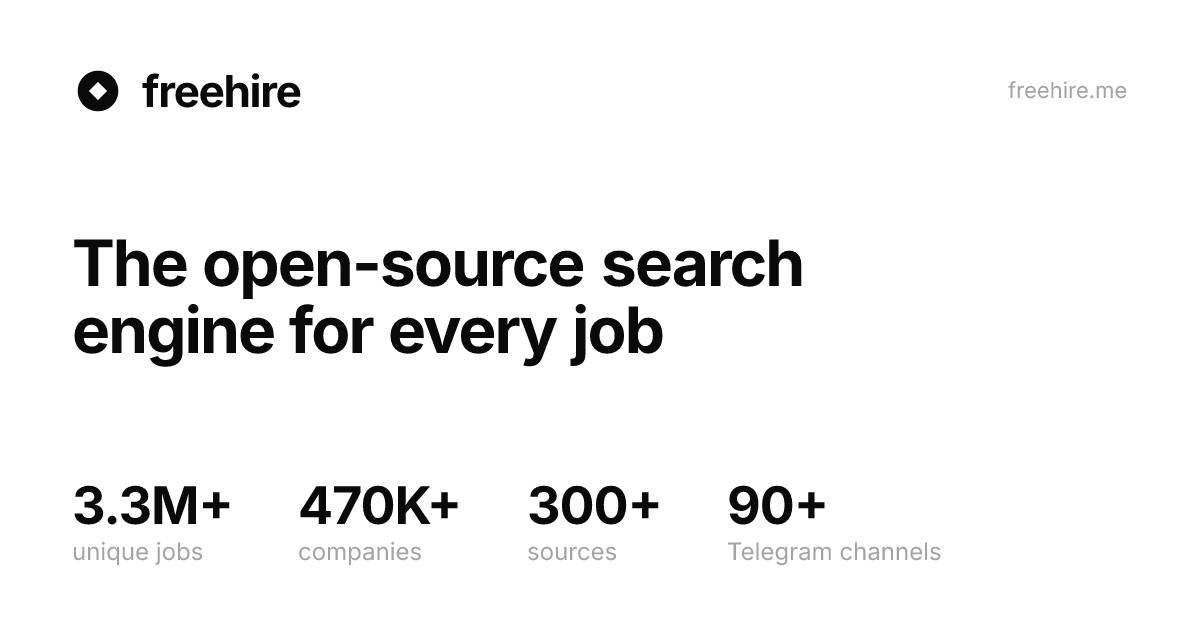
Postings are fetched from company ATS platforms directly: Workday, Greenhouse, Lever, Ashby, and iCIMS among them. Each posting is normalized into a single schema and deduplicated on a stable key, so one role posted across multiple boards counts once. 3.3M+ unique open postings from 470,000+ companies as of October 2026.
Full-text and faceted search powered by Meilisearch filters by region, work mode, seniority, skills, and salary. Facet values come from curated dictionaries rather than being inferred from raw text, which keeps seniority and stack filters reliable across differently worded postings.
A single binary CLI (no Go required) covers search, saved searches, and application tracking from the terminal. An MCP server connects Claude Desktop and Claude Code to the same catalogue, letting agents run searches, read facets, and move an application along without leaving their environment.
Per-user tracking across stages (viewed, applied, saved), an inbox that links recruiter replies to the application they came from, and an append-only event ledger for auditing the full application history. Reminders and Telegram digests are included.
A side-panel extension sits next to any job posting in Chrome, reads the page, scores it against the user's stored CV, and can fill the application form. Works on any site, not only the ones Freehire indexes, installed from the Chrome Web Store.
A posting-reality signal behind each listing indicates whether a job is still genuinely open, based on ATS status and timing patterns. This reduces time spent on listings that are technically visible but practically closed, a common problem with aggregator-sourced feeds.
Features
- Direct ATS crawling across 117 platforms
- Faceted search with curated dictionaries
- CLI and MCP server
- Application tracking and inbox
- Chrome extension for in-page application
- Ghost-job signal
How to install
Install the CLI with one command or self-host the full stack with Docker Compose.
curl -fsSL https://freehire.me/install.sh | shRecommended for this setup
Strengths
- Keyless public API: The catalogue is available over a public HTTP API requiring no credential: GET https://freehire.me/api/v1/jobs needs no sign-up. This makes the index usable as a data source for scripts, agents, and recruitment tooling without gating access behind a paid tier, unlike commercial job data APIs that require subscriptions.
- MIT license with no self-hosting restrictions: MIT license means no licensing fee and no resale restrictions on a self-hosted instance. Fork the indexer, run it on your own infrastructure, or build a product on top of it commercially with no additional terms.
- Source breadth with deduplication: 320 sources spanning 117 ATS platforms, 133 aggregators including 97 Telegram channels, and 52 direct company feeds. A role posted on multiple boards collapses into one entry on a stable key, so search results reflect actual open positions rather than re-indexed duplicates from the same ATS.
- Developer-first access surface: Alongside the web UI, Freehire ships a single-binary CLI, an MCP server for AI agent integration, a keyless REST API, and a browser extension. This range of access points lets teams plug the job catalogue into their own pipelines without rebuilding the index layer.
Trade-offs
- Complex self-hosted stack: Running Freehire self-hosted requires Go, Postgres with pgvector, Meilisearch, Redis, and S3-compatible object storage. The Docker Compose setup handles local development, but a production deployment needs each of these services sized and maintained separately. This is not a single-process install.
- AI features require LLM configuration: Enrichment, CV tailoring, fit analysis, and the in-app assistant depend on an LLM endpoint configured in the environment. The features stay disabled when LLM credentials are unset, but full functionality requires connecting an OpenAI-compatible provider and incurring per-call costs.
- Recently launched project: The repository was created in June 2026. The project has active development and over 2,700 GitHub stars, but it is a young codebase. Teams depending on it in production should track the changelog and treat the API schema as subject to change between releases.
Tech stack
FAQ
Yes. The web search at freehire.me is free with no account required. The public API is keyless. The self-hosted version is MIT licensed and runs on your own infrastructure at no licensing cost. The only paid element is the LLM credits used by AI features like CV tailoring and fit analysis, which require your own LLM API key.
Freehire crawls company ATS platforms directly rather than republishing aggregator feeds. Each adapter targets one ATS provider (Greenhouse, Lever, Workday, and others) and fetches postings from the companies using it. A deduplication step on a stable key collapses the same role appearing on multiple boards into one entry, so the 3.3M+ count reflects unique open postings.
Yes. The full stack runs with Docker Compose and includes the API server, SvelteKit web frontend, Postgres with pgvector, Meilisearch, Redis, and object storage. A production deployment needs each of these services maintained. Setup instructions and the full environment variable reference are in the repository README at github.com/strelov1/freehire.
The ghost-job signal tracks whether a posting is still genuinely open based on ATS status and timing patterns. Many boards keep listings indexed long after the role closes at the company's ATS. The signal surfaces this so candidates can prioritize postings that are actually active rather than spending time on roles that closed weeks ago.
Yes. The catalogue is available over a keyless public HTTP API: GET https://freehire.me/api/v1/jobs requires no credential or sign-up. Jobs and companies are addressed by their public slug. The full API reference including every endpoint, its parameters, and the search filter vocabulary is at freehire.me/docs/api.