
Elephant Goldfish Model
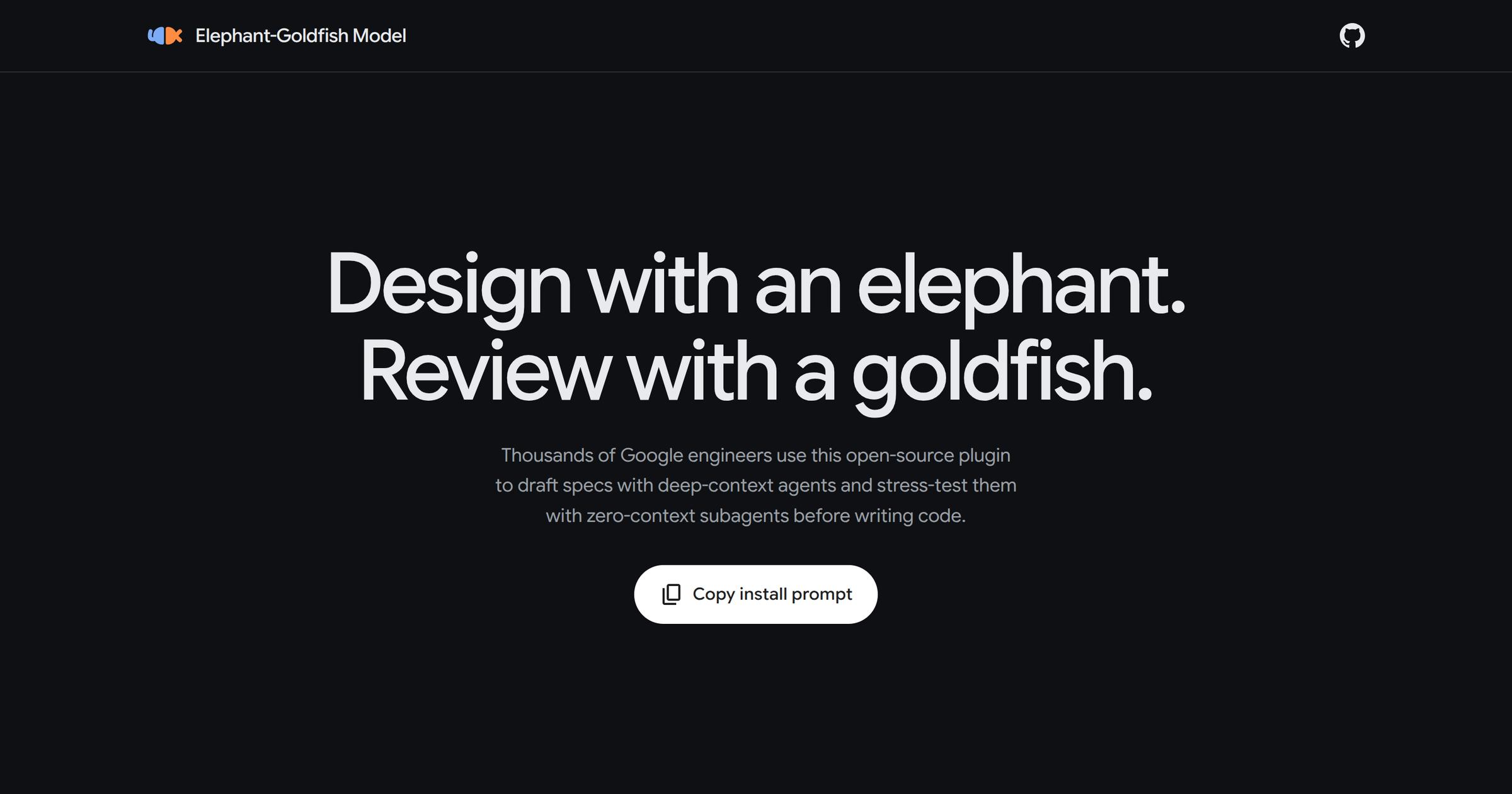
Draft specs with context, review with fresh zero-context agents.
Replaces Amazon Kiro
Who it's for
EGM fits into the design phase of agent-assisted development. Before asking your coding agent to implement a feature, you run /egm-brainstorm and /egm-draft to produce a spec, then /egm-review to check it with fresh Goldfish subagents. The spec captures architectural decisions, edge cases, and trade-offs; the agent implements from that spec rather than from a rough prompt.
Your features are small enough that a one-line prompt to the agent produces the right result. EGM adds the most value at the boundary of non-trivial design decisions with multiple trade-offs.
EGM gives a team a shared spec format (docs/designs/) and a repeatable review process. Engineers submit specs for Goldfish review before coding begins, and the drift report keeps specs accurate after implementation. Teams get a lightweight paper trail of design decisions without the overhead of a formal RFC process.
Your team already has a spec review process that works. EGM is most useful when the missing step is structured review before implementation, not when you already have that gate.
The Goldfish review and /egm-drift-report skills give leads a way to verify that an AI-generated spec was stress-tested before code was written, and that the final implementation matches the approved design. The spec artifacts (docs/designs/, concept briefs) are version-controlled and reviewable in pull requests alongside the code.
Your review process happens at the code level and your team is not using AI coding agents for design. EGM's value is specific to the agent-assisted development flow.
The problem
AI coding agents are good at building what they are asked to build. The problem is that the person asking them has blind spots: unstated constraints, implicit assumptions, and design gaps that seem obvious in hindsight but are invisible at the time of writing. When an agent builds from a brief that contains those gaps, the resulting code reflects them too. This surfaces late. A feature passes its own tests and fails at the integration boundary. An architectural decision turns out to conflict with an existing constraint nobody mentioned. An edge case that happens one percent of the time causes a data integrity issue in production. The earlier in the development cycle these failures appear, the cheaper they are to address. A bug in a spec costs minutes to fix; the same bug in shipped code costs hours or days.
How it works
The Elephant agent loads full project context including system history, architecture, and component boundaries, then explores the problem through open-ended questioning and structured brainstorming. It saves the agreed direction in a concept brief, then turns it into a living design doc under docs/designs/, section by section, pausing after each section for your feedback in chat.
Fresh stateless subagents read only the draft spec and live source code, without any conversation history. A Goldfish swarm checks completeness, clarity, self-containment, and implementation readiness from independent, conflicting perspectives. The design is stress-tested before any code is written, exposing unstated assumptions the author and their context-loaded agent cannot see.
After implementation, the /egm-drift-report skill compares the checked-in design documents with the current source code and reports where they diverge. This keeps specs accurate as the codebase evolves and surfaces when the implementation has drifted from the approved design.
The /egm-review-loop skill runs a configured group of Goldfish reviewers for a specific review task. You can use the stateless review pattern on non-software documents or with custom reviewers and standards beyond the built-in five-stage software spec review.
The /egm-bootstrap skill creates or updates documentation for an existing codebase that lacks a spec or design docs. It is the entry point for teams adopting EGM mid-project, before they have a docs/designs/ directory to work from.
EGM installs as a plugin into Claude Code, Codex CLI, Antigravity CLI, and ChatGPT and Codex Desktop. Each agent gets the same set of skills; the install path differs per agent. Claude Code and Antigravity use a prefixed command format (/egm:egm-brainstorm); Codex uses a skill picker.
Features
- Elephant brainstorm and draft
- Goldfish zero-context review
- Drift report after implementation
- Configurable review loop
- Bootstrap for existing codebases
- Multi-agent support
How to install
Install EGM into your AI coding agent using your agent's plugin system. The plugin source is available to download from GitHub Releases: https://github.com/google/elephant-goldfish-model/releases/latest
# Claude Code
claude plugin marketplace add google/elephant-goldfish-model
claude plugin install egm@egm

# Codex CLI
codex plugin marketplace add google/elephant-goldfish-model
codex plugin add egm@egm

# Antigravity CLI
agy plugin install https://github.com/google/elephant-goldfish-model
Recommended for this setup
Strengths
- Stateless review catches what context-loaded agents miss: The core design principle is deliberate: Goldfish subagents start each review with no conversation history. This is not a limitation but the mechanism by which the tool surfaces blind spots. A reviewer who has seen the problem being discussed will unconsciously fill in gaps; a reviewer who sees only the document cannot. This is EGM's primary differentiator from single-agent spec tools.
- Apache 2.0 license with no commercial restrictions: The Apache 2.0 license allows unrestricted commercial and team use, modification, and redistribution. Teams can use EGM inside proprietary workflows, contribute back changes, or fork the plugin without opening their own code. There are no seat fees, no usage quotas, and no vendor lock-in.
- Works inside your existing coding agent: EGM installs into Claude Code, Codex CLI, Antigravity CLI, and the ChatGPT and Codex Desktop apps. Teams using multiple agents, or switching between them, can carry the same spec workflow across agent environments. The skills and reviewer prompts are part of the installed plugin, so they read consistently across each supported agent.
- Built by Google engineers, 16,499 stars: The plugin was developed by and for Google engineers: the project website states that thousands of Google engineers use it. With 16,499 GitHub stars and 1,217 forks, EGM has seen broad adoption beyond Google. The project has an active contribution model with public issues, discussions, and contributing guidelines.
Trade-offs
- Requires a coding agent that can spawn fresh subagents: Goldfish reviews depend on the ability to create stateless subagent contexts. If your coding agent cannot create fresh subagents, EGM stops the review and reports the limitation. The README documents which agent environments support multi-agent execution (Claude Code, Codex, Antigravity) and which do not. Teams on agents without subagent support get brainstorm and draft but not Goldfish review.
- Review does not replace tests or human judgment: EGM's README states this explicitly: a Goldfish review checks the spec, not the code, and does not substitute for unit tests, integration tests, or human code review. It catches design gaps before implementation, not correctness bugs in the implementation itself. Teams expecting automated correctness verification will need to combine EGM with their existing test suite.
- 63 open issues in active development: With 63 open issues, EGM is in an active development phase. Some agent-specific rough edges exist: the README documents known version-specific issues (for example, Antigravity CLI 1.4.8 does not complete prefixed command names, while 1.4.10 does). Teams on specific agent versions should check the issues list before expecting every feature to work as documented.
Tech stack
FAQ
EGM supports Claude Code, Codex CLI, Antigravity CLI (command-line and app), ChatGPT Desktop, and Codex Desktop. Each has a different install path: Claude Code uses `claude plugin marketplace add google/elephant-goldfish-model` and `claude plugin install egm@egm`; Codex CLI uses `codex plugin marketplace add google/elephant-goldfish-model` and `codex plugin add egm@egm`; Antigravity CLI uses `agy plugin install https://github.com/google/elephant-goldfish-model`. ChatGPT and Codex Desktop apps use the published plugin listing in the desktop app. Goldfish review requires the agent to support fresh subagent creation; not all agents or versions support this.
The Elephant is a deep-context agent that holds your full project history, architecture, and component details. It runs the brainstorm and draft phases, exploring the problem and producing the spec with knowledge of everything that came before. The Goldfish is a set of stateless subagents that read only the draft spec and referenced source code, without any prior conversation. Because Goldfish reviewers start fresh, they catch assumptions the Elephant took for granted and gaps that only appear obvious from the outside.
Yes, with the /egm-review-loop skill. The built-in /egm-review is designed for software design documents and runs a five-stage review. /egm-review-loop lets you configure custom reviewers and standards for other document types. /egm-bootstrap and /egm-drift-report are specific to software codebases; they compare documents against source code and generate documentation for existing codebases.
Yes. EGM is Apache 2.0 licensed, which means you can use it commercially, modify it, and redistribute it with no licensing fees. The plugin itself is free; you pay only for whatever AI coding agent you install it into. The Apache 2.0 license places no restrictions on commercial or team use and does not require you to open-source code you build with the tool.
No. EGM's README states this explicitly: a Goldfish review checks the design spec, not the code, and does not replace unit tests, integration tests, or human code review. Its purpose is to catch design gaps and unstated assumptions before implementation, so the bugs found are in the spec rather than in running code. After implementation, /egm-drift-report checks whether the code matches the approved spec, but it does not run the code or verify correctness.