
Dolibarr
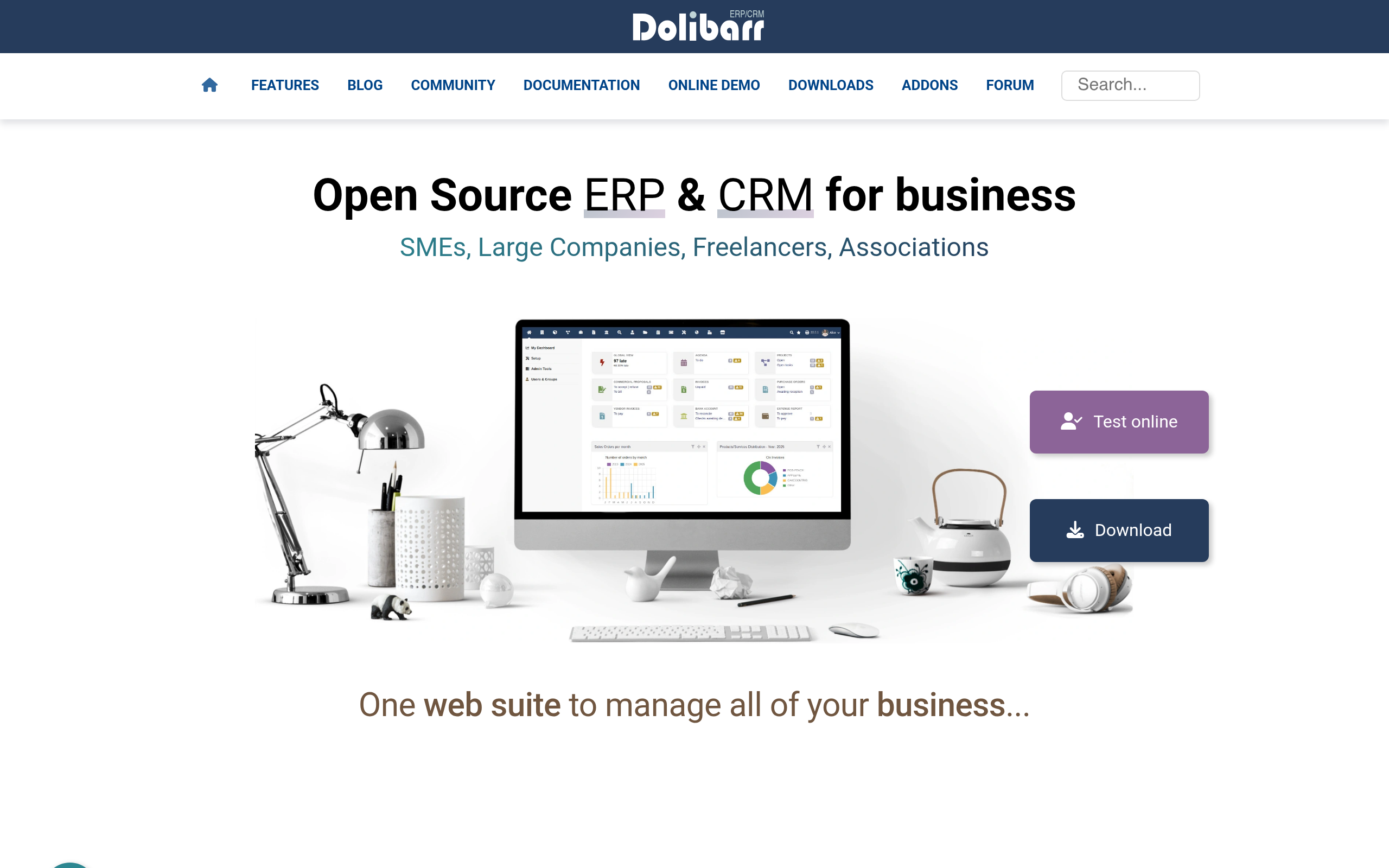
Dolibarr ERP/CRM is an open-source business suite for SMEs,
Replaces Salesforce, Hubspot Crm, Quickbooks Online, Zoho Crm
Who it's for
Dolibarr fits small companies that need contacts, quotes, invoices, orders, stock, and agenda workflows in one self-hosted business application.
You need a heavily customized enterprise ERP rollout with dedicated implementation consultants from day one.
Freelancers and service firms can use Dolibarr to centralize customer records, proposals, invoices, and activity tracking without adopting a large hosted suite.
You only need a lightweight invoice generator and no CRM or stock management.
The README names foundations as a target user, making Dolibarr relevant for organizations that need business operations software with control over hosting and licensing.
Your team requires a managed SaaS product with vendor-run hosting and support.
The problem
Small organizations often outgrow spreadsheets and disconnected invoicing, contact, stock, and accounting tools before they are ready for a complex enterprise ERP rollout. Each new department can add another database, another login, and another export problem. Dolibarr addresses that middle ground with a modular business suite that can run on familiar web hosting. The tradeoff is that teams still need to decide which modules to enable, how to host the PHP and database stack, and how to maintain upgrades over time.
How it works
Dolibarr covers core business records such as contacts, suppliers, invoices, orders, stock, agenda, accounting, HR, documents, and manufacturing activity.
The README says Dolibarr can run as a web application on the Internet or a LAN, which lets organizations control hosting and access.
Dolibarr supports packaged installers, a generic PHP web server setup with MariaDB, MySQL, or PostgreSQL, and Docker images for teams that prefer containers.
The README states that Dolibarr is released under GPL-3+ terms, allowing users to use, study, modify, and distribute the software under that license.
Features
- ERP and CRM in one suite
- Self-hosted web application
- Multiple install paths
- Open license for business use
Recommended for this setup
Strengths
- Broad business coverage: Dolibarr combines CRM, invoicing, orders, stock, accounting-adjacent workflows, HR, and documents, reducing the need to stitch together many small tools.
- Approachable deployment options: Packaged installs help less technical users, while generic PHP hosting and Docker options give IT teams more control.
- Useful for many organization sizes: The project explicitly targets businesses of different sizes, foundations, and freelancers, making it a practical ERP candidate outside large enterprises.
Trade-offs
- ERP scope brings configuration work: A broad ERP and CRM suite requires process decisions around modules, permissions, accounting flows, and data migration before it feels simple to staff.
- Self-hosting needs PHP operations: The generic install path expects a web server, PHP, database setup, filesystem permissions, and browser-based installer steps.
- SaaS convenience is separate: The README points users without time to install Dolibarr toward commercial cloud offerings, so teams choosing self-hosting should plan their own maintenance path.
Tech stack
FAQ
Dolibarr is an open-source ERP and CRM suite for managing business activity such as contacts, quotes, invoices, orders, stock, agenda, accounting, HR, documents, and manufacturing.
Yes. The README describes Dolibarr as a standalone or web application and lists generic web server installs, packaged installers, and Docker images.
The README says Dolibarr is released under the GNU General Public License version 3 or later, commonly written as GPL-3+.
Dolibarr is best for small and mid-sized organizations that need ERP and CRM basics in a self-hosted PHP web application.