
deer-flow
Build super agents with DeerFlow's powerful framework
Replaces Manus, Devin Ai
Who it's for
Use DeerFlow when your team wants to operate a configurable agent harness rather than buy a closed hosted agent product.
You only need a simple chat assistant for support or internal Q&A.
The harness fits multi-step research, coding, and creation tasks that need memory, tools, and sub-agent coordination.
Your tasks fit in one short prompt and do not need execution sandboxes.
AI platform teams can use DeerFlow to test model routing, sandboxes, MCP servers, skills, and tracing.
You cannot allocate engineering time to configure and operate the runtime.
The problem
Long-running agent work needs durable orchestration, memory, tools, sandbox execution, and deployment controls. DeerFlow addresses that by packaging those pieces into an inspectable harness that teams can configure instead of relying only on single-agent chats or closed hosted products.
How it works
The README describes DeerFlow as handling tasks that can take minutes to hours across research, coding, and creation.
The harness supports sub-agent coordination and extensible skills so different capabilities can be loaded for different tasks.
Memory support helps the runtime preserve context and prior work across longer agent sessions.
DeerFlow documents local, Docker, and Kubernetes-backed sandbox execution modes for running agent code.
Setup paths include make setup, make docker-start, make dev, and make up, with sizing notes for evaluation and server use.
Features
- Long-horizon agent harness
- Sub-agents and skills
- Configurable memory
- Sandbox execution modes
- Docker and local operation
How to install
git clone https://github.com/bytedance/deer-flow.git cd deer-flow make setup make docker-init make docker-start
Recommended for this setup
Strengths
- Built for operators: The README covers configuration, deployment sizing, sandbox choices, tracing, and gateway behavior rather than hiding runtime details.
- Open runtime control: Teams can inspect and adapt the harness, model configuration, and execution modes under an MIT license.
- Multiple integration surfaces: MCP server support, IM channels, skills, and model-provider configuration give teams several extension paths.
Trade-offs
- Operationally heavier than a chatbot: DeerFlow requires Python, Node.js, model configuration, sandbox choices, and service startup, so it is not a low-ops SaaS assistant.
- Resource planning matters: The README includes CPU, memory, and disk sizing guidance, which signals that heavier workflows need real infrastructure.
- Advanced configuration surface: Teams must understand model providers, sandbox modes, memory paths, and gateway limits to run DeerFlow well.
Tech stack
FAQ
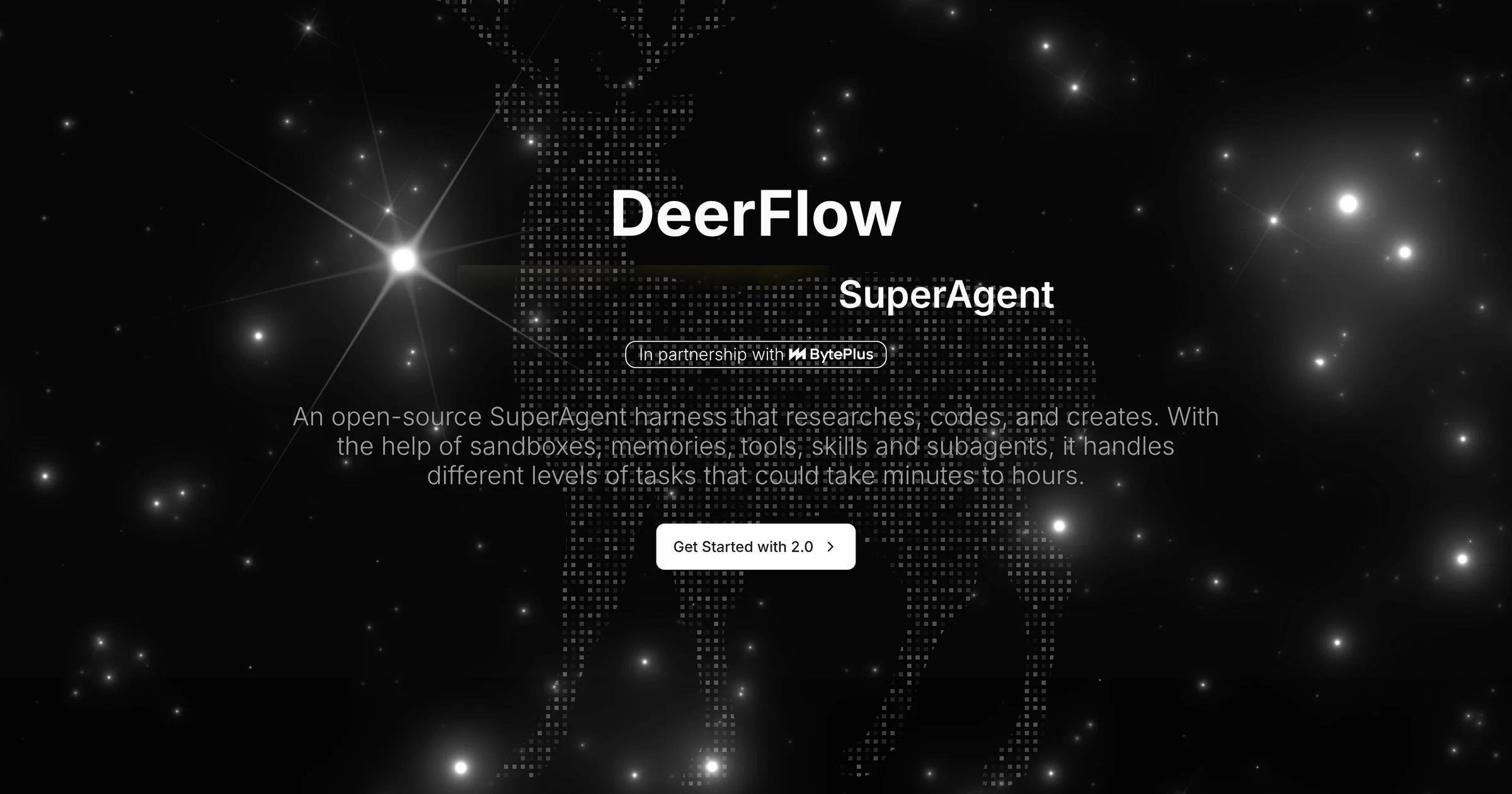
DeerFlow is an open-source super-agent harness for long-horizon workflows that use sub-agents, memory, sandboxes, tools, and skills.
GitHub metadata reports DeerFlow as MIT licensed.
Yes. The README documents Docker development with make docker-init and make docker-start, plus production startup with make up.
DeerFlow fits teams building or operating custom agent runtimes. It is heavier than a simple hosted chatbot.