DCTS
Self-hosted Discord-style chat with encrypted DMs and voice
Replaces Discord, Slack, Microsoft Teams, Google Chat, Rocket Chat
Who it's for
Teams that need message data on their own servers will find DCTS covers the core Slack use case: organized text channels, encrypted direct messages, and voice communication. The AGPL-3.0 license and self-hosted model mean no vendor access to message history and no recurring per-seat cost.
Your team relies heavily on Slack integrations or automated workflows via Slack bots and connectors. DCTS does not replicate the Slack integration ecosystem, so integration-heavy workflows will lose significant tooling.
Communities currently on Discord for voice channels, text rooms, and community management can host a comparable experience with DCTS. Voice chat with screensharing and camera support covers the main Discord voice use cases, and Android and desktop clients give members a native app experience.
Your community depends on the Discord bot ecosystem, game status integrations, or Discord's frictionless onboarding. DCTS requires members to create an account on your instance, which adds friction for casual joiners.
DCTS is built in JavaScript and uses sockets, making the source readable and modifiable for developers who want to customize their communication setup. The project's commitment to building its own libraries means the codebase follows consistent internal patterns.
Skip if you need a production-grade system with a vendor-backed SLA, enterprise compliance certifications, or guaranteed uptime. DCTS is an independently maintained project without commercial support.
The problem
Slack and Microsoft Teams dominate team communication, but both host your messages on vendor-controlled servers with no self-hosting option. For teams handling sensitive conversations, working under data residency requirements, or simply unwilling to pay per-seat pricing for a chat tool, this is a real problem: message data leaves your control the moment it is sent, and the vendor sets the terms for retention, access, and pricing. Voice-first communities face the same challenge with Discord: the server is centralized, accounts are tied to Discord's infrastructure, and any policy or pricing change affects your community immediately. Running your own communication server eliminates this dependency but historically required assembling separate tools for text chat, voice, and mobile access.
How it works
DCTS encrypts server direct messages between users, a feature explicitly listed in the README and reflected in the project's e2ee and encrypted GitHub topics. For teams with sensitive conversations, this ensures DM content stays private at the application layer.
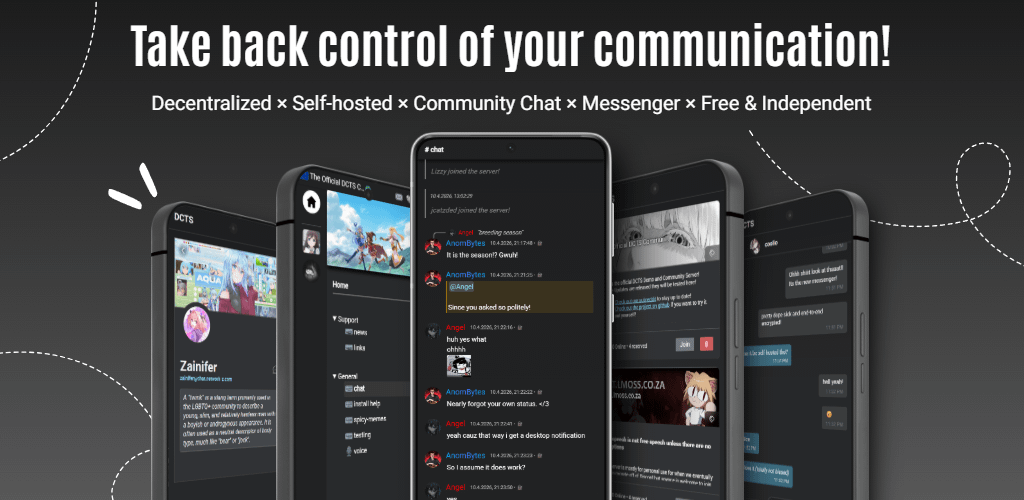
DCTS ships a working voice layer that includes screensharing and camera support, matching the voice channel experience Discord users are familiar with. Voice communication runs through the server you control, with no third-party relay required.
A dedicated desktop client and a full Android app are available alongside the web interface. Both clients include an integrated decentralized messenger, giving your team a native app experience separate from the main web chat server.
DCTS ships a Pterodactyl egg for panel-based automated deployment alongside Docker support, giving server operators two installation paths. The Pterodactyl egg covers hosting environments that already use panel-based server management, while Docker covers standard VPS and container setups.
DCTS runs on both Node.js (tested on v16 through v24) and Bun (tested on 1.3.x), giving operators a choice of JavaScript runtime. This covers current long-term support Node.js releases and the faster Bun runtime for performance-oriented setups.
The DCTS project builds its own libraries rather than depending on third-party packages, aiming for long-term stability and independence from external dependency changes. This lets the codebase adopt new features without waiting on upstream library updates.
Features
- End-to-end encrypted server DMs
- Voice chat with screensharing and camera support
- Desktop and Android clients
- Docker and Pterodactyl deployment
- Node.js and Bun runtime support
- Independent custom library ecosystem
How to install
Self-hosting DCTS starts with cloning the repository; Docker deployment and manual server setup guides are available in the project docs at docs.dcts.community.
git clone https://github.com/hackthedev/dcts-shippingRecommended for this setup
Strengths
- AGPL-3.0 license with full self-hosting: DCTS is licensed under AGPL-3.0 and runs on your own server, so there are no per-seat fees and no vendor access to your messages. Unlike Slack or Microsoft Teams (proprietary, no self-hosting), you own the infrastructure and can audit the source code.
- Voice, text, and encrypted DMs in one install: Many self-hosted chat tools handle text only and require a separate voice tool. DCTS ships encrypted direct messages, text channels, and voice chat with screensharing and camera support in a single server deployment.
- Actively maintained with multi-platform clients: The repository last pushed on August 16, 2026, and the project ships clients for web, desktop, and Android. Maintaining multiple client platforms alongside the server signals continued active investment, not a maintenance-only project.
- Multiple deployment paths: Operators can deploy via Docker or through a Pterodactyl egg, covering standard container environments and panel-based hosting setups. Tutorial videos and documentation at docs.dcts.community lower the barrier for first-time server operators.
Trade-offs
- AGPL-3.0 restricts SaaS distribution: The AGPL-3.0 license requires distributing source changes to users if you run a modified version of DCTS as a network service. For commercial managed hosting or SaaS deployments, this is a meaningful legal constraint. Internal team use and private community hosting are not affected.
- Requires server administration: Unlike Slack or Microsoft Teams, DCTS requires a server, a domain, and enough technical knowledge to configure and maintain the software. The README directs setup questions to external documentation rather than including a one-command quick-start. Teams without a server administrator will face setup friction.
- Early-stage ecosystem: With 634 GitHub stars and 14 open issues, DCTS is an actively developed but emerging project. The third-party integration ecosystem (bots, workflow connectors, plugins) is limited compared to Slack's app directory or Discord's bot ecosystem. Teams that depend heavily on integrations will need to build their own.
Tech stack
FAQ
Yes. DCTS is licensed under AGPL-3.0 and free to self-host on your own server with no licensing fees. The project accepts donations via PayPal and Ko-fi to fund independent development, but donations are not required to use or run the software.
Yes. A full Android app is available at android.dcts.community and a desktop client is available at desktop.dcts.community. Both clients include the standard chat features plus an integrated decentralized messenger that operates separately from the main server chat.
Both are self-hosted chat projects with open source codebases, but they target different audiences. Rocket.Chat is a mature project with enterprise features and a large plugin ecosystem. DCTS is a newer, lighter project focused on encrypted DMs, voice chat with screensharing, and a Discord-style community experience. Choose DCTS if voice and data sovereignty are the priority; choose Rocket.Chat if you need enterprise integrations or a larger support community.
DCTS covers the core Slack use cases: text channels, encrypted direct messages, and voice communication. What it does not replicate is Slack's integration ecosystem, search at scale across large message archives, or enterprise compliance features like e-discovery and data retention policies. For small teams prioritizing data ownership over integrations, DCTS is a capable alternative; for teams with integration-heavy workflows, the switch involves losing significant tooling.
DCTS runs on Node.js (tested on v16 through v24) and Bun (tested on 1.3.x). Beyond the JavaScript runtime, you need a server with enough capacity for your expected concurrent users. Docker deployment is supported and a Pterodactyl egg is available for panel-based hosting environments. Full setup requirements are documented at docs.dcts.community.