
Cyrus
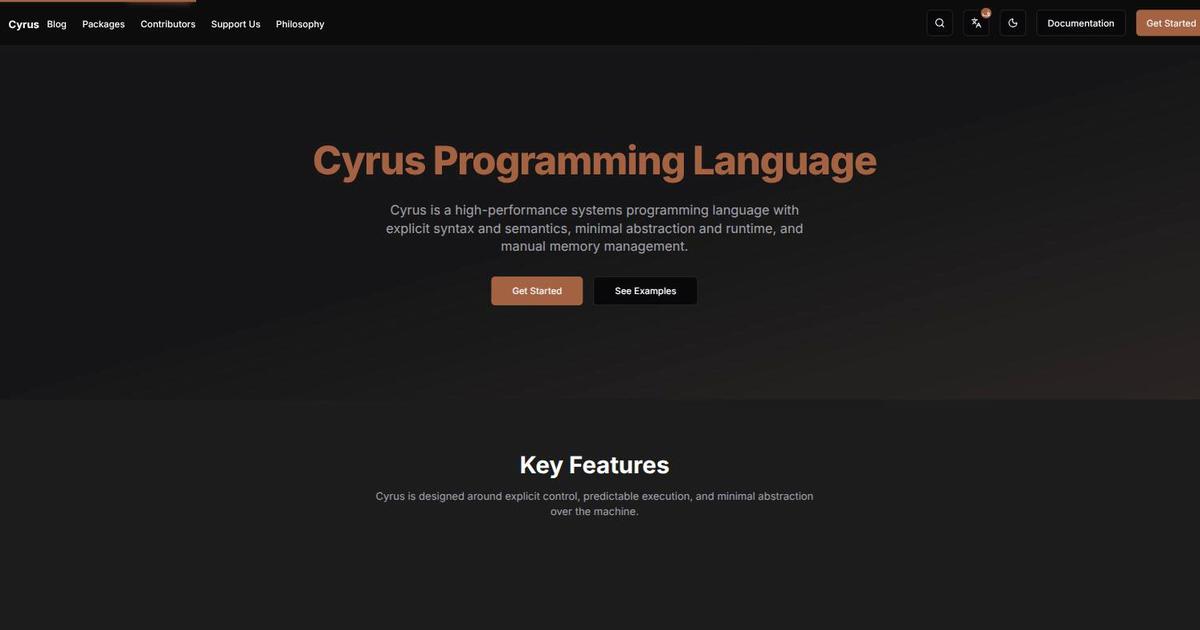
Systems language: manual memory, no GC, LLVM-native compilation
Replaces —
Who it's for
Cyrus provides the control of C with generics, a real module system, algebraic types, and `defer`-based resource cleanup. If C's lack of these constructs has led to hand-rolled workarounds in your codebase, Cyrus gives a path forward without adopting a garbage-collected language or Rust's ownership model. Mutability, pointer indirection, and type casts are all explicit at the call site.
You need Windows or macOS support at this time. The current compiler only targets Linux (x86_64).
Cyrus supports inline assembly, `extern` for C ABI compatibility, `naked` functions for interrupt handlers, pointer arithmetic, and custom allocator strategies. Zero hidden runtime overhead and fully manual memory control make it usable in contexts where a garbage collector or managed runtime is not acceptable.
Your target platform is not Linux (x86_64). Multi-platform support is in the roadmap but not yet available in the current release.
For teams writing high-performance CLI tools, compilers, parsers, or infrastructure utilities in Rust but experiencing friction with the borrow checker for data-structure-heavy code, Cyrus offers a similar performance ceiling with fewer lifetime constraints. The LLVM backend produces native binaries with no external runtime dependency.
Your team is productive with Rust and not experiencing borrow-checker friction. Cyrus trades safety guarantees for a simpler ownership model, not a safer one.
Cyrus is self-hosting: the compiler is being rewritten in Cyrus itself. The project documents its design rationale and deliberate omissions in the README and on the project website. Developers interested in compiler construction have a live LLVM frontend written in Rust to read, contribute to, and study alongside the official documentation.
You need a stable, production-ready language with ABI guarantees. Cyrus is pre-self-hosting and breaking changes are expected during the current development phase.
The problem
Systems programming requires precise control over memory, allocation, and execution flow. C provides that control but lacks a real module system, generics, and type safety for common patterns, so teams accumulate wrapper libraries and header workarounds to compensate. Rust solves those ergonomics problems but introduces a borrow checker and lifetime annotations that many teams find restrictive, particularly for data-structure-heavy work or embedded firmware where ownership patterns do not fit neatly. The gap is that the middle ground is mostly unoccupied. Developers who want C-level control without C's ergonomics deficits, but who do not want Rust's ownership rules for straightforward systems work, have limited choices. Existing options either bring a garbage collector (Go), a heavy runtime (Java, .NET), or require a paradigm shift (Rust). Teams end up spending time fighting tooling instead of writing the low-level code that actually matters.
How it works
Cyrus compiles ahead-of-time through LLVM to optimized native machine code, producing deterministic performance characteristics. Full interoperability with C code is available via the C ABI, so you can call C functions from Cyrus and expose Cyrus functions to C projects without writing glue code. The compiler accepts `extern(c)` on both sides of the boundary.
Memory is managed explicitly through manual allocation patterns and custom allocators. The `defer` keyword schedules cleanup at scope exit in LIFO order, keeping resource management flat and readable. There is no garbage collector and no hidden ownership system. Custom allocators (stack, bump, libc) are first-class via the `Allocator` interface, so you can swap strategies without changing calling code.
Strong static typing with no implicit conversions between types. Safe widening (for example, `int32` to `int64`) happens automatically, but any operation with risk of data loss or signedness mismatch requires an explicit `@cast`. Generics are monomorphized at compile time for direct static dispatch with zero runtime abstraction cost.
Mutability is declared with `const` or `var` at the definition site. Pointer indirection uses `->` explicitly, so every memory boundary crossing is visible in the source. There are no hidden allocations: every heap allocation requires calling an allocator explicitly. No monkey-patching, no implicit type coercions, no silent behavior behind compiler-driven assumptions.
Call C functions from Cyrus or expose Cyrus functions to C code using `extern(c)`, with no additional tooling or FFI wrappers required. This makes incremental migration from existing C projects feasible and allows reuse of the C ecosystem without rewriting libraries. Inline assembly, `naked` functions, and union type punning are also supported for low-level system interfaces.
Enums support unit variants, tuple variants, struct variants, and valued variants. Pattern matching uses a `switch` statement with case destructuring. Generics work across functions, structs, unions, enums, and interfaces, all type-checked at compile time without instantiation. Interfaces support both static (monomorphized) and explicit dynamic dispatch via the `dynamic` keyword.
Features
- LLVM-Based Native Compilation
- Manual Memory Management with Defer
- Strict Explicit Type System
- No Hidden Semantics
- Bidirectional C ABI Interoperation
- Algebraic Types and Pattern Matching
Recommended for this setup
Strengths
- No GC, No Borrow Checker: Cyrus deliberately omits both garbage collection and Rust's borrow checker. You get deterministic memory management and full control over allocation strategy without the cognitive overhead of lifetime annotations. This is the primary differentiator for teams who find Rust's ownership model too constraining for data-structure-heavy or embedded work.
- Explicit Semantics Throughout: Every operation with a side effect is visible in the source: mutability via `const`/`var`, pointer indirection via `->`, explicit casts via `@cast`, explicit allocations via an allocator call. No silent coercions, no hidden vtables on struct access, no implicit type transformations. Predictability is a design goal, not a side effect.
- Modern Language Features on a Proven Compiler Backend: Generics, algebraic types, interfaces with static and dynamic dispatch, modules, and `defer` for deterministic cleanup, all built on the LLVM infrastructure. The backend produces native binaries using the same optimization pipeline as Clang and Rust, so performance characteristics are comparable to C at the machine level.
- MIT License, No Usage Restrictions: The MIT license places no restrictions on commercial use, modification, or redistribution. You can use Cyrus to build commercial products, fork the compiler, or incorporate it into proprietary toolchains. The project is under active development with the most recent push in August 2026.
Trade-offs
- Linux-Only Compiler at Current Release: The current Cyrus compiler supports Linux (x86_64) only. Windows and macOS support is planned after the self-hosting milestone is complete. Teams working on macOS or targeting Windows cannot use Cyrus for production work until multi-platform support ships.
- No Stable ABI Between Versions: Cyrus does not guarantee a stable ABI between releases. Calling conventions, type layouts, and optimization strategies may change to improve performance. For cross-language boundaries, the project recommends using the C ABI (`extern(c)`) and treating the Cyrus-to-Cyrus ABI as an internal implementation detail.
- Pre-Self-Hosting, Breaking Changes Expected: Cyrus is actively working toward its self-hosting milestone, rewriting the compiler in Cyrus itself. Several planned features are not yet implemented: slices, full generic instantiation safety (currently behaves like C++ templates, not Rust-style), attributes, and a test framework. Teams should expect breaking changes during this phase.
- No Compiler-Enforced Memory Safety: Data races, dangling pointers, and use-after-free errors are possible and are not prevented by the compiler. The runtime enforces bounds checking, null pointer detection, and integer overflow, and sanitizers (ASan, TSan) are supported for debugging. The design trades safety guarantees for direct machine access and simpler code without ownership rules.
Tech stack
FAQ
No, not by design. Cyrus explicitly omits Rust's borrow checker and ownership system. Data races, dangling pointers, and use-after-free errors are possible. The runtime enforces bounds checking, null pointer detection, and integer overflow, and ASan/TSan sanitizers are supported for debugging. The trade is deliberate: Cyrus prioritizes direct machine access and code without lifetime annotations over compiler-enforced memory safety.
The current Cyrus compiler supports Linux (x86_64) only. Windows and macOS support is planned after the self-hosting milestone, which involves rewriting the compiler in Cyrus itself. A nightly binary is available for download, and building from source is documented on the project website at cyrus-lang.ir.
Memory is managed explicitly. You allocate memory using an allocator (libc, arena, or custom) and free it yourself. The `defer` keyword schedules cleanup at scope exit in LIFO order, keeping resource management readable and flat. Custom allocators implement the `Allocator` interface, so you can swap between strategies (arena vs. libc) without changing the calling code.
No. Cyrus does not guarantee a stable ABI between versions. Calling conventions, type layouts, and optimization strategies may change between releases to improve performance and code quality. The project recommends using the C ABI (`extern(c)`) for all cross-language boundaries and treating the Cyrus-to-Cyrus ABI as an internal detail that may evolve.
Cyrus positions itself between C and Rust. It has the explicit control and direct memory access of C, with a modern type system (generics, algebraic types, modules, no silent coercions) that C lacks. Unlike Rust, it has no borrow checker or lifetime annotations, so there is no ownership-based safety. It is closer in ergonomics to a modernized C than to Rust's safety-first model, targeting developers who want control without the complexity of lifetimes.