
Cube
Headless BI platform with a shared semantic layer for your data
Replaces Atscale, Looker, Tableau Embedded Analytics
Who it's for
Cube provides governed metrics and cached APIs for product analytics features shown inside an application.
Skip if all analytics are internal and your BI tool already handles performance well.
Use Cube to keep revenue, usage, and operational metrics consistent across BI, notebooks, and application APIs.
Skip if your organization is not ready to maintain semantic models in code.
The problem
Analytics teams often define the same metric in dashboards, notebooks, warehouse SQL, and application code. Revenue, activation, and retention numbers drift because each tool has its own formulas, filters, and joins. The pain grows when product teams embed analytics into customer-facing apps. Developers need fast APIs and caching, while data teams need metric definitions that stay consistent across tools.
How it works
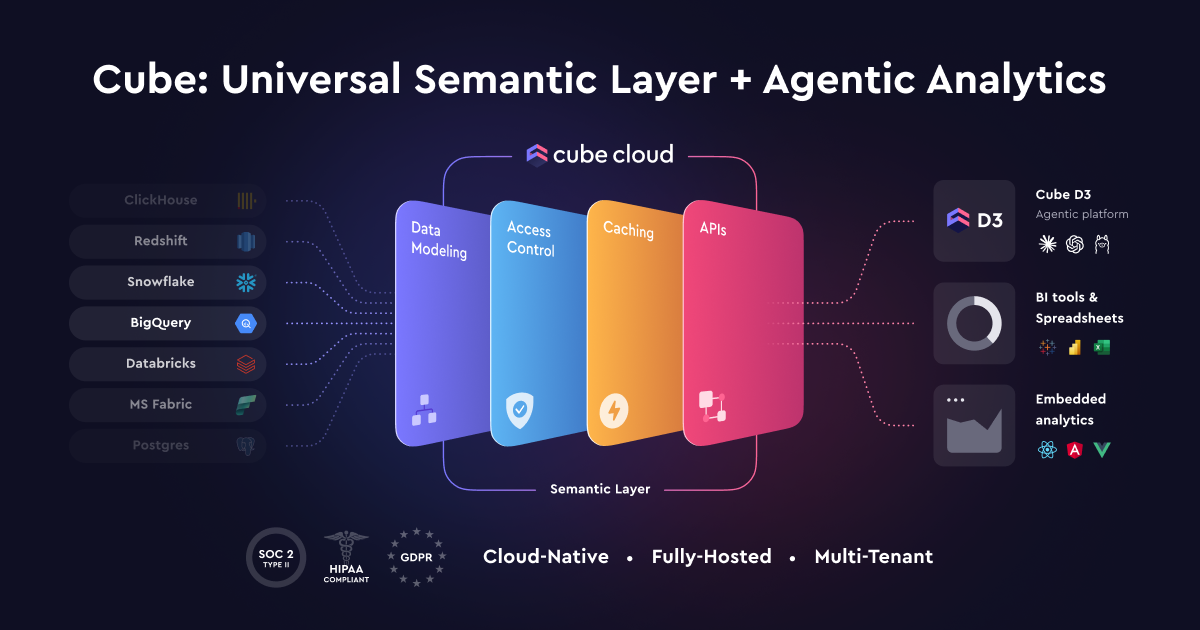
Models cubes, measures, dimensions, joins, and access rules in code so metrics can be reviewed and versioned.
Exposes REST, GraphQL, SQL, and client SDK paths for building dashboards and data apps on top of the same metric definitions.
Supports pre-aggregations and query acceleration so high-traffic embedded analytics do not hit the warehouse for every request.
Features
- Code-defined semantic layer
- APIs for embedded analytics
- Caching and pre-aggregations
Recommended for this setup
Strengths
- Metric logic leaves the BI silo: Cube lets teams define metrics once and serve them to multiple frontends instead of copying SQL between dashboards and apps.
- Good fit for embedded analytics: The API-first model serves product teams building analytics into SaaS applications, not only analysts using internal BI.
Trade-offs
- Semantic modeling is upfront work: Teams must design cubes, joins, measures, and cache strategy. For a small internal dashboard, a direct BI connection may be simpler.
Tech stack
FAQ
Cube has an open source core and publishes its code on GitHub.
Cube is used as a semantic layer and API layer for analytics, especially embedded dashboards and customer-facing data apps.
Looker is a proprietary BI platform with its own semantic modeling layer. Cube focuses on an open source, API-first semantic layer that can power many frontends.