
Bugsink
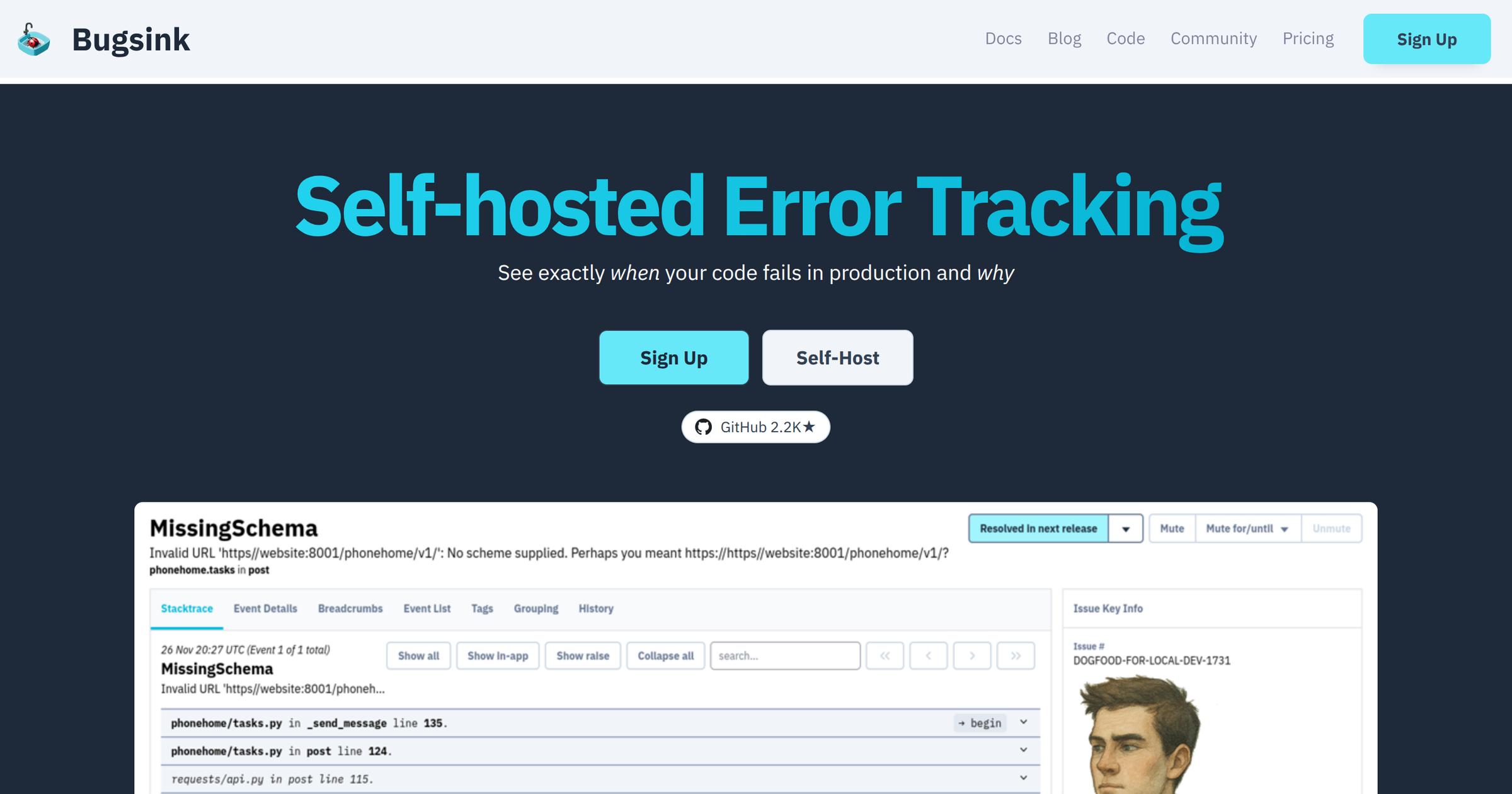
Self-hosted error tracking, drop-in compatible with all Sentry SDKs.
Replaces Sentry, Rollbar, Bugsnag, Honeybadger, Raygun, Airbrake
Who it's for
Teams instrumented with Sentry SDKs who want to reduce their monthly monitoring bill can migrate by changing a single DSN value. No instrumentation changes are needed. The full stacktrace and local variable capture remains identical to what Sentry provides.
Skip if your team has no existing Sentry SDK instrumentation and is evaluating error trackers from scratch. Bugsink's main advantage is a zero-friction migration path; starting fresh removes that edge.
Development teams running services that generate a large number of exceptions, whether from traffic spikes, background jobs, or noisy error conditions, benefit most from a self-hosted model. Event-volume costs that grow linearly on hosted services become a fixed infrastructure cost instead.
Skip if your production error rate is low and your hosted error tracker plan is well below its tier limit. The cost argument is weakest when event volume is small.
Applications that handle EU user data and need to control where exception payloads and local variable captures are stored can self-host on their own infrastructure or use the managed EU-hosted plan. Exception data, which may include user context, stays within controlled boundaries.
Skip if data residency is not a concern and you prefer a fully managed service with no infrastructure overhead. Hosted Sentry and Bugsnag remain strong options for teams without compliance constraints.
A single Docker command gets Bugsink running locally. The self-hosted path has no licensing cost for internal use under PolyForm Shield, so small teams can track production errors without a recurring SaaS subscription.
Skip if you need built-in performance monitoring, tracing, or session replay in the same tool. Bugsink focuses on error and exception tracking; Sentry's full paid plan covers a wider observability surface.
The problem
Hosted error tracking charges by event volume. A backend service that throws exceptions during a traffic spike or a noisy logging period can generate events in large numbers with no corresponding limit on the monthly bill. Most hosted error trackers tier by error volume, so the more exceptions your production systems generate, the more you pay. Rollbar, Bugsnag, and Sentry all follow this model on their hosted plans. The other issue is data residency. Exception payloads contain stacktraces, local variable values, and sometimes user context. Sending that data to a third-party cloud service adds a dependency outside the team's control and raises questions for GDPR-regulated deployments. Teams that need their error data to stay on their own infrastructure have no option on the major hosted services.
How it works
Accepts events from any Sentry-compatible SDK without code changes. Updating the DSN in your existing Sentry configuration is the entire migration. SDKs for Python, JavaScript, Go, Ruby, PHP, Java, and other languages all work out of the box.
Every exception includes the full call stack and the value of every local variable at each frame at the moment the error fired. This gives you the exact state of the application at the point of failure, not just where it crashed.
Self-hosted Bugsink has no event-volume caps or per-event charges. You pay for the server, not for the number of exceptions. The product website states teams can cut a Sentry invoice by up to 80% on a managed Bugsink plan.
The quickest path is one docker run command with three environment variables: a secret key, a superuser credential, and a port. No external database is required to evaluate the tool; a Postgres database is added for production persistence.
Bugsink offers a managed plan hosted in EU infrastructure alongside the self-hosted option. Both run the same product, so teams can switch between managed and self-hosted without changing SDK configuration or losing event history.
Features
- Drop-in Sentry SDK compatibility
- Full stacktraces with local variable capture
- No per-event billing on self-hosted instances
- Single Docker command to get started
- Managed and self-hosted on the same codebase
How to install
Self-hosting runs via Docker; a Postgres database is recommended for production deployments.
docker pull bugsink/bugsink:latest

docker run \
  -e SECRET_KEY=PUT_AN_ACTUAL_RANDOM_SECRET_HERE_OF_AT_LEAST_50_CHARS \
  -e CREATE_SUPERUSER=admin@example.org:admin \
  -e PORT=8000 \
  -p 8000:8000 \
  bugsink/bugsink
Recommended for this setup
Strengths
- Identical SDK interface as Sentry: Any application already instrumented with a Sentry SDK can point at Bugsink by changing one DSN value. No library change, no code rewrite. This removes the main friction from migrating away from a hosted error tracking plan.
- Event storage without volume caps: Unlike Sentry's hosted plans, which cap error events by tier, a self-hosted Bugsink instance stores every event it receives at no incremental cost. Teams running high-throughput services or frequent exception bursts are not penalized.
- GDPR-friendly data location: Self-hosting keeps all exception data, stacktraces, and local variables on the team's own infrastructure. The managed Bugsink plan runs in EU data centers. Both options let teams control where error payloads, which may contain user context, are stored.
- Active development since August 2024: The repository reached its last push on November 4, 2026 and has 2,166 stars and 146 forks. Over 2,000 teams are using Bugsink weekly according to the product website, with community testimonials noting easy setup and ARM compatibility.
Trade-offs
- PolyForm Shield license restricts competitive use: Bugsink uses the PolyForm Shield 1.0.0 license, which permits self-hosting and internal commercial use but forbids building a product that competes with Bugsink or any product its affiliates offer using the software. Teams that want to build a hosted error tracking service on top of Bugsink cannot do so under this license.
- 115 open issues at the time of review: The GitHub repository carried 115 open issues at the time this entry was written (from GitHub Issues API, pull requests excluded). For a project launched in August 2024, this indicates active use and ongoing development, but also suggests some rough edges that more mature tools have resolved.
- No performance monitoring or distributed tracing: Bugsink focuses on error and exception tracking. It does not include performance monitoring, distributed tracing, profiling, or session replay. Teams that need a full observability surface beyond error tracking will need to combine Bugsink with separate tools, or stay on a hosted platform like Sentry that bundles all of them.
Tech stack
FAQ
Self-hosted Bugsink is free for internal use under the PolyForm Shield 1.0.0 license. The license permits self-hosting, running, modifying, and distributing the software for any purpose that does not compete with Bugsink's own products. A managed hosted plan is also available for teams that want Bugsink without the infrastructure overhead.
Yes. Bugsink is designed as a drop-in replacement for Sentry's ingest endpoint. Any application using a Sentry SDK, including SDKs for Python, JavaScript, Go, Ruby, PHP, and more, connects to Bugsink by updating the DSN. No other code changes are required.
The quickest path is a single docker run command. You set three environment variables: SECRET_KEY (at least 50 random characters), CREATE_SUPERUSER (email:password format), and PORT. Map the port and visit the login screen at http://localhost:8000. Detailed installation instructions, including production Postgres configuration, are on the Bugsink documentation site at https://www.bugsink.com/docs/installation/.
PolyForm Shield 1.0.0 permits you to self-host, run, modify, and distribute Bugsink for any purpose, including internal commercial team use. The restriction is that you cannot use Bugsink to build a product that competes with Bugsink or its affiliates. For the overwhelming majority of teams, running Bugsink for their own error tracking falls well within the license.
Sentry also publishes a self-hosted version, but it requires a full Docker Compose stack with multiple services and significantly more infrastructure than a single container. Bugsink starts with a single docker run command and a Postgres database. Teams looking for a lighter self-hosted error tracker often choose Bugsink over Sentry's self-hosted option for lower operational overhead.