Body.build
Free evidence-based weightlifting app with fractional volume counting
Replaces Fitbod, Rp Hypertrophy, Alpha Progression, Hevy, Strong
Who it's for
Lifters who want fractional volume counting, muscle-group coverage guidance, and per-group volume recommendations without a monthly subscription. Body.build encodes the Henselmans course curriculum into the program maker.
Skip if you are a beginner who needs guided progressions and polished onboarding. The README notes that making the app more accessible to beginners is a future roadmap goal, not a current priority.
The exercise library with technique cues, coaching ratings, and scientific study links doubles as a reference tool. Coaches can use the program maker to design volume-balanced, muscle-complete programs.
Skip if you need client management features such as check-ins, form review, or billing. Body.build is a programming and exercise reference tool only.
Body.build requires no account and, per the site, collects no personal data. For athletes who want no cloud dependency tied to a third-party account, this is the clearest advantage over paid apps in the category.
Skip if you need to access your training data on multiple devices. Cross-device sync is not documented.
The AGPL-3.0 source is on GitHub and written in Flutter (Dart). Developers can read the volume calculation logic, contribute new exercises to the library, or extend the project under the license terms.
Skip if you need a self-hosting setup guide. The README does not include deployment instructions; building the app from source requires Flutter toolchain knowledge.
The problem
The best evidence-based programming tools all charge ongoing subscription fees. Fitbod, RP Hypertrophy, and Alpha Progression are paid apps, so you cannot read the source behind the programming approach you are trusting your training to. Lifters who want fractional volume counting, muscle-group coverage guidance, and per-muscle-group volume recommendations face a choice between paid apps and managing spreadsheets. Data ownership is a secondary concern. When training history lives inside a paid subscription app, access depends on keeping payments current.
How it works
Covers major exercises with technique variations, cue descriptions, links to relevant scientific studies, and ratings from coaches and content creators. The site describes it as an extensive catalog of exercises with technique tweaks and cues.
Measures training load in fractions rather than whole sets, giving more precise volume balancing across muscle groups. The program maker uses this to surface volume imbalances across the muscles you are training.
Identifies antagonist muscle pairings and non-overlapping musculature sets within a program. Per the site, this flags opportunities for exercise pairing that improve both time efficiency and training gains.
Generates per-muscle-group volume targets based on your body stats, lifestyle, nutrition, and training goals. The site describes these as recommendations based on the latest evidence.
Interactive anatomy reference covering all major muscles and the joint movements they control. The program maker uses it to confirm complete muscle coverage across movement patterns and muscle lengths, as the site describes.
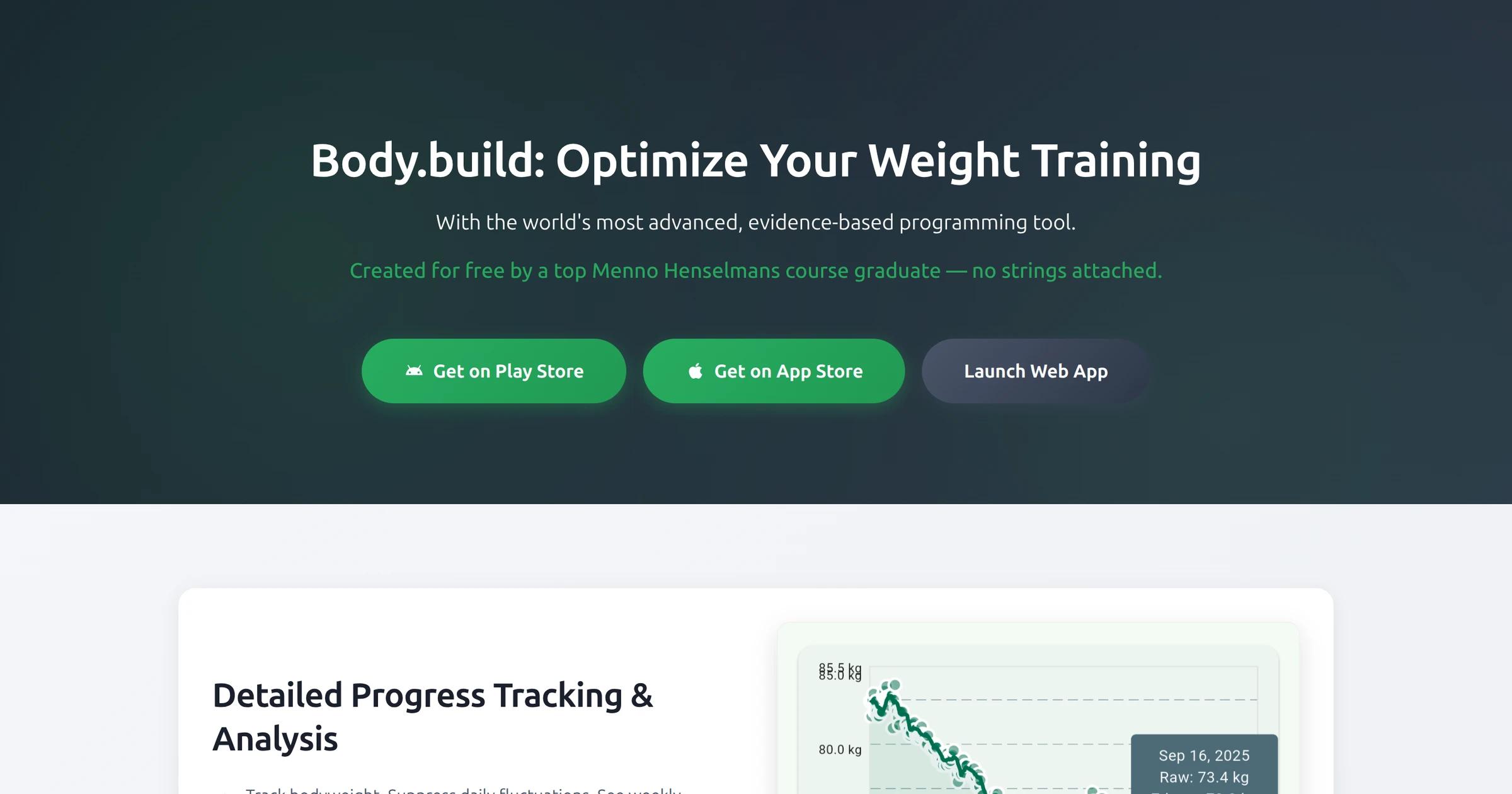
Logs individual sets with exercise cues, variations, and notes. Tracks bodyweight with weekly progress views that suppress daily fluctuations. The site also notes that deep analysis comparing performance across technique variations is coming soon.
Features
- Exercise library with technique cues and study links
- Fractional volume counting for precise load balancing
- Antagonist superset and time-efficiency detection
- Personalized weekly volume recommendations
- Anatomy module for muscles and joint articulations
- Set logging and bodyweight tracking
Recommended for this setup
Strengths
- Completely free with no account and no ads: Body.build charges nothing and requires no sign-up. The site states: "100% Free. No payment, no ads, no sign-up. No personal data collection." The creator's stated goal is a free public tool for lifting, like Wikipedia but for training.
- AGPL-3.0 source on GitHub: The full source is on GitHub at github.com/Dieterbe/body.build under AGPL-3.0. Anyone can read the volume calculation logic, fork the project, or contribute exercises to the library.
- Creator is a Menno Henselmans course graduate: The creator is a graduate of the Menno Henselmans Personal Training Course, as stated on the product website. The programming recommendations in the app reflect that course curriculum.
- Active development across web, Android, and iOS: Available as a web app and as native Android and iOS apps. The GitHub repository received its last push in October 2026, with an in-gym tracker and personal analytics listed as the next features in the roadmap.
Trade-offs
- Small community and early-stage codebase: The GitHub repository has 37 stars and 17 open issues. Compared to mature fitness apps, the user base is small, and early adopters should expect rough edges as the project matures.
- In-gym tracker and personal analytics not yet shipped: The README lists an in-gym performance tracker and personal analytics as in the works. The site also marks cut, bulk, and contest-prep cycle comparison as coming soon. Lifters who need those features today will find the feature set incomplete.
- AGPL-3.0 restricts commercial hosted service deployments: Anyone who deploys a modified version of Body.build as a public network service must publish their source changes under AGPL-3.0. Using the app as a lifter is unaffected, but building a commercial hosted service on the codebase means releasing those changes.
Tech stack
FAQ
Yes. The site states: "100% Free. No payment, no ads, no sign-up. No personal data collection." There are no subscription tiers or premium features listed on the site.
Body.build is AGPL-3.0 licensed. You can read, modify, and distribute the source. If you deploy a modified version as a public network service, you must publish your source changes under AGPL-3.0.
The site lists set logging with exercise cues and notes, bodyweight tracking with weekly progress views, the exercise library, the program maker, and the anatomy module as available. The README lists an in-gym performance tracker and personal analytics as in the works. The site also marks detailed cut, bulk, and contest-prep cycle comparison as coming soon.
Body.build is free; Fitbod and RP Hypertrophy are paid apps. Body.build's site states no sign-up and no personal data collection. The main trade-off is that Body.build's in-gym tracker and personal analytics are still in development, as noted in the README, so lifters who need those features today may prefer a paid option.
Body.build is written in Flutter (Dart). GitHub shows JavaScript as the primary language because it detects the compiled web build, but the actual source is Flutter, as noted in the README.