
Atomic CRM
Atomic CRM is a React and Supabase CRM starter for contacts, tasks, notes, email capture, deals, access control, and customization. It replaces buying a rigid CRM when developers want a codebase they
Replaces —
Who it's for
Atomic CRM fits teams that want contacts, deals, tasks, and notes but expect to customize the system heavily.
You need a vendor-managed CRM with support, marketplace apps, and sales operations features ready on day one.
The React and Supabase stack works well as a reference app for client-specific CRM or admin workflows.
Your client cannot maintain a custom application after handoff.
The problem
A CRM becomes painful when the team's sales process does not match the vendor's assumptions. Custom fields, activity history, deal stages, email capture, and access rules often turn into paid add-ons or brittle workarounds. Developer-led teams sometimes need CRM structure but still want full control over the product surface. Starting from scratch wastes time, while a closed CRM can make every meaningful customization dependent on vendor APIs and pricing.
How it works
Atomic CRM ships as a React CRM application backed by Supabase, giving developers an app-shaped starting point instead of only a component kit.
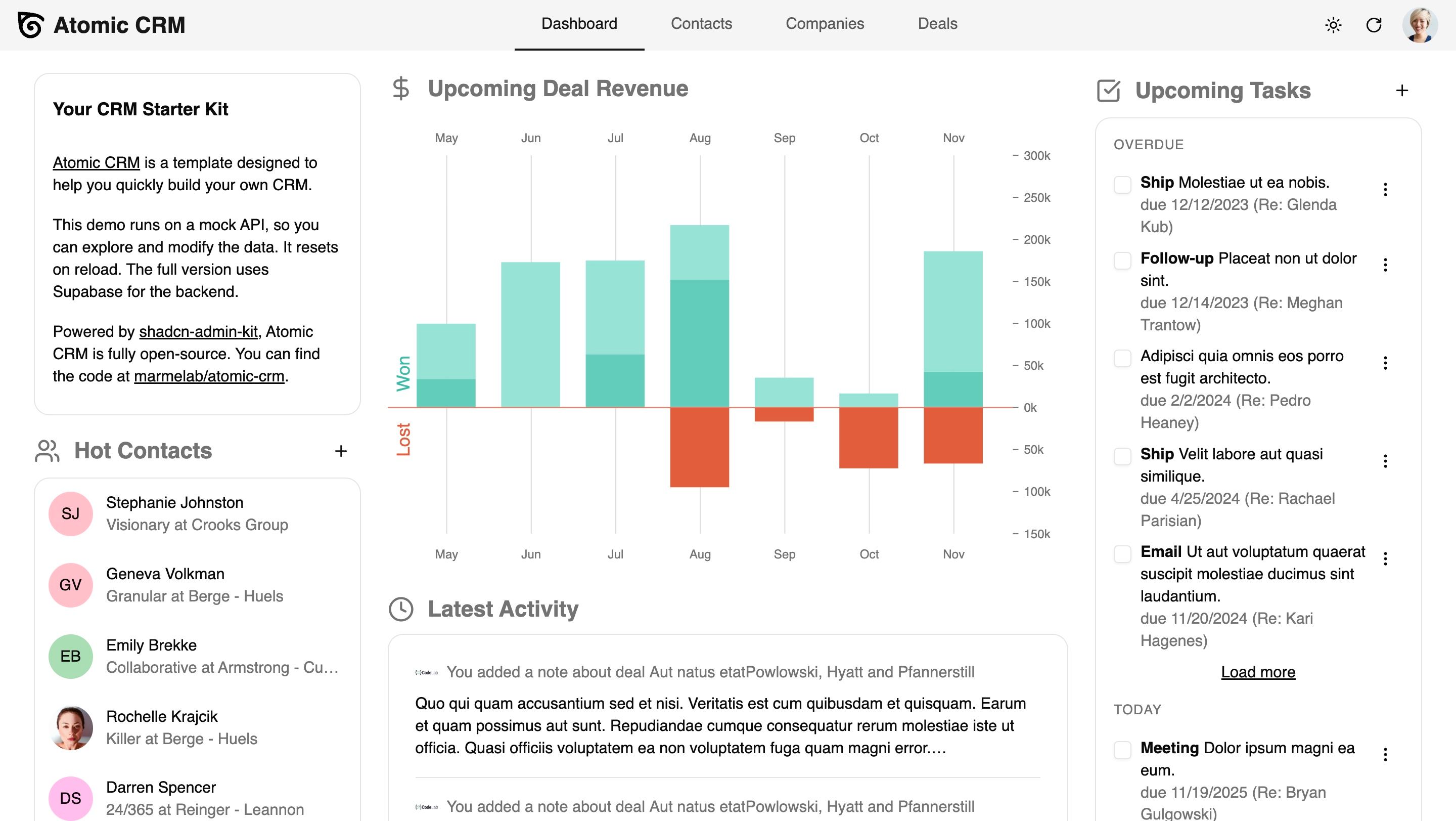
Atomic CRM includes contacts, tasks, reminders, notes, email capture, deals, activity history, and import/export, covering the core objects a small sales team expects.
Atomic CRM supports custom fields, theme changes, and component replacement, which helps teams make the CRM match internal workflows.
Features
- React CRM application
- Sales workflow primitives
- Customizable source code
Recommended for this setup
Strengths
- Developer-friendly CRM base: Atomic CRM is strongest when the buyer is also willing to adapt the code. It gives engineers a working CRM foundation instead of a blank repository.
- Forkable CRM foundation: Atomic CRM is MIT licensed, which makes it practical to fork, customize, and use commercially without vendor CRM constraints.
Trade-offs
- Requires engineering ownership: Atomic CRM is a codebase, not a turnkey SaaS with admin support. Teams need developers to run Supabase, customize flows, and maintain the app.
Tech stack
FAQ
Atomic CRM uses React, shadcn-admin-kit, and Supabase.
Atomic CRM can replace a lightweight CRM for teams willing to own the code, but it is not a Salesforce-scale sales operations platform out of the box.
Yes. Atomic CRM is free and open source under the MIT license.