
Altorank
Open-source SEO content engine with human-approval publishing
Replaces Surfer Seo, Frase, Clearscope, Marketmuse
Who it's for
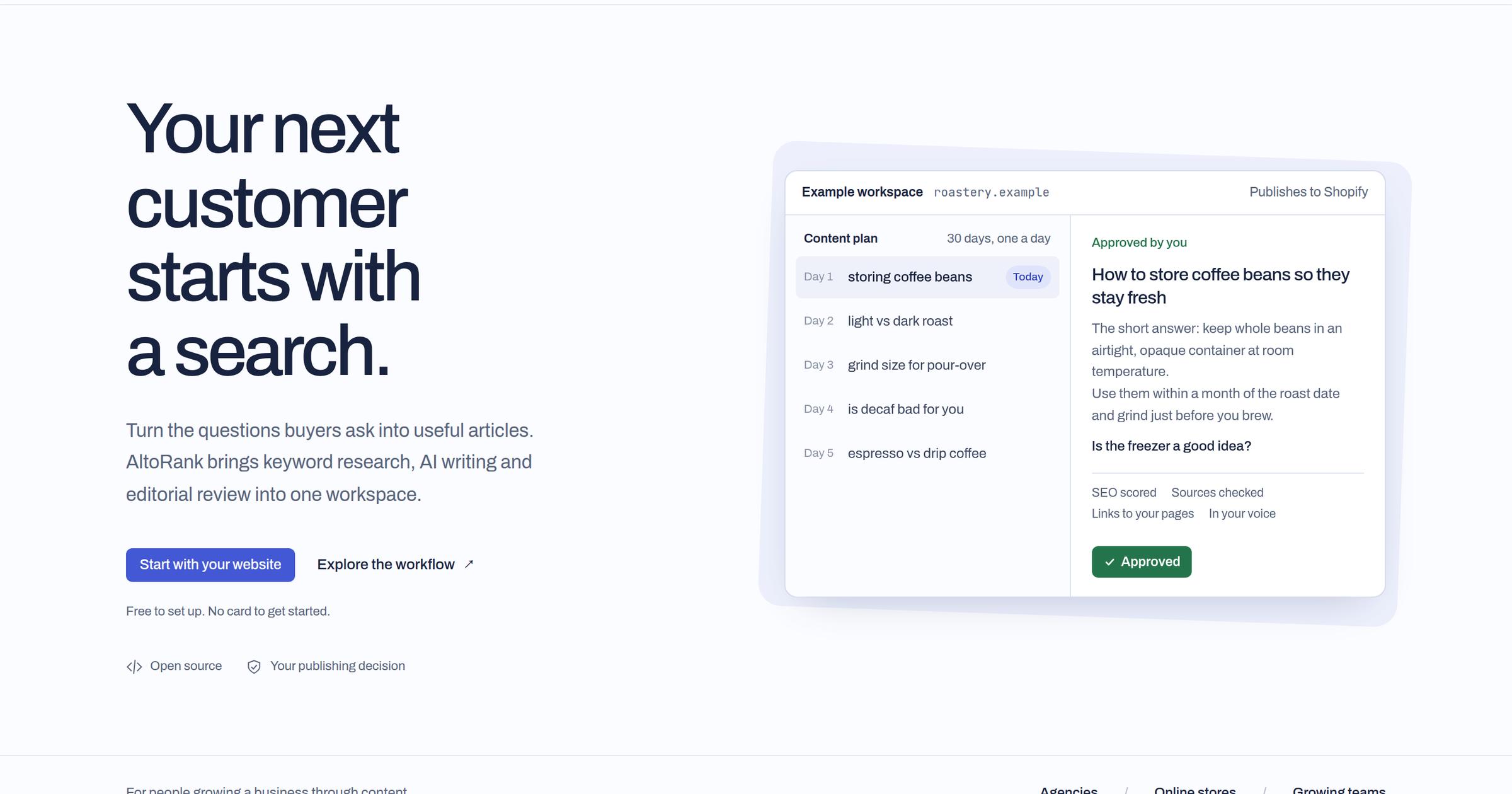
AltoRank holds a content plan (for example, 30 articles per month), drafts each article when it is due, and queues it for reviewer approval. The editorial gate keeps the team's name on every article without requiring a reviewer to be present during generation.
Your publish cadence is fewer than a few articles per week. The setup overhead is higher than drafting manually for occasional content needs.
Each workspace keeps a client's voice profile, keyword plan, content history, and analytics connections separate. The Agency hosted plan includes unlimited workspaces; self-hosting removes per-workspace cost entirely.
Your clients require direct CMS publishing today. The CMS adapters are built but not yet verified end to end; Markdown and HTML export is the current reliable path.
The MCP server and agent API let you drive keyword research, draft generation, and content plan management from an AI coding agent or custom automation. The AltoRank skill installs via npx skills add AltoRank/altorank and works with Claude Code, Cursor, Codex, and other supported agents.
You need the agent to approve and publish drafts autonomously. The API has no such calls, and adding one would violate the project's stated contribution policy.
Running AltoRank on your own Supabase instance keeps keyword data, drafts, voice profiles, and analytics connections on infrastructure you control. The AGPL-3.0 license permits commercial use, including internal client work, without a subscription fee.
You are not comfortable running a Node application with Supabase. The hosted app at app.altorank.co removes that operational overhead at €69 per month.
The problem
Scaling SEO content production means maintaining research quality, editorial consistency, and publishing control across many articles. Most teams solve this by stringing together separate paid tools, using one for keyword research, another for AI drafting, and a third for optimization scoring. The workflow breaks at each handoff, and the approvals and publishing steps remain outside those tools. The accountability gap is the harder pain. AI-generated content can reach a live site before anyone has reviewed it for accuracy or verified the sources behind its claims. For teams that put their name on the articles they publish, the absence of a reliable approval gate is a real operational risk.
How it works
Queries DataForSEO for keyword volume, difficulty, and SERP competition data to populate the content plan. Without DataForSEO credentials, the research step is skipped rather than failed, so the drafting pipeline still runs on the remaining inputs.
Generates a structured draft from a keyword brief, then runs an SEO score pass and a fact-check pass. Any figure citing a source is looked up on that source page; figures with no source are flagged. The Approve button refuses a draft with unresolved unsourced figures.
No article can reach a CMS or be marked live without approval recorded under a named person. A site member can enable an auto-approve rule that approves drafts after a configurable hold window, but the rule is set by a named person and runs stricter checks than the manual Approve button.
Exposes research, drafting, and content-plan operations as MCP tools at /api/mcp (Streamable HTTP, OAuth). AI agents can queue drafts for human review and manage the content plan; the API has no approve, delete, or publish call by design.
Every draft exports as Markdown (front matter included), HTML, or a .md file download. Thirteen adapters cover ten CMS platforms including WordPress, Shopify, Webflow, Ghost, and Framer; direct CMS publishing is built but awaiting end-to-end verification against live sites.
Features
- Keyword research via DataForSEO
- Scored and fact-checked article generation
- Human-approval gate enforced at database level
- MCP server and agent API
- Markdown, HTML, and CMS export
How to install
Self-hosting setup requires Node 22+, a Supabase project, and API keys for Anthropic and email; full environment variables are documented in docker/.env.example.
git clone https://github.com/AltoRank/altorank
cd altorank
npm install
cp docker/.env.example apps/web/.env.local
npm run dev
Recommended for this setup
Strengths
- Approval gate enforced below the application layer: The approval constraint is written into the database schema (migration 109). Only the server can mark an article as approved, and a signed-in user's own database client cannot bypass it. An edit to approved text sends the article back to review. The restriction is not a UI toggle.
- Full self-hosting with no feature tier held back: The self-hosted version is the complete product, AGPL-3.0 licensed, with no separate paid tier held behind an ee/ directory. The same codebase powers app.altorank.co, so keyword research, AI drafting, scoring, fact-checking, rank tracking, and the MCP server are all available to self-hosters.
- Agent API with enforced authority limits: The MCP server and agent API can research keywords, suggest topics, generate drafts, and manage the content plan, but have no approve, delete, or publish calls. The restriction is at the API level, not configuration, so it cannot be worked around by an agent.
- 35-locale keyword research and article generation: Keyword research, SEO scoring, and article generation span 35 locales (apps/web/lib/seo/locales.ts), covering regional search intent across European, North American, and Asia-Pacific markets without requiring separate workspace configurations per region.
Trade-offs
- CMS publishing unverified end to end: Thirteen CMS adapters are built and the connection form covers all platforms, but none has been tested against a live site. Every published draft is available as Markdown or HTML export today; direct CMS publishing requires requesting integration assistance until the adapters are verified.
- Early-stage project with limited community validation: AltoRank was created in August 2026 and has 3 GitHub stars and 13 open issues as of October 2026. The hosted app runs from main, but the codebase has not been validated by a broader contributor community. Teams with low tolerance for early-stage software should evaluate the project timeline before committing.
- Self-hosting requires multiple external services: A complete self-hosted install needs Node 22+, a Supabase project, an Anthropic API key for article generation, a Resend account for transactional email, and optionally DataForSEO credentials for keyword data. Setup involves more moving parts than a single Docker image.
Tech stack
FAQ
Yes. The self-hosted version is AGPL-3.0 licensed and carries no subscription fee. You cover your own hosting costs (a Node 22+ server and Supabase) and API usage costs for Anthropic (article generation) and, optionally, DataForSEO (keyword data). The hosted app at app.altorank.co starts at €69 per month with model and data costs included.
No. The agent API and MCP server have no approve or publish call; the only publish-side call retries a failed CMS publish of an article a person already approved. The restriction is enforced at the API level, not by configuration, so it cannot be toggled off.
Thirteen adapters cover WordPress (two paths), Shopify, Webflow, Ghost, Notion, Framer, HubSpot, Magento, Wix, WooCommerce, and git and webhook targets. As of October 2026, the adapters are built but awaiting end-to-end verification against live sites. Every draft exports as Markdown (with front matter) or HTML today.
AGPL-3.0 is an OSI-approved copyleft license. You can self-host AltoRank commercially, run it for client work, and modify it freely. The one obligation applies when you modify the source and offer that modified version to others as a network service: you must share your changes back under the same license. Running an account or using AltoRank for clients has no such obligation.
After generating a draft, AltoRank checks each cited figure against its linked source page. A figure with a source is looked for on that page; if it is absent, it is flagged for the reviewer. Figures with no source at all are also flagged. The Approve button refuses a draft with an unresolved unsourced figure, requiring the reviewer to add a source or remove the claim before publication.