
5dive
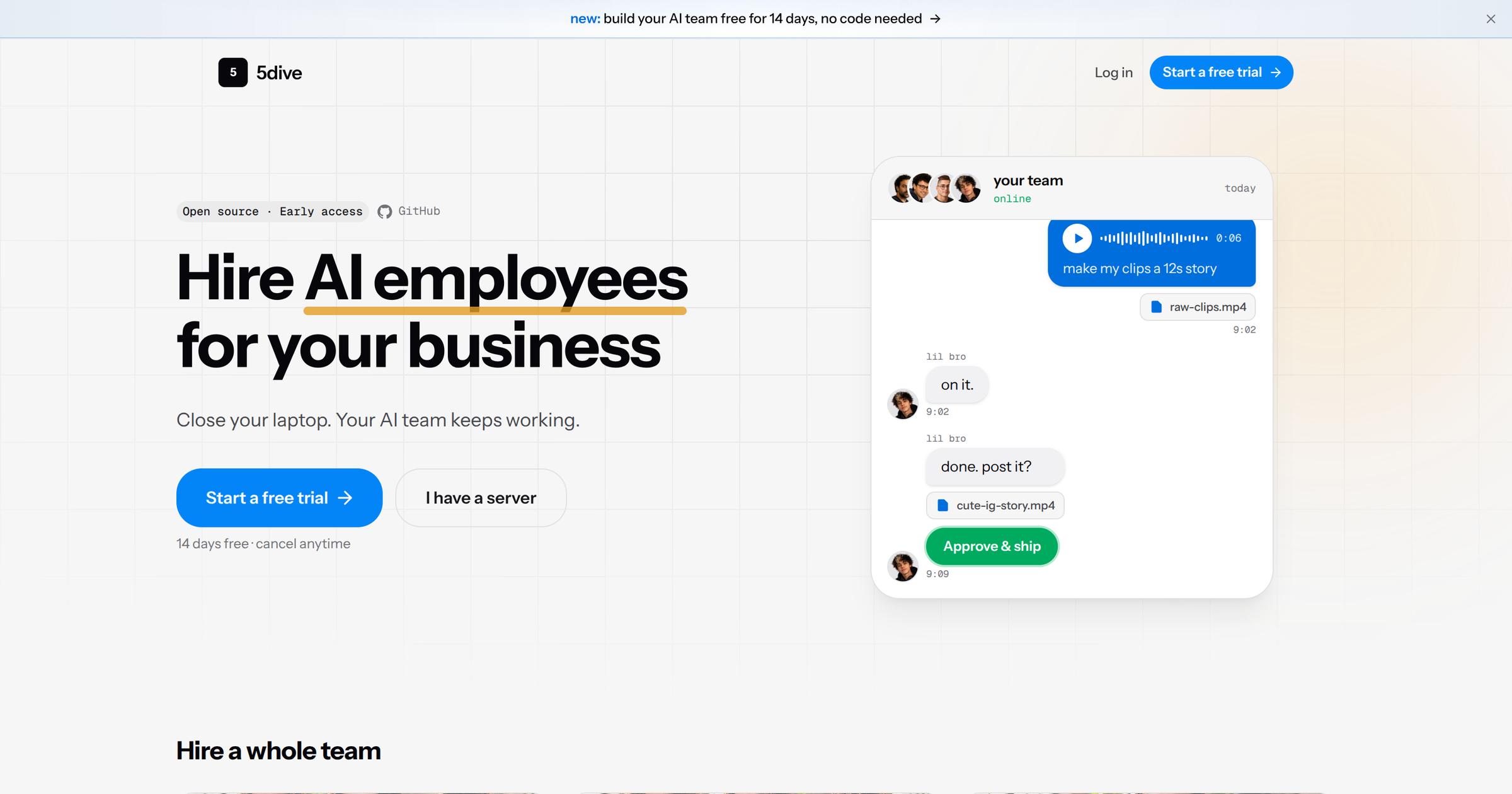
Hire a team of AI agents and run it from your phone, on a server you own.
Replaces Grok Bot, Openai Dots
Who it's for
5dive ships with ready-made agent teams you hire with one command. Assign tasks from your phone, let agents delegate to each other, and check results without babysitting a chat session. The zero-human metric in the README tracks what fraction of a week's work shipped without a human touch.
If your tasks require real-time human judgment or a highly visual workflow, persistent agent loops add overhead without matching a human. 5dive is best for structured, repeatable work that runs on a schedule or reacts to defined triggers.
Create a CTO, DevOps, and QA agent sharing one Claude subscription. Assign GitHub issues directly; agents review each other's work before a task closes. `5dive trace <task>` shows the full decision history for auditing.
If your team already uses a CI/CD pipeline with built-in AI features, 5dive adds server management without a clear net benefit. It is most useful when agents need access to private internal systems that cannot be exposed to a third-party service.
Local-only mode runs agents entirely on your hardware using Ollama or another local model server. All agent communication stays inside the network, and no task data or API keys leave the host. The setup is documented in the guide and verifiable from the config.
Local models are slower and less capable than hosted frontier models for most tasks. If strict offline compliance is not required, running agents on your own server with hosted models is faster to set up.
The marketing agent team includes a CMO, writer, researcher, and ads manager that you hire with one command. Loops for social posting, blog writing, and community replies are available from the marketplace and run on agent-defined cron schedules.
If your content workflow involves close editorial oversight or real-time brand decisions, fully automated content loops will produce drafts that need significant review. Best suited for teams comfortable with agent-generated first drafts.
The problem
Managing multiple AI agents typically means renting capacity from a managed service. With Grok Bot or OpenAI Dots, you pay for agents that run on their infrastructure, with model choices fixed to their offering and no way to audit what data passes through their systems. Costs scale with usage on terms you do not set. The underlying problem is that most AI tools are session-based: you open a chat, wait for a response, and close the tab. Running a team of agents that keeps working overnight, routes subtasks between roles, and delivers a summary to your phone requires either a managed service subscription or a way to run persistent processes on a server you control.
How it works
Each agent runs as a Linux systemd service under its own user account, so it keeps working after you close your terminal. Agents restart automatically on failure, with logs in journald. A 1 GB server is enough to run multiple agents in parallel.
The shared SQLite task queue lets one agent hand work to another, with an optional reviewer that must approve before the task closes. Tasks can recur on a cron schedule, and GitHub issues or webhooks can open new ones automatically.
One Claude or ChatGPT subscription can be shared across every agent you create. You sign in once per provider with `sudo 5dive account add` and each agent draws from that plan. Multiple agents run on a single key without separate subscriptions.
The 5dive app links your phone to your server for chat, task management, and status checks. Telegram works as a full alternative. Each agent gets its own Telegram contact. API keys arrive via one-time links from your phone, stored only on your server.
A loop assigns a recurring job to an agent, such as a competitor digest, daily briefing, or weekly social post. Ready-made loops are in the marketplace. Each loop self-scores and an agent rewrites the weakest loop's instructions weekly; you apply the change or let it apply itself.
Running `sudo 5dive config local-only on` cuts every outside connection. Agents use a local model (Ollama, LM Studio, vLLM) and you chat with them on a local web page. No data leaves your network, which meets common compliance requirements for sensitive environments.
Features
- Persistent agent processes
- Multi-agent task delegation
- Shared AI plans and API keys
- Mobile control via app and Telegram
- Loops for scheduled agent work
- Fully offline mode
How to install
Self-host 5dive on a Linux server running Ubuntu 22.04 or newer using the install script.
curl -fsSL https://install.5dive.ai | sudo bash
sudo 5dive init
Recommended for this setup
Strengths
- MIT license with no usage fees: The self-hosted version is MIT licensed, so you run it on your own infrastructure without licensing costs. Unlike Grok Bot and OpenAI Dots, there is no per-call or per-seat billing. You pay for the server and your AI provider's subscription, nothing more.
- Any model, any provider: Agents are not tied to one AI provider. You can run a Claude agent on DeepSeek, Kimi, or any OpenRouter model; run a Codex agent on a ChatGPT plan; and add local models via Ollama or LM Studio. Different agents on the same server can use different models.
- No data through 5dive servers: API keys go directly to AI providers, never through 5dive's infrastructure. No 5dive telemetry runs by default. In local-only mode, nothing leaves the host at all. The install script is public and auditable on GitHub.
- Minimal hardware requirements: The recommended minimum is a 1 GB Linux server. The core stack is Bash, systemd, and SQLite, with no Kubernetes, managed database, or container orchestration. A low-cost VPS or a Mac mini running Docker is enough for a small team.
Trade-offs
- Linux-only bare-metal install: The direct install path requires Ubuntu 22.04 or newer. macOS and Windows users must run agents in Docker or on a remote Linux server. For teams without an existing Linux server, the Docker path works but adds a setup step and resource overhead.
- Early-stage project with active development: 5dive launched in May 2026 with 97 stars and 8 open issues at the time of writing. The feature set was still expanding, with some marketplace listings and skill integrations still in progress. Teams running production workloads should enable nightly self-updates to stay current.
- Self-hosting responsibility: You manage server updates, monitoring, and backups. The `self-update` command handles 5dive itself, but OS patches and disaster recovery fall to you. For teams with no Linux administration experience, the operational overhead is real and ongoing.
Tech stack
FAQ
The bare-metal install requires Ubuntu 22.04 or newer. On macOS or Windows, you can run 5dive via the Docker path documented in the repository. The `docker exec -it 5dive 5dive init` command creates your first agent once the container is running.
5dive supports Claude (Anthropic), Codex (OpenAI), Grok, Devin, Hermes, OpenClaw, OpenCode, Pi, and Antigravity as agent types. The Claude agent type also runs on OpenRouter, DeepSeek, Kimi, Qwen, GLM, and local models via Ollama or LM Studio. One plan or API key can be shared across all agents on a server.
Self-hosting 5dive is free under the MIT license. You need a Linux server and your own AI provider subscription or API key; 5dive itself charges nothing for self-hosted use. The 5dive mobile app links to your server for free at 5dive.ai/self-host.
Every agent can add tasks to the shared queue with `--assignee` naming the agent to do the work and `--review` naming a reviewer. The reviewer agent sees the completed task before it closes and can approve or reject. `5dive trace <task>` shows the full history of every assignment and decision.
Each agent runs as its own Linux user. You set sandboxed, standard, or admin permissions at creation. API keys are delivered via one-time links from your phone and stored only on your server, never sent through 5dive. Human approval gates are configurable per agent and per action type.