
Virling
Revenue attribution for SaaS; ties visits to payments, self-hosted.
Replaces Cometly
Who it's for
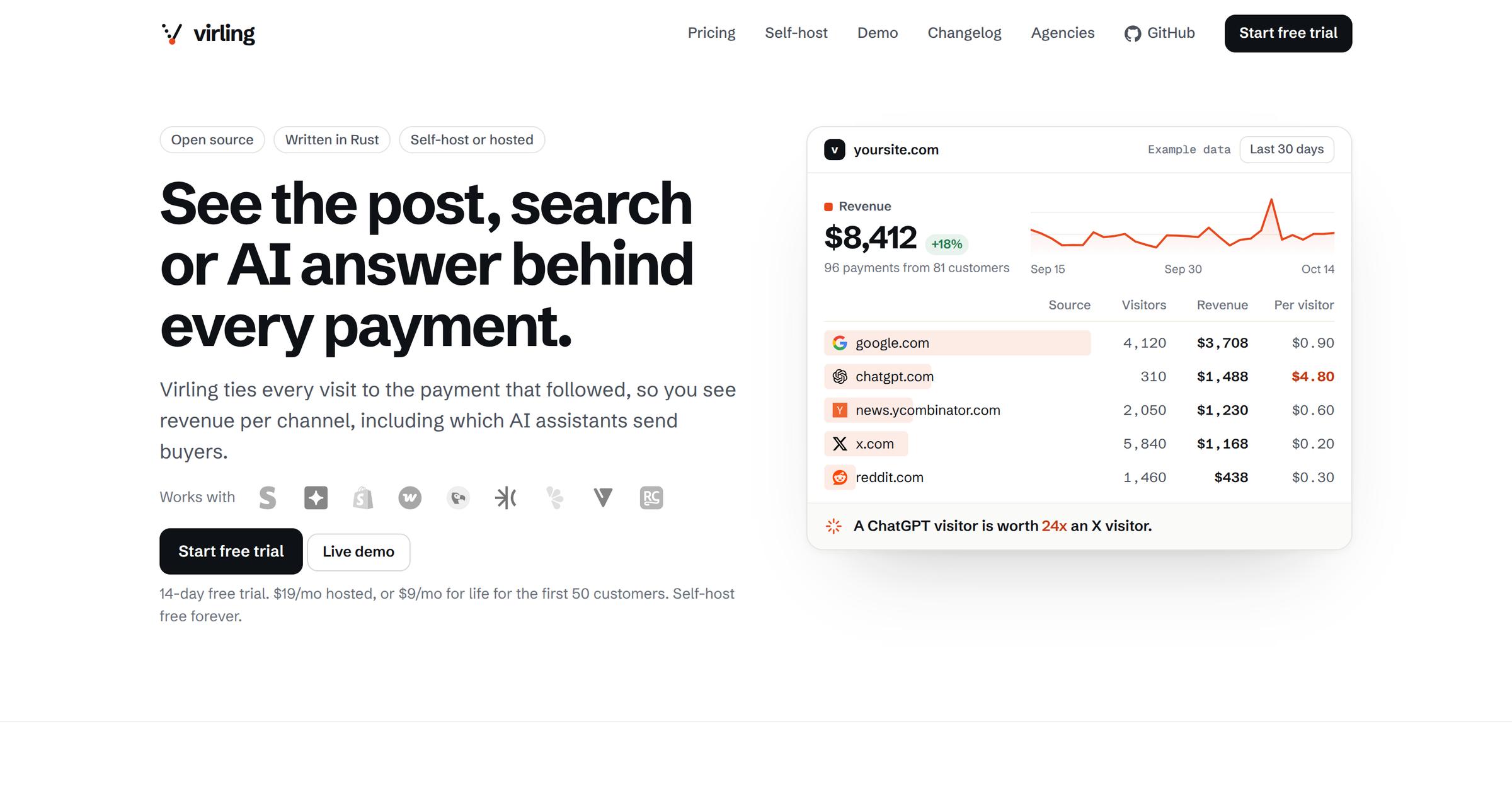
Virling reads Stripe with a read-only key, runs a 90-day backfill, and polls every minute. The dashboard shows which traffic source is worth the most per visitor, which is the number a founder needs to decide where to spend time posting or advertising. Payment journeys are clickable.
If your primary goal is funnel analysis, session replay, or A/B testing rather than channel-level revenue attribution, a general-purpose product analytics tool covers more ground.
One Docker command stands up the full tool with no Postgres or Redis. Data stays on your server, there is no monthly subscription for self-hosters, and the AGPL-3.0 license allows personal and commercial use. The install guide is at docs.virling.com.
If your payment processor is not in the supported list (Stripe, Polar, Dodo Payments, LemonSqueezy, Creem, RevenueCat, Paddle, Shopify, WooCommerce), the payment attribution side will not connect.
One Virling account handles all client sites. A branded weekly email report goes to each client every Monday showing which channels brought paying customers. The agency view gives a multi-site dashboard.
If clients need granular funnel analysis, multi-touch attribution across paid ad platforms, or session replay, Virling's channel-level revenue view does not cover those needs.
Virling ships an MCP server and a CLI, so any assistant with MCP access can query revenue data. Hosted Virling is listed in the Claude directory, and the MCP server installs as a Claude Code plugin. You can ask which channel brought the most revenue last month without opening a dashboard.
If your team does not use AI assistants for reporting, this feature adds no value; the web dashboard covers the same data.
The problem
Standard web analytics count pageviews and sessions, but they cannot know which visit led to a payment. You can see that your X post brought 500 visitors, but not whether any of them bought. The number that matters, revenue per channel, stays hidden behind a join that most analytics tools never make. Building this yourself means logging visitor IDs into your payment provider at checkout, storing them alongside payments, and writing the join query. For a solo founder or a small team, that is weeks of engineering to build and maintain. Existing hosted attribution tools that do it are subscription services with no self-hosting path, and your payment data stays on their servers.
How it works
Connects each payment to the visit before it using a visitor ID passed through checkout. The dashboard shows revenue, revenue per visitor, and conversion rate for every channel, referrer, page, country, and UTM campaign. The last non-direct channel gets the credit by default; you can switch to first touch and set the lookback window to 30, 60, 90, or 365 days.
Ships as one Rust binary with embedded DuckDB for events and SQLite for settings. No Postgres, ClickHouse, or Redis is required. Runs on Linux x86_64, arm64, macOS, or Docker. A backup is copying one folder.
Connects to Stripe, Paddle, Shopify, WooCommerce, Dodo Payments, Polar, LemonSqueezy, Creem, and RevenueCat. Stripe, Polar, and Dodo Payments use restricted, read-only API keys. LemonSqueezy, Creem, and RevenueCat add a webhook. Virling never creates, modifies, or refunds payments.
Every week Virling asks ChatGPT, Claude, Perplexity, and Gemini the questions your buyers ask, with web search on, and records whether they name your product, where you rank, and which pages they cite. Included on paid hosted plans; self-hosting uses your own API keys.
One account manages all client sites. A weekly email report goes to each client under your brand every Monday, showing which channels brought paying customers. An optional public dashboard is available per site.
Tag each post, newsletter, or campaign with a Virling link. The dashboard shows how much revenue that specific link earned, so you can compare individual posts or campaigns by actual money generated rather than click count.
Features
- Revenue per channel and per visitor
- Single binary with no external database
- Payment provider integrations with read-only keys
- AI assistant visibility tracking
- Agency multi-site reporting with custom branding
- Tracked short links for post and campaign revenue
How to install
Self-hosting uses Docker with embedded DuckDB and SQLite storage.
docker run -d --name virling -p 8080:8080 -v virling-data:/data \
  -e VIRLING_BASE_URL=https://stats.example.com \
  ghcr.io/virling/virling:latest serve --app
docker exec virling virling add-site yourdomain.com --owner you@example.com
Recommended for this setup
Strengths
- No database server required: DuckDB stores events and SQLite stores settings, both embedded in the binary. This removes the setup work and ongoing cost of running a Postgres or ClickHouse instance, which nearly every competing attribution tool requires.
- Cookieless mode for consent-banner-free sites: A daily-rotating salted hash replaces the first-party cookie for sites that need no consent banner. Events and channel data still collect; the tradeoff is that new payments cannot be linked to visits, landing as Unattributed. Visitor IPs are never stored in any mode.
- Read-only payment integrations: Stripe, Polar, and Dodo Payments connect with restricted, read-only API keys. Virling cannot create, change, or refund anything. LemonSqueezy keys cannot be restricted to read-only at the provider level, but Virling itself only reads.
- MCP server and CLI for AI-assisted revenue queries: Virling ships an MCP server and a virling query CLI. Any AI assistant with MCP access can query revenue data directly, and hosted Virling is listed in the Claude directory. Revenue attribution becomes a data source for your AI tooling, not a separate dashboard to open.
Trade-offs
- Early development: 24 open issues, breaking changes expected: The README flags this as early development and warns to expect breaking changes until a stable release. The project was created in October 2026 and has 24 open issues. Self-hosters who follow updates should read release notes before upgrading.
- AGPL-3.0 restricts running a hosted service on modified code: You can self-host Virling for your own SaaS, your team, or client work without restriction, including internal commercial use. If you modify the code and run the modified version as a hosted service for outside users, AGPL-3.0 requires sharing those changes. Offering a white-label hosted Virling service is not permitted without satisfying that requirement.
- Cookieless mode breaks payment-to-visit linking: When you enable cookieless mode, payments still count toward revenue totals but cannot be linked to the visit that preceded them. They land as Unattributed in the dashboard. Attribution quality is lower whenever the first-party cookie is absent.
Tech stack
FAQ
Yes. The self-hosted path is free forever under AGPL-3.0. You run the binary on your own server and keep all your data with no recurring fees. The hosted plan at app.virling.com starts with a 14-day free trial at $19 per month.
No. The README states that visitor IPs are never stored. The tracking script assigns a first-party visitor ID (or a daily-rotating salted hash in cookieless mode) without recording the IP.
Stripe, Paddle, Shopify, WooCommerce, Dodo Payments, Polar, LemonSqueezy, Creem, and RevenueCat. Stripe, Polar, and Dodo Payments connect with read-only keys and include a 90-day backfill. LemonSqueezy, Creem, and RevenueCat add a webhook for payment events.
You can self-host Virling for your own SaaS, your team, or client work without restriction, including internal commercial use. If you modify the code and run the modified version as a hosted service for outside users, AGPL-3.0 requires sharing those changes. Running it for your own products is fully permitted.
The README flags it as early development and warns to expect breaking changes until a stable release. The project was created in October 2026 and has 24 open issues. Releases run on your own server today and the hosted trial is available, but operators should treat it as beta-quality and read release notes before upgrading.