
VibeVoice
MIT-licensed voice AI for long-form TTS and speech recognition
Replaces Elevenlabs, Microsoft Azure Ai Speech, Playht
Who it's for
VibeVoice-TTS supports up to 4 speakers in a single 90-minute generation pass, maintaining turn-taking and conversational dynamics without manual audio stitching. Teams building automated podcast creation pipelines can feed a transcript and receive a coherent multi-voice audio file without managing segment boundaries.
If your production environment requires commercial SLAs, guaranteed uptime, or voice cloning from a custom speaker sample, ElevenLabs or PlayHT are more mature choices for that specific need.
VibeVoice-ASR handles 60-minute recordings in a single inference pass, labeling each speaker segment with who spoke, when, and what they said. The customized hotwords feature improves accuracy on technical vocabulary, project names, or internal terms that generic ASR models handle poorly.
If your recordings exceed 60 minutes, you will need to segment them before passing to the model. For speaker enrollment from a named reference audio, the current ASR model does not support that path.
The VibeVoice-ASR-BitNet variant compresses the ASR model to 1.58 GB and runs at real-time speed on 3 or more CPU threads, removing the GPU dependency. This makes it practical for edge devices, local developer environments, or embedded scenarios where GPU resources are not available.
For production deployment requiring streaming voice commands at low latency alongside other CPU-intensive work, the CPU inference may not leave enough headroom. Measure RTF under your target load before committing.
The problem
Most text-to-speech APIs and speech recognition services impose hard limits that break long-form audio workflows. Commercial TTS platforms cap output at a few minutes per request, forcing developers to stitch together audio segments that lose speaker consistency and conversational rhythm across the seams. Multi-speaker generation typically supports only 1-2 speakers, which rules out realistic podcast or panel conversation audio. On the transcription side, most ASR systems slice long recordings into 30-second chunks before processing them, discarding the global context that makes accurate diarization possible. You get a transcript, but not reliably a record of who said what with consistent speaker labels across an hour-long meeting. Adding accurate timestamps, handling domain-specific terms, and streaming results as the audio arrives are separate problems each requiring a different tool or service integration.
How it works
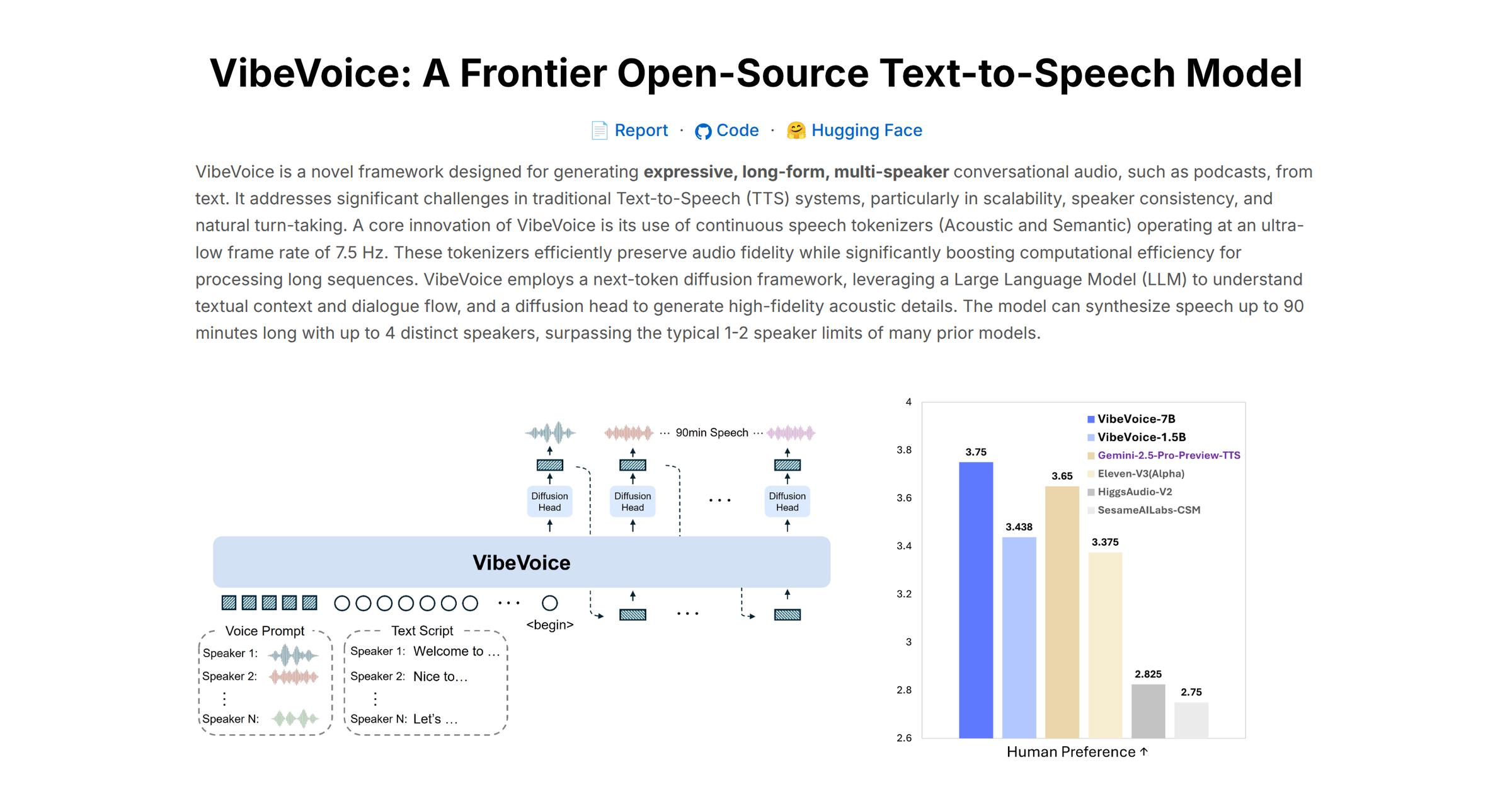
Synthesizes conversational audio up to 90 minutes in a single pass with up to 4 distinct speakers. The next-token diffusion framework uses a large language model to maintain textual and dialogue context, so speaker turns and emotional dynamics remain consistent across the full generation rather than drifting after a few minutes.
Processes up to 60 minutes of continuous audio within 64K tokens, producing structured output with speaker labels (Who), timestamps (When), and transcript text (What). Unlike chunk-based ASR that loses cross-segment speaker tracking, VibeVoice-ASR maintains diarization coherence across the full recording.
VibeVoice-Realtime-0.5B accepts streaming text input and begins generating audible speech in approximately 300 milliseconds, handling up to 10 minutes of continuous output. At 0.5B parameters it is deployment-friendly compared to the full 1.5B TTS model, and runs on Colab or modest hardware.
VibeVoice-ASR-BitNet compresses the 7B model from 4.62 GB to 1.58 GB using heterogeneous quantization (I8_S + I2_S), achieving real-time inference with RTF under 1 on 3+ CPU threads. This eliminates the GPU requirement for ASR inference, making on-device or edge deployment practical without specialized hardware.
VibeVoice-ASR handles over 50 languages natively, with customizable hotwords for domain-specific vocabulary, technical terms, or proper nouns. The streaming variant (VibeVoice-ASR-Streaming) continuously emits text chunks as audio arrives, with explicit speaker labeling across 10 supported languages.
Features
- Long-Form Multi-Speaker TTS
- 60-Minute Single-Pass ASR with Diarization
- Real-Time Streaming TTS at ~300ms Latency
- CPU-Only Edge ASR via BitNet Quantization
- Multilingual ASR for 50+ Languages
How to install
Install VibeVoice-ASR via the Hugging Face Transformers library for speech recognition, or clone the repository to access realtime TTS notebooks and documentation.
pip install transformers
git clone https://github.com/microsoft/VibeVoice
Recommended for this setup
Strengths
- MIT License with No API Fees: The entire model family ships under MIT, so you can run inference on your own hardware without per-character, per-minute, or seat-based billing. Paid alternatives like ElevenLabs charge by character and PlayHT by minute; VibeVoice's only cost is the compute you provision.
- Long-Form Limits That Exceed Commercial APIs: The 90-minute TTS and 60-minute ASR limits significantly exceed what most commercial APIs allow in a single request. For podcast generation, long-form meeting transcription, or audiobook production, this removes the stitching logic that most developers build around shorter API caps.
- Azure AI Foundry Labs Integration for Managed Access: VibeVoice-ASR is integrated into Azure AI Foundry Labs as of March 2026, so teams that need managed access or want to test the model without self-hosting infrastructure can use it through Microsoft's platform while the same weights remain self-hostable from Hugging Face.
- Active Research Trajectory with Multiple Model Variants: Since its August 2025 release, the family has expanded to include streaming ASR, a BitNet CPU variant, a realtime TTS model, and Hugging Face Transformers integration. The ASR paper is on arXiv and the TTS paper earned an Oral acceptance at ICLR 2026.
Trade-offs
- TTS Code Removed from Repo; Research-Only Recommendation: The VibeVoice-TTS source code was removed from the GitHub repository in September 2025 after the team identified out-of-scope usage. The TTS model weights remain available on Hugging Face, but the repo no longer includes TTS training or inference code, and the Quick Try entry in the README is listed as Disabled. Microsoft explicitly states the models are intended for research and development only and does not recommend production deployment without additional testing.
- GPU Required for Full-Scale Inference: The 7B ASR model and the 1.5B TTS model require significant GPU memory for full-speed inference. The BitNet CPU variant reduces this for ASR, but TTS at production scale still demands a GPU. Teams running inference on shared cloud compute should budget for the memory footprint before integrating into a service.
- 132 Open Issues: The repository had 132 open issues at the time of indexing. As a relatively recent Microsoft research release with rapid expansion into new model variants, documentation gaps and integration rough edges are expected.
Tech stack
FAQ
Yes. VibeVoice is MIT licensed, so you can run the models on your own infrastructure without licensing fees. The model weights are available on Hugging Face at no cost. Microsoft notes that the models are intended for research and development purposes and does not recommend production deployment without additional testing.
In September 2025, Microsoft discovered the tool was being used in ways inconsistent with its stated intent as a research framework for the speech synthesis community. The TTS source code was removed from the repository while Microsoft assessed controls to prevent out-of-scope use. The model weights remain available on Hugging Face, but the Quick Try for VibeVoice-TTS-1.5B in the README is currently listed as Disabled.
Yes, via the VibeVoice-ASR-BitNet variant. It uses heterogeneous quantization (I8_S + I2_S) to compress the model from 4.62 GB to 1.58 GB, running at real-time speed (RTF under 1) on 3 or more CPU threads. Standard VibeVoice-ASR-7B benefits from GPU for practical inference speed.
VibeVoice-ASR supports over 50 languages for speech recognition. The streaming ASR variant (VibeVoice-ASR-Streaming) supports 10 languages for continuous transcription. The VibeVoice-Realtime TTS model added experimental multilingual voices in nine languages (German, French, Italian, Japanese, Korean, Dutch, Polish, Portuguese, Spanish) and 11 English style voices as of December 2025.
VibeVoice-ASR jointly performs speech recognition, diarization, and timestamping in a single pass, outputting structured results for who spoke (speaker label), when they spoke (timestamps), and what they said (transcript). You can supply customized hotwords before inference to improve accuracy on domain-specific vocabulary, proper nouns, or technical terms. The model accepts up to 60 minutes of continuous audio within 64K tokens.