
Unsloth
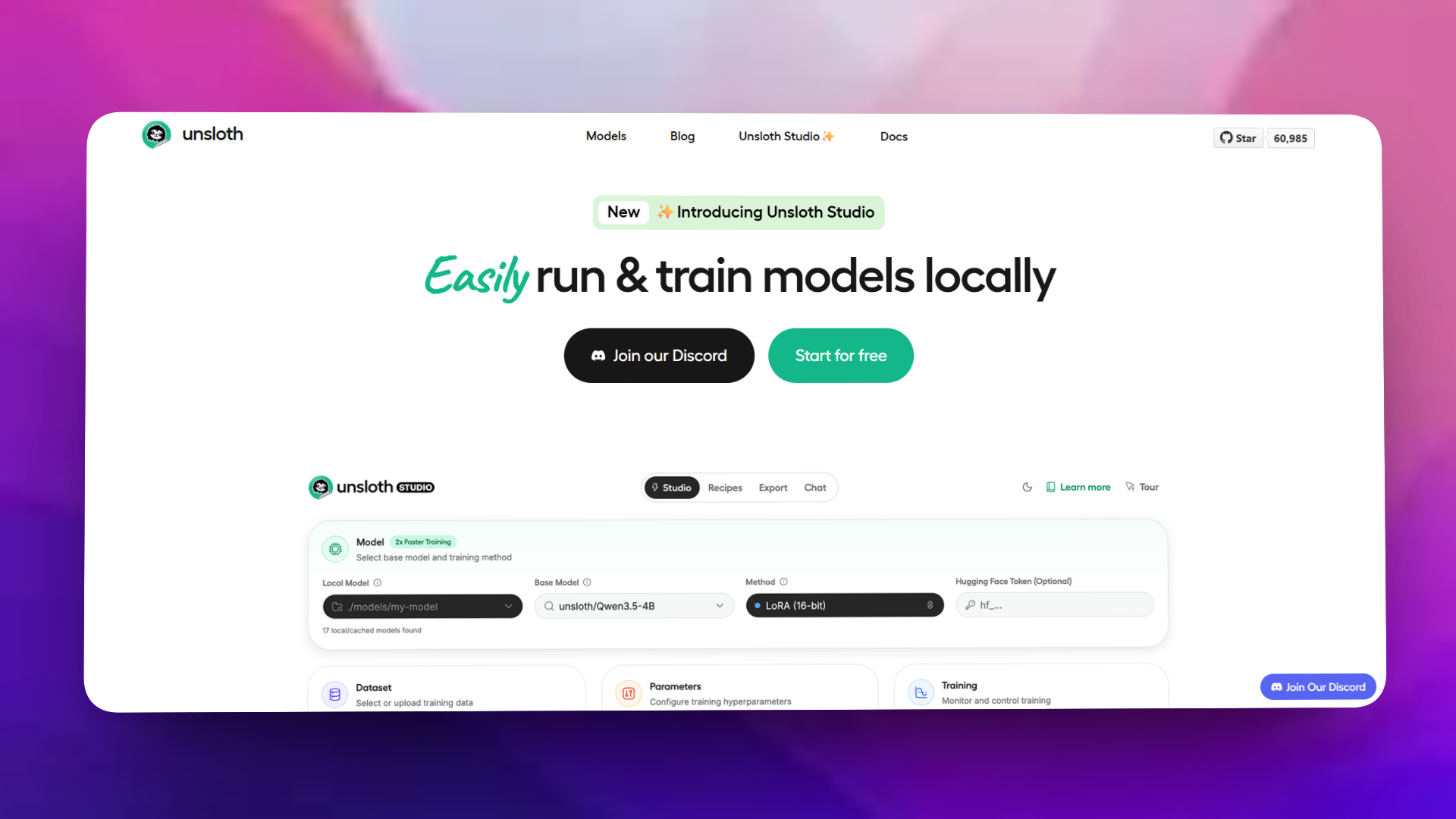
Train LLMs locally without code using a browser-based interface
Replaces Together Ai, Databricks, Google Cloud Vertex Ai, Amazon Sagemaker Canvas
Who it's for
An ML engineer at a startup with two RTX 4090s uses Unsloth to fine-tune a Mistral 7B model on customer support transcripts. The same job that cost $200 on Lambda Cloud runs overnight on local hardware at zero marginal cost.
Your team has no local GPU hardware and prefers fully managed training services.
A PhD student studying domain adaptation fine-tunes Llama 3 8B on medical literature. Unsloth's 2x speedup lets them test two hypotheses per day instead of one, making the most of limited compute time on a shared lab GPU.
Your institution has ample managed GPU cluster time with no iteration bottleneck.
An indie developer building a personal assistant fine-tunes a 7B model on their own writing using Unsloth's free Colab notebook. The memory savings mean the entire job fits on a free T4 without session timeouts.
You need repeatable production pipelines with audit logs and SLA guarantees.
A small ML team running Llama fine-tunes on AWS SageMaker ml.g5.4xlarge instances cuts their monthly AI infrastructure bill by moving the workload to on-premise A100s. Unsloth's drop-in HuggingFace API makes migration low-risk.
Your team relies on SageMaker's managed infrastructure for compliance and audit trail requirements.
An AI researcher evaluating a new 13B architecture uses Unsloth to benchmark fine-tuning performance across multiple dataset configurations. Built-in kernel validation confirms results are numerically equivalent to full-precision baselines.
Your evaluation requires multi-node GPU cluster scale from day one.
The problem
Fine-tuning large language models on custom data requires significant GPU memory and compute time, putting it out of reach for researchers and engineers without expensive cloud GPU access. A 7B parameter fine-tune can exhaust a consumer GPU in minutes, forcing teams to pay $2 to $5 per hour for cloud GPU time on runs that take days. Standard training pipelines re-compute intermediate activations during backpropagation and store full optimizer states in VRAM, consuming far more memory than theoretically necessary. Unsloth targets ML engineers, researchers, and startup teams who need to adapt models to their own data on consumer hardware or reduce cloud GPU spend without sacrificing accuracy.
How it works
Unsloth replaces PyTorch's default attention and gradient operations with hand-written Triton kernels that eliminate redundant computation. Benchmarked at 2x speedup on Llama 3 8B fine-tuning with no degradation in final model accuracy.
Memory-efficient gradient checkpointing and fused optimizer implementations reduce peak VRAM usage significantly. A Llama 3 13B QLoRA fine-tune that requires 36GB with standard tooling runs on a 24GB RTX 4090 with Unsloth.
Supports RTX 3090, 4090, and laptop GPUs alongside datacenter hardware. LoRA, QLoRA, and full fine-tuning modes all work on single-GPU consumer setups, removing the need for a cloud account for many workloads.
Llama, Mistral, Phi, Gemma, Qwen, and 50+ additional model families are pre-patched and tested. Unsloth wraps the HuggingFace Trainer API so existing training scripts need minimal changes to benefit.
Unsloth validates its custom kernels against PyTorch reference outputs and flags any numerical discrepancy. The project reports no accuracy degradation on standard benchmarks compared to full-precision baseline training.
Features
- Train 2x faster with custom Triton and CUDA kernels
- Cut VRAM usage by up to 70% versus standard HuggingFace setups
- Run large model fine-tunes on a single consumer GPU
- Fine-tune 60+ model architectures with a drop-in API
- Confirm zero accuracy loss with automatic kernel validation
How to install
# Local Studio setup (macOS, Linux, WSL)
curl -fsSL https://unsloth.ai/install.sh | sh

# Local Studio setup (Windows PowerShell)
irm https://unsloth.ai/install.ps1 | iex

# Core library setup
pip install unsloth
Recommended for this setup
Strengths
- Save hundreds per month by replacing cloud GPU fine-tune jobs with local runs: Unsloth's memory efficiency lets a 13B model fit on a single RTX 4090. Teams running weekly fine-tune jobs on SageMaker ml.p3.2xlarge instances at $3.06 per hour can eliminate that spend entirely for models up to 13B parameters.
- Switch from HuggingFace Trainer with three-line code changes: Unsloth wraps HuggingFace's FastLanguageModel and SFTTrainer APIs. Existing training scripts using Trainer or TRL need only replace the model-loading calls, keeping the rest of the training loop intact.
- Get support for new model architectures within days of community release: The Unsloth team has consistently added support for Llama, Mistral, Phi, Gemma, and Qwen releases quickly after they appear on HuggingFace. The GitHub repo is actively maintained with frequent commits.
- Start fine-tuning immediately with free Colab and Kaggle notebook templates: Unsloth publishes pre-built Jupyter notebooks for most supported architectures, runnable on free Colab T4 GPUs. This lets researchers prototype fine-tunes at zero cost before committing to a local GPU or cloud spend.
Trade-offs
- Check the AGPL-3.0 Studio license before building proprietary products: The core Unsloth library is Apache 2.0 licensed, but Unsloth Studio, the graphical interface, is AGPL-3.0. Products that distribute or host Unsloth Studio-based services must open-source their code under AGPL-3.0.
- Expect diminishing VRAM gains on models above 70B parameters: Unsloth's memory savings are most dramatic on 7B to 13B models. For 70B+ parameter models, memory pressure may still require multi-GPU setups or gradient offloading, and the 2x speed claim may not hold at every scale.
- Accept that custom kernels may lag behind new PyTorch releases: Hand-written Triton and CUDA kernels need updates when upstream PyTorch or CUDA versions change. Users on cutting-edge CUDA versions may encounter compatibility issues before the Unsloth team pushes a fix.
- Avoid Unsloth for multi-node distributed training across dozens of GPUs: Unsloth is optimized for single-GPU and single-node training. Multi-node distributed training with DDP or FSDP requires standard PyTorch setups. Teams needing to scale across many GPUs should verify single-node constraints fit their workflow.
Tech stack
FAQ
Unsloth claims zero accuracy loss versus full-precision training on standard benchmarks. The project validates its custom kernels against PyTorch reference implementations. Independent community benchmarks on HuggingFace have confirmed equivalent results on Llama and Mistral models.
The core Unsloth Python library is Apache 2.0 licensed. Unsloth Studio, the graphical fine-tuning interface, is AGPL-3.0. If you build a hosted service using Unsloth Studio, you must open-source that service under AGPL-3.0.
Unsloth supports 60+ model architectures including Llama 2, Llama 3, Mistral, Mixtral, Phi, Gemma, Qwen, DeepSeek, and others. The team typically adds support for new popular models within days of their HuggingFace release.
Unsloth is optimized for single-GPU training. Multi-node distributed training with DDP or FSDP is not the design target. For single-node multi-GPU setups, some users report success, but this is not a primary supported configuration.
Yes. Unsloth publishes free Colab and Kaggle notebooks for most supported architectures. A 7B model fine-tune fits on a free Colab T4 GPU (16GB VRAM) with Unsloth's memory optimizations, though training time will be longer than on an A100.