
UniMate
Text-to-animation for any rigged skeleton, no per-rig retraining
Replaces Deepmotion Saymotion
Who it's for
Generate rough walk, fly or swim motion for a non-human rig from a short prompt, to block out a scene before committing to hand animation.
You need production-ready, hand-polished animation with guaranteed quality on a specific rig.
Use the code, checkpoints and UniML3D dataset as a baseline for work on cross-topology motion generation.
You do not have a GPU environment or the time to set up a research codebase.
The problem
Rigging has become fast, but animating the result has not. Learned animators usually depend on category-specific templates, per-skeleton fine-tuning, or reference motions at inference. Teams working with varied characters, creatures and rigid objects either buy fixed motion packs or hand-animate each rig. UniMate targets that gap: given any rigged asset and a text prompt, it synthesizes motion for that exact skeleton, with no test-time optimization.
How it works
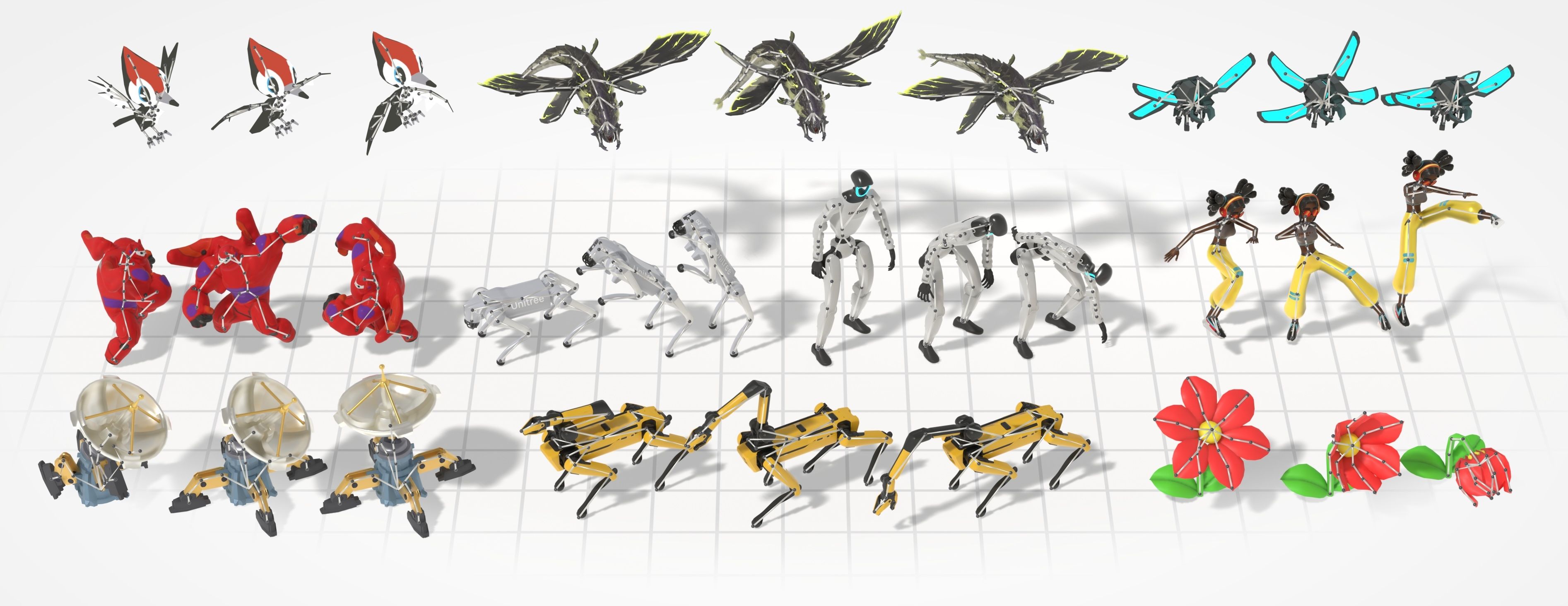
A topology-aware diffusion transformer adapts to each rig's structure, covering bipedal, quadrupedal, avian, marine, insectoid, serpentine and articulated rigid objects without retraining per skeleton.
Provide a rigged 3D asset and a prompt such as a dog walking or a dragon taking off. The model generates motion for that skeleton and exports sample renders and motion files.
The same trained model keeps chosen joints or keyframes fixed and regenerates the rest, or chains several prompts into a longer motion, with no fine-tuning or auxiliary networks.
The repo includes training configs, inference scripts and a data-processing pipeline. UniML3D holds 13,006 text-paired motion sequences, released on Hugging Face.
A helper script turns generated motion files into an animated GLB and FBX for the original rigged mesh, so results can move into a standard 3D workflow.
Features
- One model for diverse skeletons
- Text-prompted motion generation
- Zero-shot editing, in-betweening and expansion
- UniML3D dataset and training code
- Animated mesh export
How to install
Setup uses a conda environment with Python 3.10 and the repository's requirements file.
git clone https://github.com/Friedrich-M/UniMate.git
cd UniMate
conda create -n unimate python=3.10 -y
conda activate unimate
pip install "setuptools<81"
pip install -r requirements.txt --no-build-isolation
Recommended for this setup
Strengths
- Topology generalization: One set of weights handles very different skeletons, so you do not need a separate model or fine-tuning run for each creature or object rig.
- Open code, weights and data: Training and inference code is MIT licensed, preview checkpoints are on Hugging Face, and the processed dataset and its pipeline are published.
- Several tasks from one model: Editing, in-betweening and motion expansion reuse the pretrained model by holding parts of the motion fixed during sampling.
Trade-offs
- Early research release: The README calls UniMate an early step toward text-to-animation for any skeleton and says many motions and skeletons still fail. Expect rough results on unusual rigs.
- Setup and hardware demands: You install a conda environment and run Python scripts, and sampling expects the training dataset features for the target skeleton to be present. A GPU is practical for any serious use.
- Data licensing gaps: The Truebones ZOO motions are a commercial asset pack that cannot be redistributed, so you must buy that pack yourself to rebuild the full dataset. An official preprocessing pipeline for new rigs was still listed as a TODO.
Tech stack
FAQ
It generates articulated motion for a rigged 3D asset from a text prompt. A single unified model handles many skeleton types, with no per-skeleton retraining and no test-time optimization.
The repository is MIT licensed. The Truebones ZOO motions used to build part of the dataset are a separate commercial pack that is not redistributed, so you must purchase it directly to reproduce that portion.
Yes. The same pretrained model supports motion editing, in-betweening and expansion by pinning chosen joints or keyframes during sampling, with no fine-tuning.
Not yet. The authors describe it as an early step and note that many motions and skeletons still fail. Preview checkpoints are on Hugging Face and new ones will be synced there.