
TradingAgents
Multi-Agent LLM Framework for Financial Trading
Replaces Lseg Workspace Formerly Refinitiv Eikon, Alphasense
Who it's for
A quant researcher can run the same ticker and date through bullish, bearish, technical, sentiment, and risk agents to compare how each role affects the final recommendation.
You need audited live-trading infrastructure with compliance approvals, broker routing, and production risk controls already included.
A fintech team can use TradingAgents as a reference architecture for an explainable research assistant, then adapt prompts, model providers, and portfolio constraints to its own product.
Your team cannot maintain Python services, API keys, model configuration, and data-vendor integrations.
Finance and AI researchers can inspect a real multi-agent trading workflow, cite the paper, and run controlled experiments around model choice, debate rounds, and ticker history.
Your study requires certified investment recommendations or licensed proprietary market data bundled with the tool.
A technical trader can run local experiments through the CLI, review generated analyst reports, and use the decision log to compare later outcomes against prior recommendations.
You want a no-code retail trading app that connects directly to a brokerage account.
The problem
Quant teams and fintech builders often need to test market hypotheses across fundamentals, news, sentiment, technical signals, and portfolio risk, but paid market intelligence products package that work inside proprietary content, search, analytics, and workflow environments. That makes it hard to customize the research process itself, audit each agent role, or compare how different LLMs handle the same ticker. TradingAgents addresses the research workflow gap for teams that can bring their own data, model keys, and engineering discipline. It is not a financial advice tool or a ready-made broker app; it is a framework for building, inspecting, and stress-testing multi-agent trading decisions before any production use.
How it works
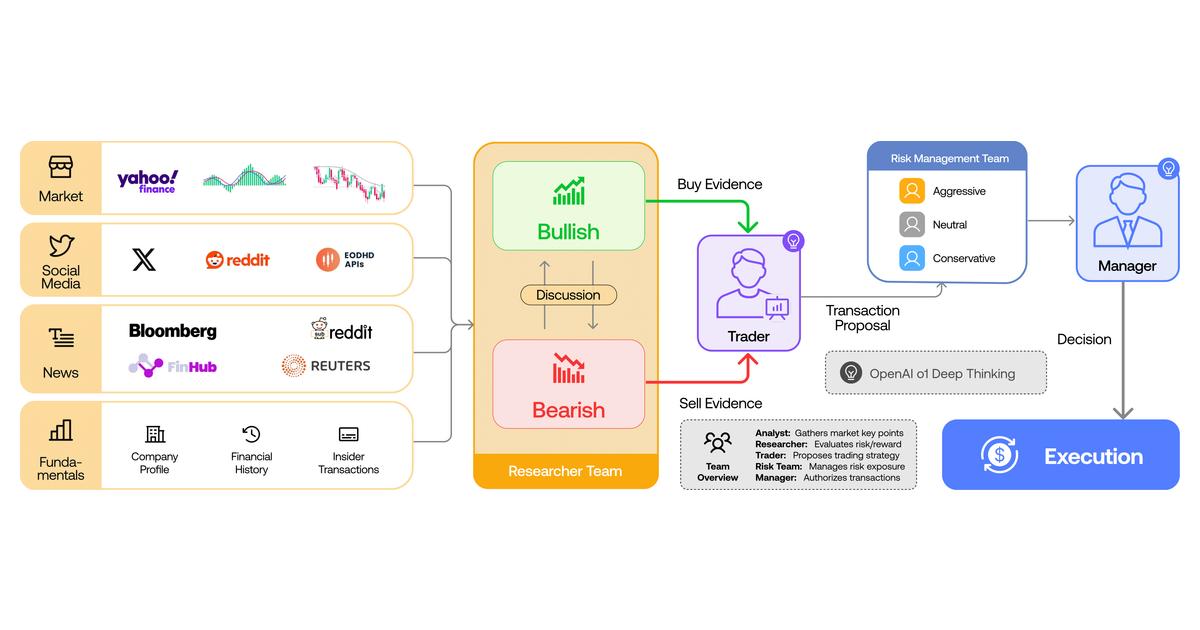
TradingAgents models a trading firm as a LangGraph workflow with analyst, researcher, trader, risk management, and portfolio manager roles. Each role contributes a separate report or decision step, so teams can inspect how a ticker analysis moves from evidence to final recommendation.
The framework includes fundamentals, sentiment, news, and technical analyst agents. The sentiment analyst aggregates news headlines, StockTwits, and Reddit chatter, while the technical analyst uses indicators such as MACD and RSI to frame price action.
Researcher agents argue bullish and bearish cases before a trader forms the transaction proposal. This debate structure helps expose competing assumptions instead of collapsing the workflow into a single prompt response.
Risk management agents review volatility, liquidity, and other risk factors before a portfolio manager approves or rejects the proposed transaction. Approved proposals route to a simulated exchange, which keeps experiments separate from live brokerage execution.
TradingAgents supports OpenAI, Google, Anthropic, xAI, DeepSeek, Qwen, GLM, MiniMax, OpenRouter, Ollama, and Azure OpenAI. Teams can run cloud models, enterprise providers, or local Ollama models while keeping the same agent workflow.
Features
- Multi-agent trading graph
- Specialized analyst team
- Bull and bear research debate
- Portfolio and risk review
- Multi-provider model support
How to install
git clone https://github.com/TauricResearch/TradingAgents.git
cd TradingAgents

conda create -n tradingagents python=3.13
conda activate tradingagents

pip install .
cp .env.example .env # add your API keys
docker compose run --rm tradingagentsdocker compose --profile ollama run --rm tradingagents-ollamaRecommended for this setup
Strengths
- Apache-2.0 code you can inspect: TradingAgents is Apache-2.0 licensed, so teams can fork, modify, and run the framework without a proprietary terminal contract. That matters when the research process itself needs auditability, custom prompts, or internal review.
- Inspectable orchestration layer: LSEG Workspace and AlphaSense focus on packaged data, search, analytics, and enterprise workflows. TradingAgents exposes the agent roles, debate flow, decision log, and configuration, which helps researchers inspect the orchestration layer behind a recommendation.
- Flexible model and deployment choices: The same workflow can run against major hosted LLM providers, enterprise Azure OpenAI setups, OpenRouter, or local Ollama models. That flexibility helps teams compare model behavior without rebuilding the trading graph.
- Built for research iteration: The CLI lets users choose tickers, dates, LLM providers, and research depth, then watch results stream as agents run. Checkpoint resume and a persistent decision log support repeatable experiments across interrupted or repeated ticker analyses.
Trade-offs
- Research framework, not trading advice: The project explicitly says TradingAgents is designed for research purposes and is not financial, investment, or trading advice. Performance can vary with model choice, temperature, trading period, data quality, and other non-deterministic factors.
- Requires external data and model keys: Useful runs require API keys for at least one LLM provider and, for many setups, market data such as Alpha Vantage. Self-hosting the code does not remove usage costs from model calls, data vendors, or infrastructure.
- Not a full market data terminal: TradingAgents does not replace the licensed content libraries, managed search, analyst-ready interfaces, or vendor support that paid market intelligence products provide. It is strongest when you already have data sources and want an open agent layer.
- Setup expects developer ownership: The documented install path uses Git, Python packaging, environment variables, and optional Docker or Ollama configuration. Non-technical traders looking for a polished hosted app will need engineering help or a different product.
Tech stack
FAQ
Yes, TradingAgents is Apache-2.0 licensed and free to run from source. You still need to pay for any external LLM, market data, or infrastructure services you connect to it.
TradingAgents is documented as a research framework, not a live brokerage system. The README describes approved proposals being sent to a simulated exchange, so production trading would require separate broker integration, controls, and review.
TradingAgents supports major hosted LLM providers, OpenRouter, Azure OpenAI, and local Ollama models. The README lists the current provider catalog, and the CLI lets users choose separate deep-thinking and quick-thinking models.
Yes, TradingAgents supports Ollama for local models. The README documents `OLLAMA_BASE_URL` for local or remote Ollama endpoints and includes a Docker Compose profile for Ollama runs.
TradingAgents can replace part of the research orchestration workflow, but it does not replace proprietary data terminals or premium research libraries. It is best when you want open, inspectable agent logic and already have access to the data sources you need.