Thingino Firmware
Open-source firmware for Ingenic SoC IP cameras
Replaces Wyze, Tp Link Tapo
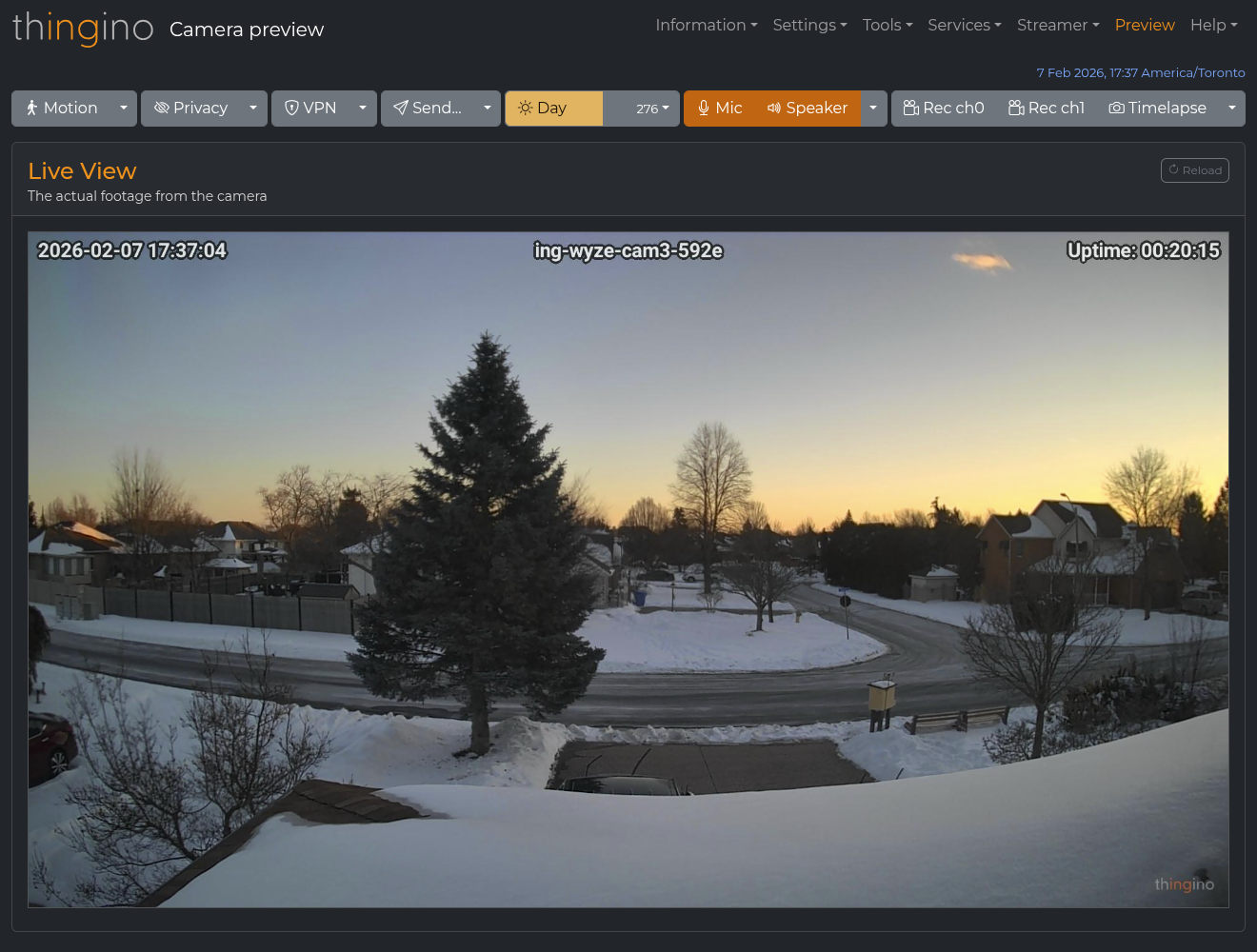
Who it's for
A homeowner who has flashed Wyze Cam 3 or TP-Link Tapo cameras can run Thingino to point their cameras at a local NVR over ONVIF, keeping all footage on-premises with no vendor cloud dependency.
User needs cameras that work out of the box with a vendor app and has no interest in firmware modification.
A user concerned about proprietary firmware phoning home can replace the stock firmware on a supported Sonoff or Xiaomi camera and inspect exactly what the device sends over the network.
User is not comfortable with the flashing process or does not have supported hardware.
A developer working on Ingenic SoC-based camera products can use Thingino's Buildroot configuration and master branch as a starting point or reference for custom firmware, contributing fixes upstream.
When a camera vendor drops firmware updates or shuts down cloud services, users with supported hardware can flash Thingino to continue using the camera with active security maintenance from the community.
Camera model is not in the supported hardware list.
The problem
Consumer IP cameras ship with closed, vendor-controlled firmware that cannot be audited, modified, or updated independently. When vendors drop support or require cloud services, cameras become insecure or non-functional. Users have no way to control what data the firmware sends or to add features the vendor chose not to provide.
How it works
Thingino covers 170 camera models across brands including Wyze, Eufy, TP-Link Tapo, Sonoff, Xiaomi, Wansview, Galayou, and many others, spanning Ingenic T10 through T31 SoC families.
The ciao branch delivers a tested, reliable build using the original ONVIF server and Prudynt with libconfig. The master branch tracks active development with the new raptor streamer and experimental mainline U-Boot, for contributors who build from source.
Firmware can be built inside a Podman or Docker container using a prebuilt builder image pulled automatically from ghcr.io/themactep/thingino-builder-image, removing the need to configure a local Buildroot toolchain manually.
The stable branch includes an ONVIF server, enabling Thingino-flashed cameras to integrate with standard NVR software and IP camera management systems that speak the ONVIF protocol.
Supported hardware spans 17 Ingenic SoC variants, over 50 image sensor models, and more than 30 wireless modules, reflecting the wide hardware diversity found across budget IP camera brands.
Features
- Support for 170 cameras
- Stable and development branches
- Container-based builds
- ONVIF support
- Broad SoC and sensor coverage
How to install
git clone --recurse-submodules https://github.com/themactep/thingino-firmware cd thingino-firmware ./build-container.sh
Recommended for this setup
Strengths
- Eliminates vendor lock-in: Replacing proprietary firmware removes dependency on vendor cloud services and update schedules. Cameras can be operated and updated independently of the original manufacturer.
- Wide brand and hardware coverage: With 170 supported cameras across mainstream consumer brands, Thingino covers a significant slice of the budget IP camera market built on Ingenic silicon, making it practical to adopt without buying specialist hardware.
- Reproducible builds via containers: The prebuilt builder image and container build path mean developers can reproduce firmware builds on any machine with Podman or Docker without managing a Buildroot host environment by hand.
- Active community and documentation: The project maintains a GitHub wiki, Discord, Telegram group, and public issue tracker. CI badges for toolchain and stable firmware workflows indicate continuous integration is in place.
Trade-offs
- Master branch requires UART access: The master branch uses a highly experimental mainline U-Boot. The project explicitly warns that UART port access and unbricking skills are strongly recommended before flashing master branch images, raising the barrier for non-technical users.
- Limited to Ingenic SoC cameras: Thingino only supports cameras built on Ingenic SoCs. Cameras using Hisilicon, Ambarella, Novatek, or other chipsets are not supported and there is no roadmap to add them.
- Flashing carries bricking risk: Installing third-party firmware on a camera always carries the risk of a failed flash leaving the device unresponsive. Camera recovery documentation is provided, but hardware access (UART) may be required to recover.
Tech stack
FAQ
Thingino supports 170 camera models across brands including Wyze, Eufy, TP-Link Tapo, Sonoff, Xiaomi, Wansview, Galayou, and others. All supported cameras use Ingenic SoCs in the T10 through T31 families. The full list is on the project website and in the repository's supported hardware document.
The ciao branch is the stable release intended for everyday users. It uses the original ONVIF server and Prudynt with libconfig and receives only critical fixes. The master branch is the development branch with new features and the experimental raptor streamer; it is intended for contributors who build from source and can handle instability.
Clone the repository with submodules, then run `make update && make` for a native build, or run `./build-container.sh` for a container build using Podman or Docker. The container path pulls a prebuilt builder image automatically.
The project provides camera recovery documentation. Recovery from a failed flash typically requires access to the UART port on the camera. The project recommends having UART access and unbricking experience before flashing master branch images in particular.
Yes. The stable (ciao) branch includes an ONVIF server, which allows Thingino-flashed cameras to connect to NVR software and IP camera management systems that support the ONVIF protocol.