
Svelte
Compiler-based UI framework with no runtime overhead.
Replaces —
Who it's for
Teams building public-facing pages where initial load time and JavaScript bundle size affect user experience will find Svelte's zero-runtime output a direct fit. Smaller bundles translate to faster time-to-interactive for every visitor.
Your team is already committed to a framework with a mature third-party component library ecosystem and migrating would outweigh performance gains.
Engineering teams that want full control over their markup, component behavior, and output code, rather than committing to a visual builder or managed platform, can use Svelte to build and self-host their own applications.
Non-technical contributors need to edit and publish web content without touching code; a CMS with a visual editing interface will serve that workflow better.
The problem
Most JavaScript web frameworks deliver a client-side runtime to the browser alongside application code. That runtime initializes on page load, tracks application state, and executes on every state change throughout the page lifecycle. For developers building public-facing websites where initial load performance and JavaScript weight matter, this runtime cost is a real challenge: it adds to what the browser must download, parse, and execute before anything becomes interactive. Teams wanting component-based development without that overhead have historically faced a trade-off between authoring productivity and delivery cost.
How it works
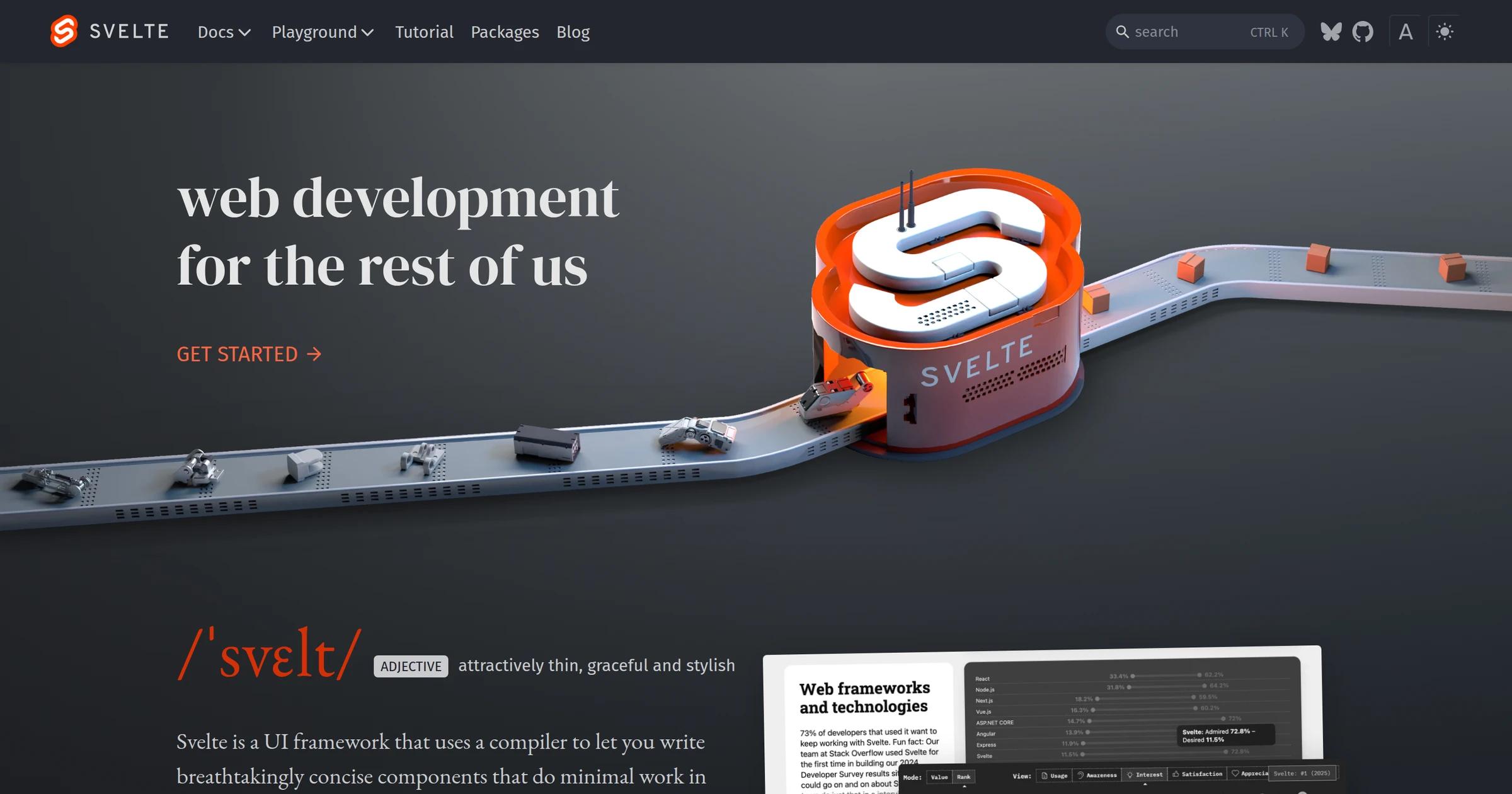
Svelte is a compiler, not a browser-side runtime library. It reads declarative component files during the build step and emits the JavaScript the browser will run. No framework code travels to the user's device alongside the application.
Conventional frameworks ship abstractions that run on every page load. Svelte moves all of that work to compile time. The output is vanilla JavaScript with no framework present in the browser's execution environment.
The compiled output updates only the specific DOM nodes that need to change in response to state changes. This tight, generated update path reflects what the project describes as code that "surgically updates the DOM."
Svelte is released under the MIT license. This permits use in commercial and non-commercial projects, modification, and redistribution with no restrictions beyond attribution.
The Svelte repository has over 89,000 GitHub stars and 6,000 forks. The project receives ongoing commits from a volunteer contributor community, with the most recent code push in November 2026.
Features
- Compiler-Based Architecture
- No Runtime Overhead
- Surgical DOM Updates
- MIT License
- Active Open Source Project
Recommended for this setup
Strengths
- Zero framework weight in production: Every byte of JavaScript shipped to the browser is application code produced by the compiler, not framework infrastructure. Teams building pages with strict performance budgets benefit directly from this output model.
- Unrestricted MIT license: The MIT license places no constraints on commercial use, modification, or deployment. Organizations running Svelte-built properties internally or as services owe no licensing fees and face no source disclosure obligations.
Trade-offs
- 1,000 open issues: The GitHub repository carried 1,000 open issues at time of research. For a widely used framework, this count includes edge cases, feature requests, and compatibility reports across diverse environments, and some issues may stay open for extended periods.
- Volunteer-driven development pace: Svelte's development is carried entirely by volunteers, funded through Open Collective donations. Roadmap progress and release frequency depend on contributor availability rather than a dedicated engineering organization.
Tech stack
FAQ
Yes. Svelte is released under the MIT license, which permits use in commercial and non-commercial projects, modification, and redistribution without restriction. No subscription or licensing fee applies to any use of the framework.
Runtime frameworks ship a JavaScript library to the browser that runs alongside your application code on every page load. Svelte processes component files at build time and outputs vanilla JavaScript the browser runs directly. No framework is present in the browser's execution environment; the compiler's output is the entire application code, and it updates the DOM surgically in response to state changes.
The Svelte GitHub repository has over 89,000 stars and more than 6,000 forks. The project maintains a Discord community at svelte.dev/chat and receives financial support through Open Collective. It has been under active development since 2016.
The repository carried 1,000 open issues at the time this information was gathered, based on GitHub's issue search API excluding pull requests. For a widely used framework, this count includes feature requests, bug reports across diverse environments, and documentation gaps alongside active bug work.
Svelte is maintained by volunteers. Its README states that "ongoing development is made possible entirely by fantastic volunteers." Financial support comes through Open Collective, where donations cover development-related expenses such as hosting costs. If sufficient donations are received, funds may also support development more directly.