
SearXNG
Self-hosted metasearch across 261 engines, no tracking.
Replaces Kagi
Who it's for
SearXNG gives developers who self-host other services, such as email, notes, or home automation, a private search instance they control. Because no query data leaves the server, it fits cleanly into a zero-dependency personal stack. Docker deployment takes minutes on an existing VPS.
If you rely on Google's AI-augmented results, featured snippets, or structured data answers for daily use, SearXNG aggregates from those same engines but without the personalization layer, which may change result ranking. A no-setup commercial option like DuckDuckGo requires less maintenance.
Teams that need to provide employees a search interface without routing queries through Google or Bing can self-host SearXNG on internal infrastructure. The configurable engine list lets IT administrators enable only engines appropriate for the organization's jurisdiction and data policies.
If your organization requires enterprise support, audit logs, SSO integration, or guaranteed SLAs, SearXNG provides none of those. A commercial search appliance or a managed private search service is a better fit for regulated environments with compliance requirements.
SearXNG is compatible with the Tor network, which routes connections through multiple relays before reaching the instance. For journalists or researchers who need to protect their sources and research patterns, running queries through a private SearXNG instance over Tor reduces the metadata trail significantly.
If your threat model includes nation-state actors or requires complete air-gapped environments, SearXNG alone is insufficient. It still queries public search engines from the server's IP unless each engine is also accessed through a privacy layer.
About 70 public instances are operated by community members and listed at searx.space. Projects and communities can run a listed instance for their members. The AGPL-3.0 license requires publishing any source modifications, which fits the values of most open source communities.
Public instances see higher CAPTCHA rates from upstream engines and have no quality-of-service guarantees. If users expect reliable uptime and consistent result quality, a dedicated instance with controlled traffic is the better deployment model.
The problem
Every major search engine builds a behavioral profile from your queries. Google, Bing, and similar commercial platforms log your searches, tie them to your account or IP address, and use that data to serve targeted ads and filter results. The practical effect for users who want neutral search results is a feedback loop where every query makes future results more personalized and your data more valuable to advertisers. For individuals and organizations that need search without profiling, the options have been limited. Private-by-default search engines like DuckDuckGo reduce tracking but still route your queries through a third party's servers, which means the query text is visible to that provider. Running genuinely private search historically required either accepting weaker result quality or deploying custom infrastructure that few teams had the expertise to maintain.
How it works
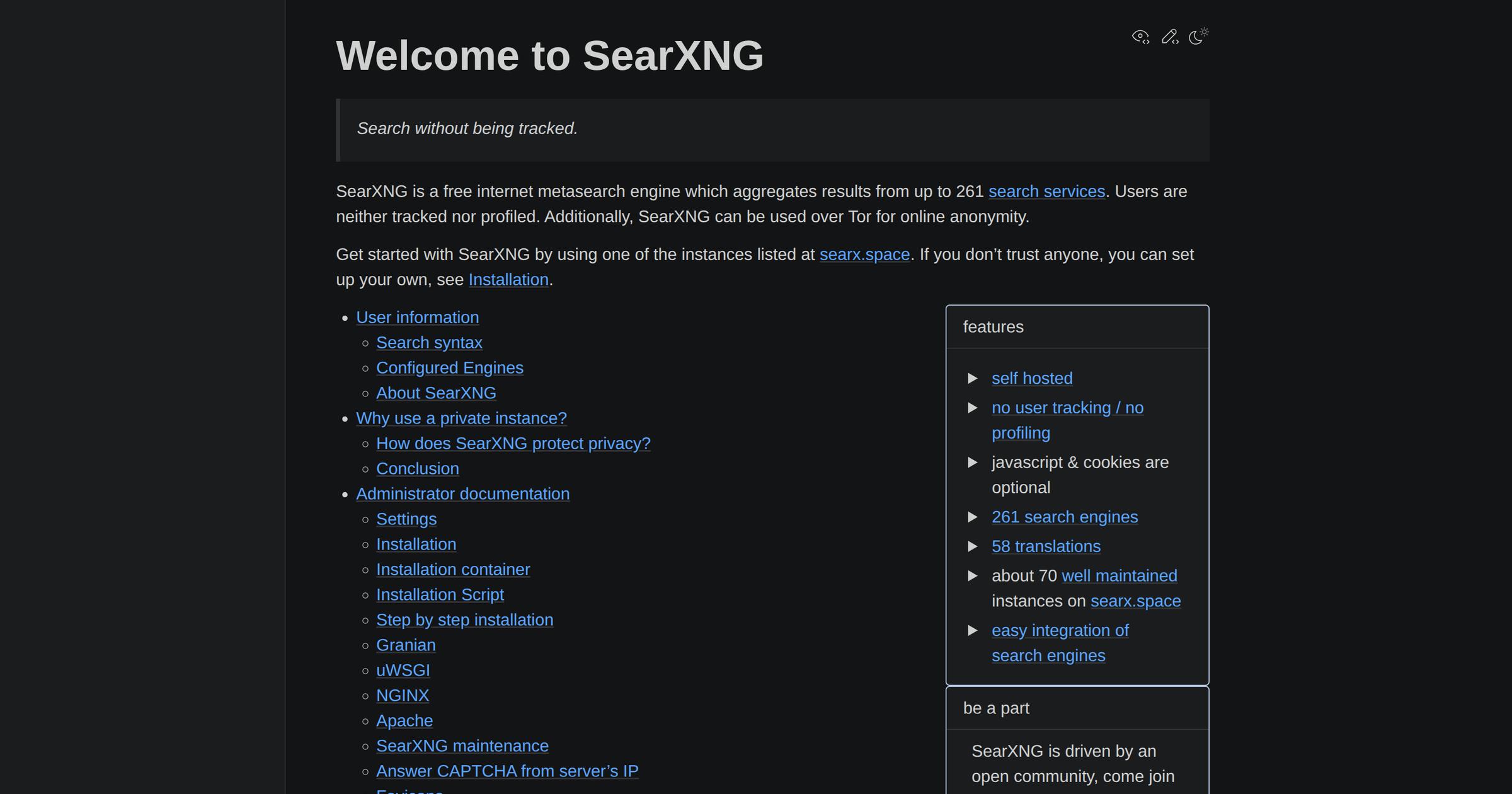
Sends your query to multiple search engines simultaneously, including Google, Bing, Brave, DuckDuckGo, Qwant, and Startpage among others. Results are merged, ranked by relevance, and deduplicated before display. Admins configure which engines are active on their instance, so users get broader coverage than any single engine provides.
By design, SearXNG logs no IP addresses, query history, or any user-identifying data. Each search request reaches upstream engines without exposing who made it. No cookies are required; JavaScript is optional. The instance cannot build a user profile because no user state is stored between requests.
SearXNG can be used over the Tor network, which routes connections through multiple relays before reaching the instance. This prevents the instance operator from seeing the user's real IP address, adding a layer of anonymity beyond what SearXNG provides on its own. Useful for journalists and researchers who need to protect their query patterns.
Official docs at docs.searxng.org cover Docker container deployment, a one-command installation script, and a manual step-by-step setup with uWSGI or Granian behind NGINX or Apache. No external database is required for a basic instance. All three paths are documented with configuration guidance.
The interface is translated into 58 languages, with translations maintained through Weblate on Codeberg. This makes SearXNG deployable in multilingual organizations or non-English-speaking regions. The translation project is community-maintained and open to contributions.
About 70 community-maintained instances are listed at searx.space with uptime and reliability data. Users who cannot or do not want to self-host can try a public instance. Each instance is independently operated, so the choice involves the operator's privacy practices as much as the software.
Features
- Aggregates Up to 261 Search Services
- No User Tracking or Profiling
- Tor-Compatible Anonymization
- Three Documented Installation Paths
- 58 Language Translations
- Public Instance Directory at searx.space
How to install
Self-hosting SearXNG uses Docker; the full configuration guide is at docs.searxng.org.
docker run -d -p 8080:8080 searxng/searxngRecommended for this setup
Strengths
- AGPL-3.0 License with Full Self-Hosting: AGPL-3.0 means anyone can run, fork, and modify SearXNG on their own servers at no licensing cost. Unlike Kagi, which is a commercial subscription with no self-hosting option, SearXNG costs only the server it runs on. Internal use by teams and organizations is permitted without restriction.
- Active Codebase with 39,000 GitHub Stars: SearXNG was forked from the searx project in mid-2021 and had its last commit in November 2026, with 39,214 GitHub stars and 3,581 forks. The project has an active community on Matrix (#searxng:matrix.org) and an organized contribution workflow. This makes it one of the most widely-adopted self-hosted search projects.
- No Single Search Provider Dependency: Because SearXNG aggregates from dozens of engines simultaneously, it is not disrupted when any one provider changes its API, adds CAPTCHAs, or adjusts its ranking behavior. Administrators can disable individual engines and add new ones through the settings file. The result is a search layer that is not tied to any single provider's decisions.
- No External Database or API Keys Required: A basic SearXNG instance needs only a Linux server and Python. No external database, no paid API keys, and no cloud services are required. This keeps the operational surface small and makes it straightforward to run on a minimal VPS or homelab server.
Trade-offs
- Result Quality Reflects Upstream Engines: SearXNG does not crawl the web or maintain its own index. All results come from the search engines it queries, so result quality mirrors those engines on a given topic. If a subject is poorly covered by Google, Bing, and other configured engines, SearXNG returns those same gaps. It cannot compensate for weaknesses in upstream coverage.
- High-Traffic Instances Trigger CAPTCHA Challenges: Shared public instances and high-traffic self-hosted instances can trigger rate limiting and CAPTCHA challenges from upstream search engines, which are designed to block automated queries. Self-hosters with low to moderate query volumes typically avoid this, but unconfigured or high-traffic instances may see degraded results from certain engines.
- Administration Requires Linux and YAML Familiarity: While Docker deployment is documented, tuning engine selection, rate limits, and result filters requires editing a YAML settings file. The official docs are thorough, but SearXNG is not a one-click consumer app. Teams without a sysadmin will face a configuration learning curve before getting optimal results.
Tech stack
FAQ
No. SearXNG is a fork of the original searx project, started in mid-2021 by a separate development team. The two are related but maintained independently. SearXNG has diverged significantly: it has a rewritten interface, more active development, and a larger community. When you encounter recommendations for 'searx' in community discussions, they generally mean SearXNG today.
By design, no. SearXNG stores no query history, IP addresses, or user identifiers. Each search is treated as a stateless request and no user profile is built. However, the upstream search engines SearXNG queries do receive the query text and the instance's server IP, so they can see what is being searched from that server. Using SearXNG over Tor prevents upstream engines from tying queries back to your IP.
The official docs at docs.searxng.org cover three installation paths: a Docker container (the fastest for most users), a one-command installation script, and a manual step-by-step setup with uWSGI or Granian behind NGINX or Apache. No external database is required for a basic install. The Docker path takes minutes on a Linux server.
SearXNG is licensed under AGPL-3.0. You can run it on your own servers, modify the source code, and use it for internal team or personal purposes at no cost. If you modify the source and run the modified version as a network service accessible to others, the AGPL-3.0 requires publishing those modifications under the same license. There are no restrictions on internal use.
Yes. About 70 community-maintained public instances are listed at searx.space with uptime and reliability data. Each instance is independently operated, so choosing one means trusting its operator with your query metadata instead of a large corporation. The instance operator can see your queries and IP address unless you access it over Tor.