
Pomerado
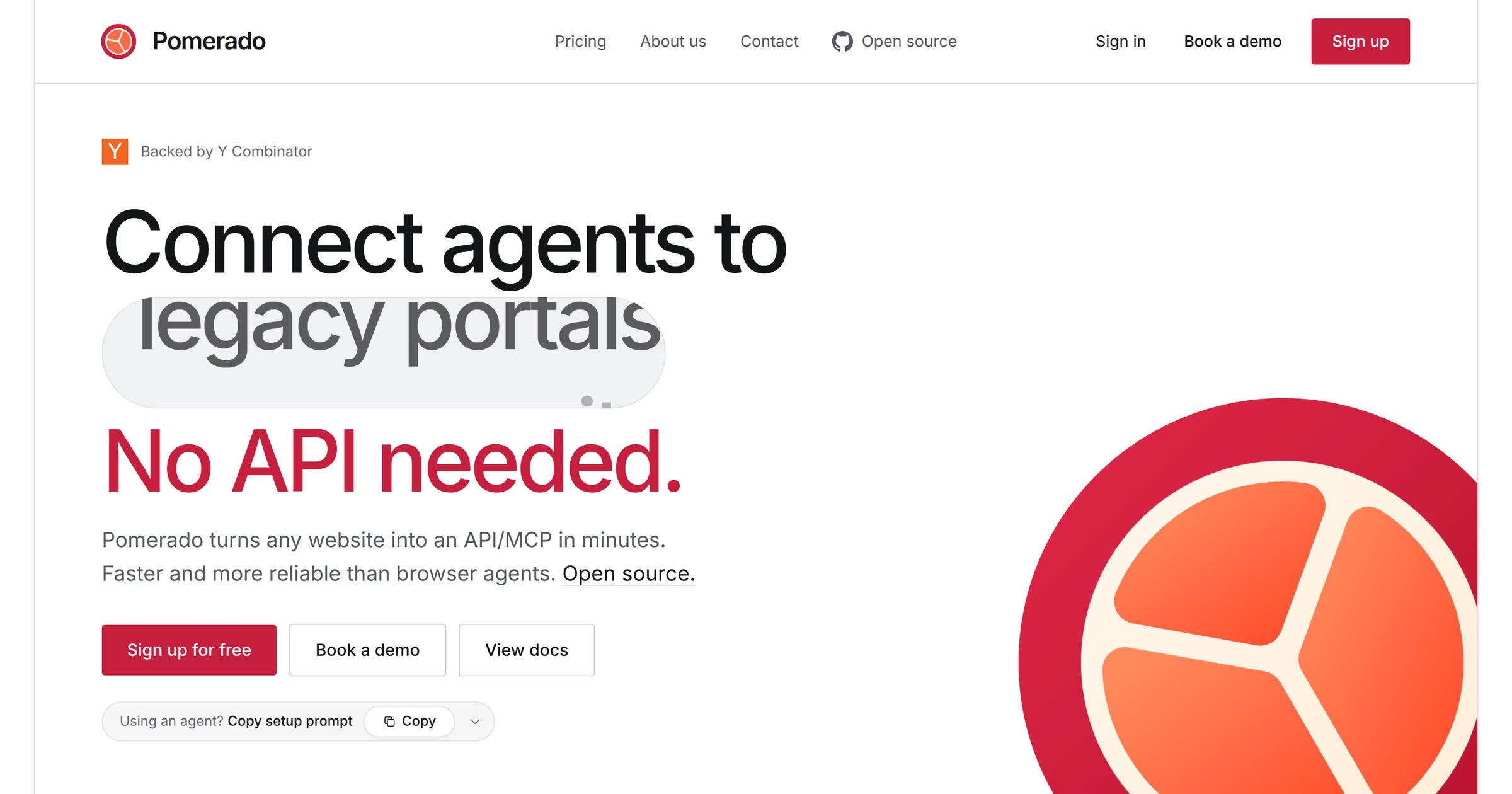
Build website MCP integrations from natural language, no API required.
Replaces Skyvern, Multion
Who it's for
Pomerado replaces fragile browser-agent scripts for teams running Codex, Claude Code, or Cursor agents that need to interact with procurement systems, CRMs, ERPs, and HR portals. The agent calls Pomerado's MCP tools to mint and run integrations without leaving its own context, and the resulting integration files can be committed to version control.
If the target system has a public REST or GraphQL API, use that directly. Pomerado's value is specific to sites with no existing programmatic interface.
Claims status checks, prior authorizations, and billing lookups all live behind provider portals with no public API. Pomerado's benchmark covers OpenEMR, OpenMRS, and payer portal tasks. The self-healing feature on Pomerado Cloud catches portal layout changes that would otherwise break automated claims checks mid-run.
If your healthcare vendor offers an HL7 FHIR API or EDI integration, that path is more reliable. Pomerado suits portals where no programmatic interface exists.
Pomerado's free cloud tier covers 100 tool calls per day and 10 new integrations per month, which is enough for personal use cases such as checking flight prices, reading order status, or searching hotel availability. The keyless MCP endpoint at mcp.pomerado.ai lets an agent connect for read-only tasks with no account setup.
If the data you need is available through a public API or RSS feed, use that instead. Pomerado's advantage is for sites with no structured data export path.
Pomerado's Business tier covers 100,000 or more tool calls per day, private integrations, roles and permission management, audit logs, SLAs, and custom 2FA, which suits organizations running several internal agents that need access to vendor portals and SaaS tools under SSO. Integrations can be shared across agents without each team re-minting.
Teams whose vendor catalog primarily exposes native API access or webhook integrations will see less benefit. Pomerado is most valuable for the portion of your catalog that has no programmatic interface at all.
The problem
Automating tasks on websites that have no API requires a browser agent to navigate and interact with each page in real time. This approach is slow, expensive, and breaks whenever the site changes its layout or form structure, because the agent must rediscover the right sequence of clicks and inputs on every run. For AI engineers and developers building production workflows against legacy portals, healthcare systems, procurement tools, or consumer sites, browser-agent instability creates a ceiling: the automation is never reliable enough to run unattended. The cost compounds too; a single multi-step browser session can spend dollars in model tokens, making high-frequency automation economically unviable.
How it works
Pomerado builds a complete MCP integration from a plain-language task description and a target URL, with no HAR file, recording, or API spec needed. The minter runs in a real Chromium browser, completes an example of the task, generalizes the steps, and saves the integration as a folder of TypeScript source modules your agent can call directly.
Once minted, an integration runs as a fast, deterministic API rather than a live browser session. Task completion takes seconds instead of the minutes a browser agent needs for the same operation, and the cost per call is near zero because no model inference runs at execution time. Running an existing integration requires no OpenAI key.
Pomerado signs into password-protected portals and handles two-factor authentication codes, including SMS, authenticator app TOTP codes, email OTPs, and recovery codes. Credentials can be stored securely in Pomerado or passed with each API request; saved credentials never appear in chat or logs.
Pomerado Cloud detects when a site changes its layout or form fields, repairs the integration automatically, and completes the original call without returning an error to the agent. The repair runs in the background and the calling agent receives its result once the fix is validated, rather than receiving a failure.
Each minted integration is saved as a folder of TypeScript modules you own. The integration ships with a README, MCP server entry, input and output schemas, and sign-in records. Running an integration makes no model requests, so the code can be audited, modified, and version-controlled independently of the Pomerado service.
Pomerado exposes four MCP tools to the calling agent: mint, get_job, provide_input, and cancel_job. Any MCP-compatible coding agent, including Claude Code, Codex, Cursor, Gemini CLI, or VS Code, can trigger an integration build and run results without leaving its own context.
Features
- Integration minting from natural language
- Deterministic API execution
- Login and 2FA handling
- Self-healing integrations (Pomerado Cloud)
- Source code ownership
- Agent-native MCP workflow
How to install
Install Pomerado globally via npm, then install the Chromium browser it uses for minting integrations.
npm install -g pomerado
npx -y -p pomerado playwright install chromium
Recommended for this setup
Strengths
- MIT licensed open source core: The complete Pomerado minter, runtime, and integration core are MIT licensed. You can run the full stack on your own infrastructure, modify the source, and use the integrations commercially. The Pomerado Cloud service runs the same core code for teams that prefer managed hosting over self-operated infrastructure.
- Benchmark-verified speed and cost advantage: The published benchmark covers 30 tasks in 25 business applications. Pomerado completed them 2x faster, at 10 to 1,000 times lower cost, and with 30% better accuracy than Astra Computer Use, Instinct, and Muse. The employee onboarding task completed in 8 minutes 16 seconds for $0.03, versus Codex Computer Use at 21 minutes 22 seconds for $41.01.
- No model inference at execution time: Only the mint phase requires an OpenAI API key. Once an integration is minted, every subsequent run executes without any model call. This makes the per-call cost near zero and execution latency predictable, unlike browser agents that spend model tokens on each run regardless of whether the task changes.
- Works on any website without an existing API: Pomerado covers legacy portals, government systems, healthcare EMRs, ERPs, and consumer sites, as shown by the 25 test applications in its benchmark, including OpenEMR, ERPNext, Moodle, QuickBooks, and Delta flight search. If a site has a login and a URL, Pomerado can mint an integration for it.
Trade-offs
- Requires an OpenAI API key to mint integrations: The build phase uses OpenAI models to explore the site, generalize steps, and write the integration source. You need a valid OpenAI API key to create new integrations. Running existing integrations has no model requirement, but adding new sites to your catalog always does. The key is read from the server environment, not chat.
- Very new project with an active open issue count: Pomerado was created in October 2026 and had 842 stars and 40 open issues at the time this was written. The codebase is early-stage; expect API surface changes and gaps in documentation for edge cases. The team reviews all pull requests before merging, which keeps quality up but slows the pace of external contributions.
- Self-healing and managed fleet are Cloud-only features: Automatic breakage detection and repair, managed browser fleet with bot protection, OAuth brokerage, and team access controls are Pomerado Cloud features, not available in the self-hosted core. Self-hosted users must manage their own Chromium instance and re-mint integrations manually when sites change.
Tech stack
FAQ
No. The MIT-licensed open source core runs entirely on your machine with no Pomerado account. You need Node 24, an OpenAI API key for minting new integrations, and an MCP client such as Claude Code or Cursor. The cloud service at pomerado.ai is optional and adds managed hosting, breakage repair, and OAuth brokerage for teams that want production-grade reliability without managing their own infrastructure.
Skyvern and MultiOn are browser-agent tools that navigate the page from scratch on each call, spending model tokens to find and interact with elements every run. Pomerado mints a deterministic API once and runs it with no model inference afterward. The published benchmark shows 2x faster task completion and 10 to 1,000 times lower cost than comparable browser-agent approaches across 30 tasks. Pomerado also saves integrations as source code you own and can audit; browser-agent tools run statelessly with no persistent artifacts.
Yes. Pomerado handles SMS codes, authenticator app TOTP codes, email OTPs, and recovery codes. On Pomerado Cloud, it uses its own phone number for SMS 2FA so your personal number is not exposed. Credentials and 2FA details are stored encrypted and never appear in chat or logs. The free tier supports one saved account per website; the Business tier adds unlimited accounts and custom 2FA configurations.
On the self-hosted core, a failed call returns an error object with a code, a write_status, and a retry flag. You would re-mint the integration to rebuild it for the new site layout. On Pomerado Cloud, breakage detection runs automatically: when a site change causes a run to fail, Pomerado starts a maintenance job, repairs the integration, and completes the original call. The calling agent receives its result rather than an error.
The free Pomerado Cloud tier allows 10 new integrations per month; the $50 per month Premium tier allows 100. The self-hosted open source version has no integration limit beyond your own compute and OpenAI API costs. Each mint takes up to 20 minutes of active browser work, and time spent waiting for your answers during the build does not count against that limit.