
OpenObserve
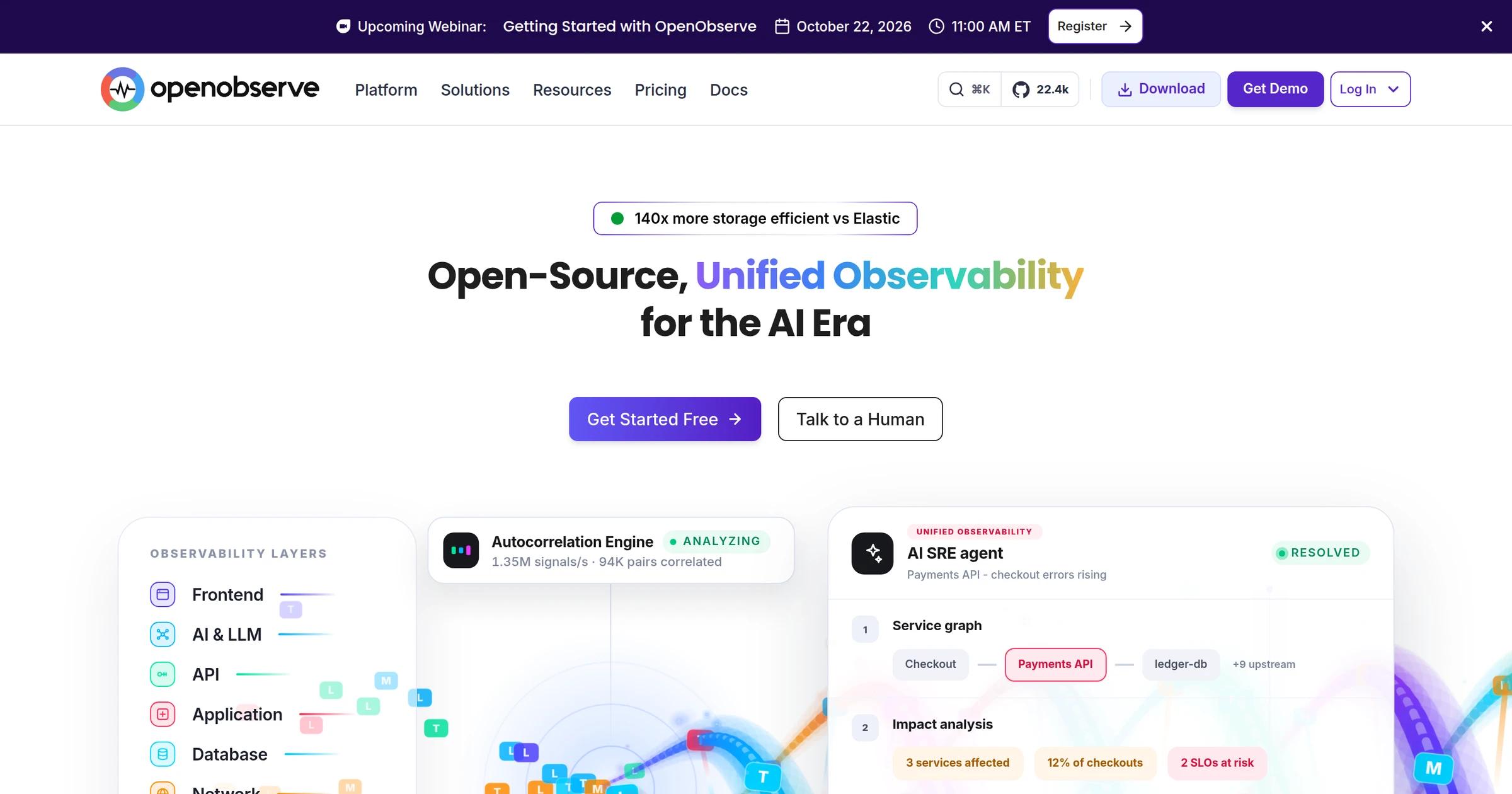
Self-hosted observability for logs, metrics, and traces
Replaces Datadog, New Relic, Dynatrace
Who it's for
Use OpenObserve to retain more telemetry in object storage while keeping search, dashboards, and alerting available.
Skip if your team depends heavily on Datadog-specific integrations and managed workflows.
Logs, metrics, and traces in one open source platform can replace a patchwork of tools early in the infrastructure lifecycle.
Skip if no one on the team can operate an observability backend reliably.
The problem
Observability data grows faster than most infrastructure budgets. Logs, traces, metrics, and session data can create unpredictable bills in proprietary platforms, and teams often reduce retention or sampling just to control spend. The operational risk is clear: when an incident happens, the missing data is often the data the team dropped to save money. Teams need observability they can afford to retain and query without giving all telemetry to a vendor.
How it works
Ingests logs, metrics, and traces into one observability interface with dashboards, search, and alerts.
Uses object storage for telemetry data, which can lower retention cost compared with vendor-priced hot storage.
Teams can run OpenObserve themselves or use the managed service depending on their operations capacity.
Features
- Unified telemetry platform
- Object-storage based architecture
- Self-hosted and cloud options
Recommended for this setup
Strengths
- Cost control for high-volume logs: The architecture is attractive for teams whose proprietary observability bill is driven by log volume and retention.
- Open source observability stack: AGPL-3.0 source availability gives teams a path to inspect and modify the platform instead of treating observability as a black box.
Trade-offs
- Datadog ecosystem is broader: OpenObserve covers core observability needs, but Datadog still has a larger integration catalog, mature enterprise workflows, and many specialized monitoring products.
Tech stack
FAQ
Yes. OpenObserve is open source under the AGPL-3.0 license.
OpenObserve handles common observability data including logs, metrics, traces, dashboards, and alerts.
OpenObserve gives teams an open source, self-hostable observability platform with a cost-control focus. Datadog remains stronger for managed enterprise features and its integration ecosystem.