
OpenCart
OpenCart is a PHP e-commerce store builder for merchants who want to run their own online shop without Shopify lock-in. It gives store owners product catalog, order, payment, extension, and theme cont
Replaces —
Who it's for
OpenCart works well when an agency needs code-level access to themes, checkout, and integrations for small or midsize merchants.
Choose a hosted commerce service if the client has no technical support and wants vendor-managed hosting, upgrades, and app support.
Store owners can move catalog and checkout control onto their own hosting stack while keeping an extension-based commerce workflow.
Skip it if the store relies on managed fraud tooling, built-in point-of-sale flows, or app-store integrations that must work without maintenance.
The problem
Hosted commerce tools make store launches fast, but they tie checkout, themes, apps, and customer data to a vendor account. Once a store depends on a proprietary app marketplace or plan tier, changing checkout behavior, payment flows, or catalog structure can become expensive. Small merchants also face a maintenance tradeoff when they self-host. They gain code and data ownership, but they need a team or agency that understands PHP hosting, upgrades, extensions, and payment integrations.
How it works
OpenCart runs as a PHP web application, so store owners can host it on standard PHP infrastructure instead of a proprietary commerce backend. The repository documents PHP 8.0 or newer and includes Docker-based local development commands.
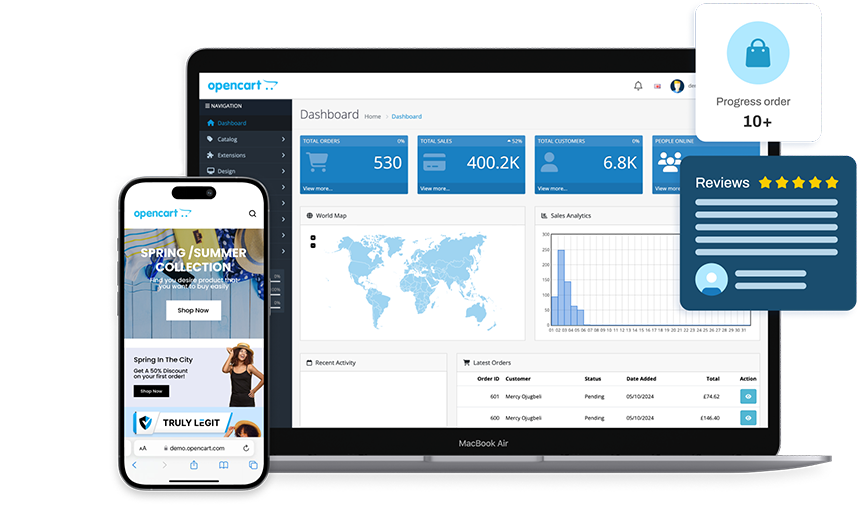
The project positions itself as an online merchant foundation, covering the core store workflow: products, shopping cart, orders, themes, and extension-driven customization.
OpenCart's model centers on modules, extensions, and themes, which lets agencies adapt storefront behavior without rebuilding a commerce backend from scratch.
The repository includes a Docker workflow for local development, which helps contributors and agencies test changes before moving them into a maintained store environment.
Features
- Self-hosted PHP storefront
- Store management foundation
- Extension-friendly commerce stack
- Docker local development path
Recommended for this setup
Strengths
- Merchant ownership of storefront code: Unlike hosted commerce tools, OpenCart gives teams direct access to the PHP application and database. That matters when checkout, integrations, or catalog rules need custom behavior.
- Familiar hosting model: PHP hosting is widely available, and OpenCart does not require a specialized cloud runtime. Agencies that already manage LAMP-style sites can support it with familiar tools.
- Established extension ecosystem: OpenCart's long-running extension and theme model makes it practical for merchants to add payments, shipping, and storefront features without commissioning every integration from scratch.
Trade-offs
- Hosting and upgrades are your job: OpenCart shifts operations from a SaaS vendor to the store owner or agency. Security patches, extension conflicts, database backups, and PHP compatibility need active maintenance.
- Extension quality varies: Third-party modules can solve specific commerce needs, but they also create dependency risk. A store with many extensions needs careful upgrade testing before production changes.
Tech stack
FAQ
Yes. OpenCart is a PHP application that you host yourself, with Docker-based local development support in the repository. Production hosting still requires web server, database, and security maintenance.
OpenCart fits small and midsize online stores that need ownership of storefront code and can maintain PHP hosting. It is less attractive for merchants who want all hosting, updates, and checkout operations handled by a SaaS vendor.
Yes. OpenCart has an extension and theme model for payments, shipping, storefront changes, and other commerce needs. Extension quality should be reviewed before depending on it for critical checkout paths.